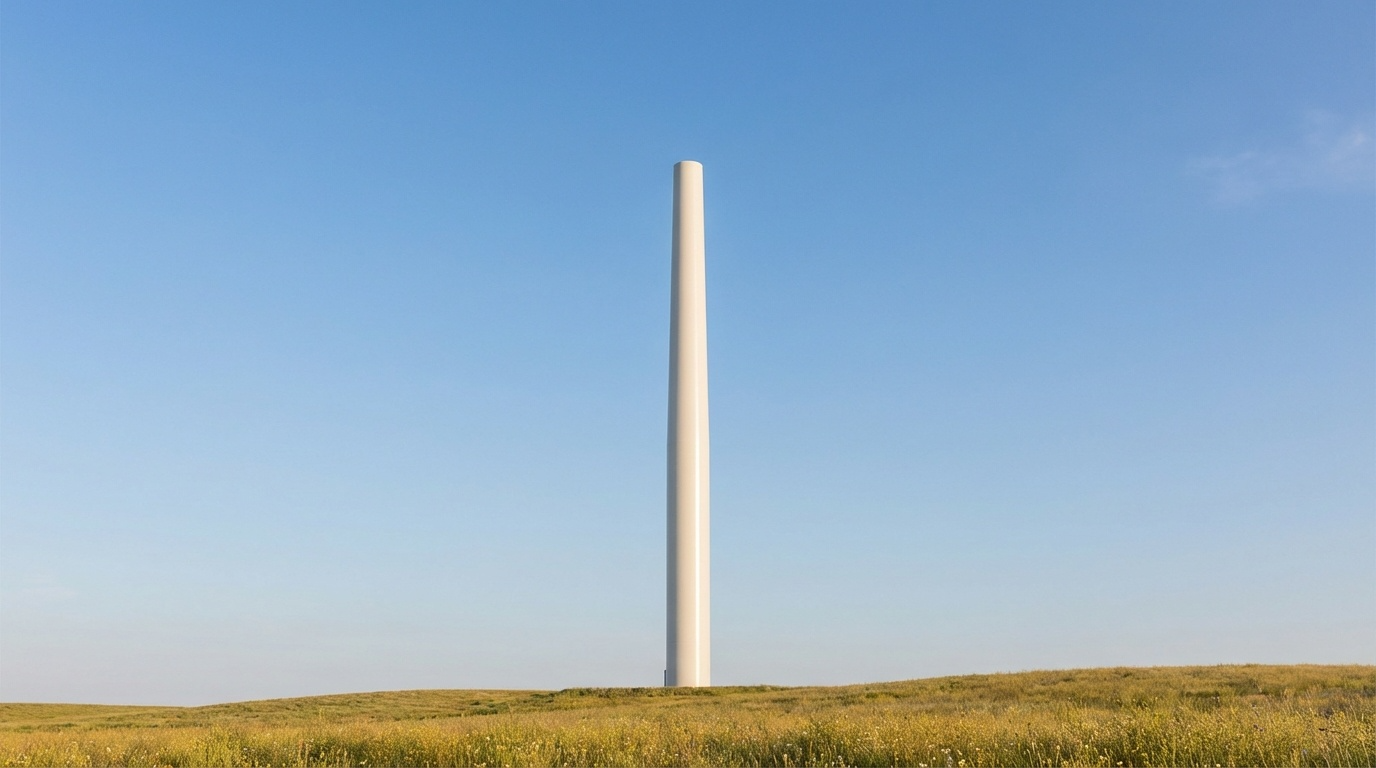
✅ Roughly speaking
🌪️ "Bladeless wind power generation" that generates electricity only with vibration without a propeller is attracting attention
⚖️ In Japan, existing laws and regulations such as the Electricity Business Act apply, but there are also issues of interpretation due to new technologies
📝 Although it is not yet commercially available, it is meaningful to anticipate and organize contractual issues for future commercialization
📈 The market is expected to grow at an annual rate of around 9% through 2037, and is in the transition period from demonstration to commercialization.
✅ Click here for an audio summary of this post
Introduction
In this article, we will explain new technologies related to wind power generation.
When you think of wind power generation, many people probably think of huge white propellers lining up on a vast expanse of land.
However, at present, "wind turbines without blades" that overturn this common sense are attracting attention around the world.
This technology has been introduced under various names such as "bladeless wind power generation," "vortex excitation wind power generation," and "vibration resonance wind power generation," all of which are revolutionary mechanisms that generate electricity by vibrating structures in response to the wind.
Because it is noisy, can be installed in urban areas, and has little impact on wild birds, it is expected to be a next-generation distributed energy source.
However, this technology is still in the demonstration experiment stage and has not yet been commercialized. Spain's Vortex Bladeless was originally scheduled to be sold in 2020, but it is still being demonstrated, and Japan's Channelage is also in the stage of conducting demonstration experiments in 2024-2025.
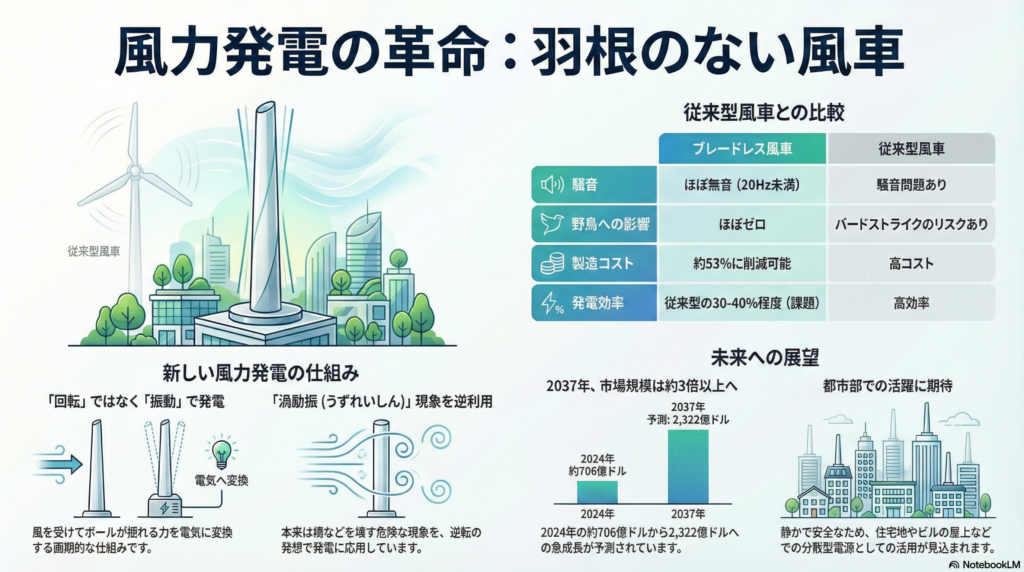
Still, with market forecasts projecting rapid growth from approximately $70.6 billion in 2024 to $232.2 billion by 2037, commercialization is only a matter of time. As a lawyer, I believe that it is meaningful to organize legal issues from the stage before they are put into practical use.
In this article, we will provide an overview of the technical mechanism of bladeless wind power generation and explain the legal framework in Japan and contractual considerations for future commercialization.
What is bladeless wind power?
Differences from conventional wind power generation
Conventional wind turbines generate lift when the wind hits the blades (blades), and the rotational motion is transmitted to the generator to generate electricity.
Horizontal axis type (propeller type) and vertical axis type (Darius type, etc.) are typical, both of which are powered by "rotation".
On the other hand, bladeless wind power generation is fundamentally different in that it uses "vibration" as an energy source rather than rotation.
Cylindrical or pole-shaped structures vibrate in the wind, and the vibration energy is converted into electricity by an internal generator (linear alternator).
This difference gives rise to the following characteristics:
- Significant Noise Reduction: No high-speed rotating blades, resulting in near-silent levels below 20Hz
- Reduced maintenance costs: The structure does not allow moving parts to come into contact with each other, resulting in low wear and tear, and the equipment life is estimated to be 32~96 years.
- Avoiding bird strikes: almost no risk of wild birds colliding
- Reduced manufacturing costs: It is estimated that it can be manufactured at about 53% of the cost of conventional models without the need for nacelles (generator storage units) or blades
However, the power generation efficiency is estimated to be about 30~40% of that of conventional models, and this difference in efficiency is one of the challenges in commercialization.
Mechanism of generating electricity by vibration (vortex excitation phenomenon)
The core technology of bladeless wind power generation is a physical phenomenon called vortex induced vibration (VIV).
As the wind passes through a cylindrical structure, vortices alternately form behind the structure (Kalman vortex sequence). When the frequency of this vortex approaches the natural frequency of the structure (resonant frequency), the structure begins to vibrate greatly. This is the vortex excitation phenomenon.
In the world of architecture, this phenomenon is known as a risk to avoid.
In 1940, the Tacoma Narrow Bridge in Washington State, USA, resonated with vortex excitation caused by the wind and collapsed in just four months. In the design of high-rise buildings and bridges, measures to avoid this resonance are mandatory.
Bladeless wind power generation was born from the idea of reversing this "avoidable phenomenon" and deliberately causing resonance and using it for power generation.
The specific power generation mechanism is as follows.
- The wind hits the cylindrical structure, creating a vortex
- If the frequency of the vortex matches the resonance frequency of the structure, the structure vibrates greatly.
- The coils and magnets inside the structure move relative to each other, generating electricity through electromagnetic induction.
- The magnet also acts as a "tuning system", changing the apparent elastic constant in response to the wind speed to maintain vibration over a wide range of wind speeds
This mechanism makes it possible to generate electricity from a light breeze with a wind speed of about 3 m/s, and it is believed that sufficient energy can be extracted even from the wind that blows daily in urban areas.
Key Developers and Development Status
Currently, the development of bladeless wind power is led by the Spanish company Vortex Bladeless. The company was founded in 2012 by David Yáñez and Raul Martin and holds six patents.
Vortex Bladeless is currently developing three models.
- Vortex Nano: 1m high, 3W power. Compact model designed for use with solar panels
- Vortex Tacoma: 2.75 m high, 100 W power. For self-generation in houses and farmland
- Vortex Atlantis/Grand: Height 9~13m, output around 1kW. Large models for factories and commercial facilities (prototype stage)
The company originally planned to sell it for about 200 euros (about 25,000 yen) in the second half of 2020, but practical use has been delayed, and it is still in the stage of conducting product tests on 100 pre-commercial devices.
In Japan, Channelage Co., Ltd. is developing a vertical axis magnus wind turbine.
Strictly speaking, unlike the bladeless vortex excitation method, it uses the magnus force generated by a rotating cylinder, but it is common in that it is a "bladeless wind power generation".
The Chreager features a design that can withstand typhoons, and aims to install a small demonstrator in Minamisoma City, Fukushima Prefecture in 2024 and operate a full-size large-scale demonstrator in 2025.
In September 2025, we announced a business alliance with Macnica to accelerate its spread in urban areas.
In this way, it can be said that the technology is in the "transition period from demonstration experiments to commercialization" from a global perspective.
Legal Framework in Japan
Application of the Electricity Business Act
Bladeless wind turbines are also subject to the regulation of the Electricity Business Act as long as they are equipment that generates electricity.
Based on Articles 38 and 39 of the Act, commercial electrical workpieces are required to comply with technical standards, and the "Ministerial Ordinance Establishing Technical Standards for Wind Power Generation Equipment" (Ministry of International Trade and Industry Ordinance No. 53 of Heisei 9) applies.
Since this ministerial ordinance applies to "electrical works installed to generate electricity using wind power as a driving force", it is understood that it also applies to bladeless wind power generation, regardless of whether it is rotary or vibrating.
In addition, the following regulations apply depending on the output scale:
- Wind power generation equipment of 20 kW or more: Notification required as a commercial electrical workpiece
- Facilities of 50 kW or more: Obligation to appoint a chief electrical engineer
- Facilities over a certain scale: Obligation to conduct periodic safety management inspections (enforced in April 29)
Current models of bladeless wind power generation are small in terms of output of a few W~1kW, so they are often treated as general electrical work or small-scale business electrical work.
However, as they become larger in the future, they may become subject to stricter regulations.
Technical Standards and Certification Systems
Technical standards based on the Electricity Business Act are mainly formulated on the premise of rotary wind power generation.
Therefore, it is thought that the new method of vibration may have interpretive theories in the following points.
(1) Application of structural strength standards
The ministerial ordinance specifies in detail the strength standards for wind turbine supports and blades, but there are no "blades" in bladeless wind power.
In this case, it is reasonable to read the vibrating cylindrical part as the "main part subject to wind force" and apply the same strength standard.
(2) Whether or not an overspeed protection device is required
Rotary wind power generation requires the installation of overspeed protection devices to prevent over-rotation during high winds.
Since bladeless wind power does not rotate, it may be required to install a safety device that automatically stops operation if the vibration exceeds the limit value as an "overvibration protection device" instead.
In fact, Vortex Bladeless's design incorporates an automatic shut-off mechanism when the wind speed exceeds 30~35 m/s.
(3) Certification and inspection practices
In Japan, type certification and pre-use self-verification systems for wind power generation equipment are in place, but these systems are designed with conventional rotary wind power generation in mind.
When introducing bladeless wind power generation, it is necessary to clarify what test items and standards will be used to determine conformity through prior consultation with existing certification bodies and inspection bodies.
At this stage before commercialization, dialogue with regulators will also be important regarding the methodology for safety confirmation in demonstration experiments.
Environmental Regulations (Noise, Landscape, etc.)
Noise is a major legal and practical issue in the introduction of wind power generation.
In conventional wind power generation, aerodynamic noise when the blades rotate at high speed and mechanical noise from the gearbox are problems, and measures are required based on guidelines such as the Ministry of the Environment's "Response to Noise Generated from Wind Power Generation Facilities" (Heisei 28).
In contrast, bladeless wind power generation has an extremely low noise level of less than 20 Hz, which is considered to be a significant advantage from a noise control perspective.
Installation in urban and residential areas is also expected to allow for more flexible location selection due to the low noise barrier.
In addition, the impact on the landscape may be more acceptable to local residents than the conventional type because there is no huge propeller.
However, regulations by landscape laws and local landscape ordinances must be checked separately.
Even in the demonstration phase, explaining to neighbors and measuring environmental impact is considered to be an important legal process.
Comparison with conventional wind power regulations
To summarize the above, it is believed that the legal treatment of bladeless wind power generation and conventional wind power generation is basically subject to the same framework (Electricity Business Act, etc.), but there are practical differences in the following points.
| project | Conventional wind power generation | Bladeless wind power |
|---|---|---|
| Basic Decree | Electricity Business Act (same) | Electricity Business Act (same) |
| Technical Standards | Detailed provisions on the premise of rotary type | Some parts need to be interpreted and applied |
| Noise Regulation | Strict response required | Relatively easy to clear regulations |
| Environmental Assessment | Required at a certain scale or higher | Likewise necessary, but with a small impact |
| Certification Practice | Established procedures | Prior consultation is important |
| Current Development Stages | In commercial operation | Demonstration Experiment Stage |
Contractual considerations for commercialization
In this chapter, we will proactively organize the contractual issues that will be problematic when bladeless wind power is commercialized in the future.
Although commercial contracts have not yet been concluded, as a lawyer, I believe it is meaningful to anticipate and prepare for legal issues even before they are put into practical use.
Peculiarities of contracts in the demonstration phase
At the current stage of development, a demonstration test contract will be signed first. This is different in nature from a normal sales contract or an introduction contract, and is considered to have the following characteristics.
(1) Strength of R&D elements
The main purpose of demonstration experiments is not "product sales" but "technology verification".
Therefore, the nature of the contract is likely to have elements that are more like joint research and development agreements than sales contracts.
(2) Data acquisition and intellectual property rights
The data obtained from the demonstration experiment (power generation, wind conditions, vibration patterns, durability, etc.) is extremely important technical information for manufacturers.
On the other hand, it is also valuable for the installer (experimental collaborator) as environmental data on their own site.
It is considered necessary to contractually clarify the ownership of this data, the scope of use, and whether it can be disclosed to third parties.
(3) Cost Burden and Incentives
Another issue is what incentives will be provided to installers who cooperate with demonstration experiments.
It can take many forms, such as free installation, compensation equivalent to the cost of electricity, or the right of first refusal for future commercial products.
Designing performance assurance for future commercialization
When commercialized, performance warranty clauses are expected to be at the core of the contract.
However, because it is a new technology, it will require different considerations than the performance guarantee of conventional wind power.
(1) Difficulty in guaranteeing power generation
Bladeless wind power generates electricity most efficiently in a specific wind speed range, but wind conditions at the actual installation site are difficult to predict.
It is considered that the setting of the prerequisite "under the condition of annual average wind speed ○ m/s" will be more important than the conventional type.
In addition, in the absence of long-term performance data, it is difficult for manufacturers to provide reliable performance guarantees, so it may be necessary to devise "best effort" clauses and gradual increases in warranty values (moderate in the first year, full-fledged warranties after the third year, etc.).
(2) Setting of comparison targets
A relative guarantee method of "○% performance compared to conventional wind power generation" is also considered, but it may be difficult to compare depending on the installation location and conditions.
It may be realistic to combine the guarantee at an absolute value (○kWh per year) and a guarantee at a relative value (○% in the conventional value).
(3) Warranty period and step-by-step evaluation
For early commercial products, a phased approach with a short-term (1~2 years) performance evaluation period and a long-term warranty based on the results may also be worth considering.
New technology-specific risk allocation
When introducing new technologies, there is a high possibility that unexpected risks will emerge.
It is important to clarify the following risk allocation in the contract.
(1) Risk of discovering technical defects
After commercialization, design flaws and material defects may be discovered. In this case, it is necessary to clarify in the contract whether the manufacturer will be obligated to make corrections or the buyer will also bear certain risks.
In particular, for the initial lot (the first ○ units), it is possible to establish a special clause as an introduction after recognizing the risk.
(2) Risk of changes in laws and regulations
As mentioned in Chapter 2, there are uncertain laws and regulations for bladeless wind power.
New technical standards may be developed in the future or additional certifications may be required.
It is desirable to agree in advance who will bear the cost of handling in that case (modification cost, certification acquisition cost, etc.).
(3) Uncertainty of long-term durability
The equipment life is estimated to be 32~96 years, but this is only a theoretical value and is not based on empirical data.
In fact, it may deteriorate faster than expected.
It is necessary to clarify to what extent the manufacturer is responsible for performance deterioration or failure after the warranty period ends (paid repair, free replacement, etc.).
Maintenance and maintenance contract issues
Bladeless wind power is sometimes considered "maintenance-free", but in reality, regular inspections and parts replacement are considered necessary. In maintenance contracts, the following points are expected to be on the agenda:
(1) Confirmation of maintenance details
There is no need for "blade inspection" or "gearbox oil change" like conventional wind power generation, but it is expected that what kind of inspection is required will become clear through demonstration experiments.
At the time of signing the contract, it would be realistic to provide flexibility in the form of "inspection items recommended by the manufacturer" while setting an upper limit on the frequency of inspections and costs.
(2) Responsibility for supplying spare parts
Because it is a new technology, the supply system for replacement parts may not be sufficient.
For important parts, it is possible to impose an obligation on the manufacturer to secure a certain number of inventories, or to establish alternative measures (free lending of replacement machines, etc.) in case of supply difficulties.
(3) Remote monitoring and data utilization
Remote monitoring systems utilizing IoT technology are likely to be introduced.
In that case, the handling of the collected data (privacy, security, secondary use, etc.) must also be organized in the contract.
Draft contract checklist for commercialization
Based on the above, we will compile a checklist of key items to check in the contract when bladeless wind power is commercialized in the future.
□ Clarification of the nature of the contract
- Is it a sales contract, a demonstration cooperation contract, or a joint research and development contract?
- Product or prototype
□ Equipment Specifications
- Model, Output, Size, Weight
- Supported wind speed range (power generation starting wind speed, rated wind speed, cut-out wind speed)
- Expected installation environment (temperature range, weather resistance, etc.)
- Specifying whether it is a prototype or a commercial product
□ Performance Guarantee (New Technology Support)
- Availability and content of warranty (absolute or relative)
- Specify prerequisites (wind speed, utilization rate, etc.)
- Warranty period (with or without a tiered assessment)
- Remedies in case of failure to reach the guarantee value (refund, obligation to improve, right to cancel, etc.)
- Availability of "Best Effort" Clauses
□ Risk Allocation
- Sharing of responsibilities when technical defects are discovered
- Burden of response costs in the event of changes in laws and regulations
- Addressing the uncertainty of long-term durability
- Responsibility in the event of force majeure (typhoon, earthquake, etc.)
- Liability for damages to third parties (including product liability)
□ Data and Intellectual Property Rights
- Attribution and Scope of Use of Empirical Data
- Possibility of Disclosure to Third Parties
- Handling of Improved Inventions
□ Compliance with laws and regulations
- Confirmation of compliance with relevant laws and regulations such as the Electricity Business Act
- Obligation to implement certification and inspection and cost burden
- Response to changes in laws and regulations
□ Delivery and installation
- Delivery time and late penalties (flexibility due to new technology)
- Scope of installation work and division of responsibilities
- Commissioning and acceptance conditions
□ Warranty and Maintenance
- Product warranty period and warranty content
- Contents and costs of maintenance contracts (handling if the contents are not finalized)
- Response system in the event of a breakdown (contact information, response time, etc.)
- Spare parts supply system and measures in case of supply inability
- Remote monitoring system and data handling
□ Contract Termination
- Contract Duration and Renewal Terms
- Conditions for mid-term termination and penalty (consideration of special termination rights due to new technology)
- Obligation to remove equipment at the end of the contract
This checklist is only a consideration material for future commercialization, and the actual contract content should be flexibly designed according to the maturity of the technology and market conditions.
Current status and future prospects of commercialization.
Global Market Trends
The global market for bladeless wind power is expected to grow rapidly in the future, although it is in the demonstration phase. According to data from multiple market research firms, the market size is expected to reach approximately $706~71.8 billion in 2024 and reach $232.2 billion by 2037, with a compound annual growth rate (CAGR) of about 8.6~9.6%.
The following factors can be attributed to this growth forecast.
- Increasing Global Demand for Renewable Energy
- Growing Need for Distributed Power Generation in Urban Areas
- Growing Concern for Noise and Environmental Impact
- Demand as a small-scale power supply for IoT devices
In particular, it is expected to be used as a "hybrid power generation system" when used in conjunction with solar panels, and is evaluated for its ability to provide stable power even at night or in cloudy weather when solar power generation is difficult.
However, these market projections assume that "commercialization will materialize" and will be based on overcoming technical and economic challenges.
Demonstration experiments and issues in Japan
In Japan, Channel Rennery has started a demonstration experiment in Minamisoma City, Fukushima Prefecture in 2024, and aims to start operating a full-size demonstration machine in 2025. In addition, the company announced a business alliance with Macnica in September 2025, aiming to spread it as a backup power source in the event of a disaster.
On the other hand, there are some challenges in full-scale commercial development in Japan.
(1) Issues of power generation efficiency
The power generation efficiency of bladeless wind power generation is about 30~40% of that of conventional wind power generation.
From an economic perspective, it is important to see how far this efficiency difference can be covered by cost reduction and environmental benefits.
(2) Accumulation of empirical data
Long-term durability, real-world power generation performance, failure rate, etc., have not yet accumulated enough demonstration data necessary for commercialization.
Demonstration experiments in the next few years will determine the success or failure of commercialization.
(3) Issues of lineage connection
When it comes to becoming popular as a small-scale, distributed power source, there may be technical and institutional challenges in connecting a large number of generators to the power grid.
In particular, the magnitude of output fluctuations and how to deal with countercurrent currents are likely to be issues to be considered in the future.
(4) Payback period
The payback period for the initial investment compared to the traditional model is an important factor in the implementation decision.
Although the manufacturing cost is said to be low, the power generation efficiency is also low, so a comprehensive economic evaluation is necessary.
Direction of legal development from the perspective of a lawyer
The development of a legal environment is essential for the social implementation of new technologies.
It is thought that the following legal developments will be necessary for bladeless wind power generation in the future.
(1) Clarification of technical standards
The current "Ministerial Ordinance Establishing Technical Standards for Wind Power Generation Equipment" mainly assumes rotary types.
It would be desirable for the Ministry of Economy, Trade and Industry to provide technical standards specific to the vibration type, or at least interpretation guidelines.
Even at the demonstration stage, if there are guidelines on what safety standards should be used for experiments, it is thought that dialogue between developers and regulators will be facilitated.
(2) Establishment of a type certification system
For new types of wind power generation equipment, it is important for both manufacturers and installers to establish appropriate certification procedures and standards.
(3) Institutional design for small-scale distributed power generation
Bladeless wind power generation is expected to be used in a small-scale distributed manner rather than a large-scale centralized type. It is thought that it is necessary to consider the grid connection rules suitable for such new power supply forms and the scope of application of the FIT/FIP system.
(4) Measures to promote demonstration experiments
In order to accelerate the social implementation of new technologies, the regulatory sandbox system and support measures for demonstration experiments (subsidies, flexible application of regulations, etc.) are considered effective.
(5) Response to international standardization
Technical standards for wind power generation are being standardized internationally by the International Electrotechnical Commission (IEC) and other organizations. It is important for Japan companies to actively participate in the creation of international standards for bladeless wind power generation from the perspective of international competitiveness.
summary
In this article, we have taken an overview of bladeless wind power, which is attracting attention as a "bladeless wind turbine," from its technical mechanism to its legal framework in Japan and contractual considerations for future commercialization.
Bladeless wind power is a revolutionary technology that generates electricity based on the simple principle of vibration, which has the significant advantages of low noise and low maintenance costs.
The market forecast is also strong, and if technical challenges are overcome, commercialization could be in full swing in the coming years.
At the moment, it is still in the demonstration experiment stage, and the actual commercial contract will not be signed until now.
However, as a lawyer, I believe it is meaningful to organize legal issues from the stage before they are put into practical use.
In particular, issues such as how to contractually allocate risks to the uncertainties induced in new technologies, how to design performance guarantees, and how to handle data and intellectual property rights at the demonstration stage are expected to emerge as the technology matures.
In terms of laws and regulations, it is also important to have a dialogue with regulators on how to apply the conventional system based on rotary wind power generation to the new method of vibration.
There are a wide range of issues to consider, such as clarifying technical standards, developing certification systems, and designing systems as small-scale distributed power sources.
The field of renewable energy is evolving every day, with innovative technologies like bladeless wind power emerging.
As a legal practitioner, I believe that it is necessary to continue to follow the latest technological trends and prepare to legally support the social implementation of new technologies.
In the future, if there is progress in demonstration experiments or commercialization, I would like to reorganize legal issues and provide information that will contribute to practice.



comment