✅ Roughly speaking
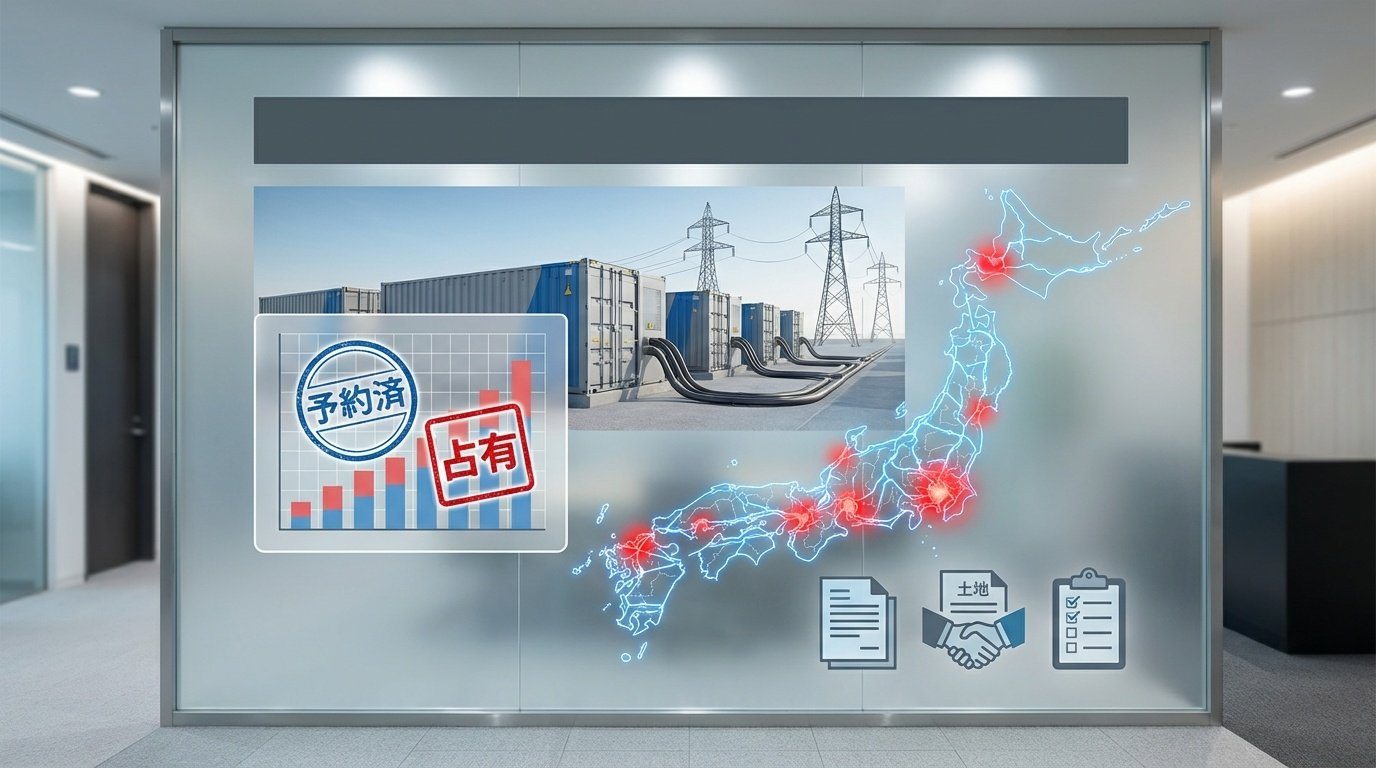
- 📈 Explosive increase in applications for grid storage battery connection : As of the end of September 2025, approximately 15,000 applications, totaling approximately 163.61 million kW, have been accepted (approximately three times the number for the same period last year). https://www.itmedia.co.jp/smartjapan/articles/2511/28/news054.html Despite this rapid increase, the actual grid connection rate is only 0.3%, indicating that the majority of these applications have not yet been realized.
- 🚫 "Empty grid connection" has become a serious social problem : Applications for connection to power grids are frequently made in locations where it is virtually impossible to install, such as disaster prevention parks and land under construction. Some operators have even applied for dozens of connections at once for speculative purposes, transferring the grid connection rights for a fee.
- 📋 Submission of land-related documents will become mandatory from January 2026 : A new system will be introduced requiring the submission of land registry documents when applying for connection. This applies not only to grid-connected batteries, but also to all new power generation facilities that require connection consideration.
- ⚖️ Strengthening regulations at the contract application stage is also being considered : Multi-layered measures to prevent empty seizures are being discussed, including securing land titles, ensuring the specificity of business plans, and streamlining long-term projects that have not yet begun construction.
✅ Audio summary of this post here
Introduction
This time, we will explain the issue of "empty reservation" in the connection procedures for grid storage batteries, which was intensively discussed at the 5th meeting of the Agency for Natural Resources and Energy's "Next Generation Power System Working Group" held on November 14, 2025.
Grid storage batteries are expected to be a key infrastructure supporting the large-scale introduction of renewable energy. However, while the number of applications for considering their connection is rapidly increasing, it is believed that the problem of grid capacity being "unused" due to applications with low business certainty is becoming a serious problem.
It can be said that the Ministry of Economy, Trade and Industry has just begun to seriously tackle the difficult issue of how to allocate the public good of limited grid capacity and how to balance this with the free activities of operators.
This article will provide a detailed explanation of the legal significance and practical impact of the strengthened regulations announced at the meeting, and will particularly clarify the actions that businesses should take immediately regarding the new requirements that will come into effect in January 2026 .
Current status of applications for considering grid storage battery connections: Data shows an abnormal surge
The reality of the "application explosion" seen in numbers
As of the end of September 2025, the status of accepting applications for grid storage battery connection and contracts is as follows:
(Reference: https://www.itmedia.co.jp/smartjapan/articles/2511/28/news054.html )
| project | number | capacity | remarks |
|---|---|---|---|
| Connection consideration acceptance | Approximately 15,000 pieces | Approximately 163.61 million kW | Chugoku area as of the end of August |
| Connection contract application acceptance | Approximately 2,800 pieces | Approximately 22.6 million kW | – |
| Connected | 111 items | Approximately 490,000 kW | Number of cases where interconnection was actually completed |
What is clear from these figures is the extreme "funnel effect" between the time of connection consideration and actual interconnection . The capacity of connection applications was approximately 163.61 million kW, while the actual connected capacity was only approximately 490,000 kW, which works out to a realization rate of just 0.3% .
Of course, it usually takes several years from the time of connection consideration to the completion of the interconnection, so we cannot evaluate everything on this figure alone. However, as we will discuss later, it has been pointed out that the connection consideration applications include many projects with little intention to realize the project, so this low realization rate is considered to be a problem that cannot be overlooked.
Regional trends: Concentration in specific areas
Looking at the connection acceptance capacity by area (as of the end of March 2025), there is a clear regional imbalance.
(Reference: https://www.jarnet.jp/20250607.pdf )
| area | Connection consideration capacity | Year-on-year change | growth rate |
|---|---|---|---|
| northeast | 41.62 million kW | +32.44 million kW | + Approximately 3.5 times |
| Tokyo | 17.91 million kW | +11.25 million kW | + Approximately 2.7 times |
| Kyushu | 15.11 million kW | +8.06 million kW | + Approximately 2.1 times |
| China | 10.41 million kW | +8.98 million kW | + Approximately 6.3 times |
This concentration appears to reflect the following economic rationale:
- Adjustment coefficients for long-term decarbonized power auctions : Different coefficients are set for each area, which affects bidding prices, leading to a concentration of applications in favorable areas
- Ease of acquiring land : Concentration in areas where it is easy to acquire relatively large tracts of land
- Information on available grid capacity : Existing grid information disclosure clarifies areas where it is easy to connect.
The rate of increase in the Chugoku region (approximately 6.3 times) is particularly notable, and it is speculated that there may be some special factor at play.
Linkage with policy support: Subsidy and auction-driven applications
An analysis by the Agency for Natural Resources and Energy revealed that applications for connection consideration are concentrated around the deadlines for subsidy and auction applications .
For subsidy applications (2023)
- Public offering begins: May 24, 2023
- Application deadline: June 14, 2023
- Peak of connection applications: January 2023 (4 months before public offering)
The background to this phenomenon is thought to be the institutional design of connection considerations.
The deadline for responding to the connection study is within three months of the application, and the response form is valid for one year. Because a connection study response form is required to apply for a subsidy, it is assumed that operators worked backwards and concentrated their applications in January.
Long-term decarbonized power auction
- Business information registration: October 24th to November 8th, 2023
- Applications for connection consideration: Gradual increase from July to October 2023
What is clear from this analysis is the existence of "strategic applications" in anticipation of policy support .
In order to meet subsidy and auction requirements, operators will have an incentive to apply for connection even when the business is still uncertain.
While this is rational business behavior, it has been pointed out that it ultimately hinders the efficient use of grid capacity.
The essence of the "empty reservation" problem: Speculation over grid connection rights
Definition and types of empty hold
"Drifting" refers to the act of continuing to secure grid capacity for a long period of time despite little intention or certainty of the project being realized.
The following types were identified from the discussions and hearings held in the Next Generation Power System Working Group.
Type 1: Application in a location where business is clearly not possible
The following cases have been reported from interviews with general electricity transmission and distribution companies:
- Public land such as disaster prevention parks : In principle, the installation of storage batteries for commercial purposes is prohibited under the Parks Act and City Planning Act.
- Land already under construction : Application for connection consideration on land where construction of other buildings is underway
- Zoning regulations : Areas where industrial facilities cannot be built, such as residential areas
- Low-lying areas : Land with a high risk of flooding and unsuitable for installing power storage facilities
General electricity transmission and distribution companies have pointed out that "it seems that applications for connection are being submitted to vacant land based on map information on the Internet."
These applications can be considered to deviate from the purpose of the "connection consideration" procedure (obtaining information for business feasibility assessment) and are essentially intended to speculatively secure grid capacity .
Type 2: Massive parallel applications (multiple applications)
During the interviews, the following business practices were identified:
"The construction cost burden at the interconnection point will only become clear once the connection study response document is submitted. Under the provisions of the grid interconnection procedure, there are no restrictions on conducting a large number of connection studies, so no matter how high the connection study costs, if an interconnection point with a correspondingly low construction cost burden is found, the costs incurred for the connection study can be recovered." (Storage battery business operator and energy storage system manufacturer)
According to the analysis, for every subsidy application or auction bid, there are businesses that simultaneously apply for dozens of connections .
Under the current system, there is no limit to the number of connection study applications that can be submitted, and multiple connection study response forms can be held simultaneously as long as they are within their validity period (one year), so this behavior is technically legal.
However, we believe that there is a need for stricter discipline in this case, as it is an act of privately monopolizing the public good of limited grid capacity .
Type 3: Resale of rights for speculative purposes
The most problematic business model is the following:
"Some businesses have no plans to engage in the battery storage business themselves, but for speculative purposes, they proceed through the procedures to the stage of connection consideration, connection contract, or connection approval, and then transfer the right to connect to the grid to a battery storage business for a fee. In some cases, such businesses bundle together dozens of connection consideration responses and conduct transactions for amounts far exceeding the construction cost burden." (Battery storage business)
Under the current Electricity Business Act, the transfer of connection consideration responses and connection contract status is possible with the consent of the general electricity transmission and distribution business operator. However, since grid capacity is a scarce resource, applications aimed at reselling for profit may be considered a deviation from the "proper operation of the electricity business" envisaged by the Electricity Business Act .
In other countries (such as the UK and the US), speculative applications are restricted by requiring the securing of land titles and the deposit of a security deposit.
Three disadvantages of empty holding
Disadvantage 1: Connection delays for projects that are truly feasible
The grid capacity is limited. It is believed that the following vicious cycle is occurring due to the use of empty capacity.
Increase in unused projects ↓ Decrease in effective utilization rate of grid capacity ↓ Delay in connection period for new applications ↓ Really feasible businesses give up on entering the market ↓ Unable to achieve targets for introduction of renewable energy and storage batteriesThis is not simply a problem for individual businesses, but is believed to be a factor hindering the achievement of Japan's overall energy policy goals.
Disadvantage 2: Limited resources for general electricity transmission and distribution companies
As of the end of September 2025, approximately 15,000 applications for connection have been received .
Considering the amount of effort required for each case (system analysis, construction cost estimates, etc.), it is believed that the human resources of power transmission and distribution companies are becoming strained, resulting in the following problems:
- It is becoming difficult to meet the deadline for responses to connection considerations (within three months)
- Impediments to formulating and implementing grid expansion plans, which should be the focus of efforts
- Increased costs for consideration (ultimately passed on to wheeling charges)
Harm 3: Loss of fairness and increased social costs
The principle of grid connection is "first come, first served."
However, the following problems arise due to the empty hold:
- Really viable later deals are being foreclosed by speculative earlier deals
- If the applicant abandons the project even after the general electricity transmission and distribution company has carried out grid expansion work, the costs will ultimately be borne by other grid users (including general consumers).
This issue of fairness is considered to be an important point that goes to the very core of the electricity business system.
Effective from January 2026: Strengthened regulations for the connection consideration stage
Summary of new requirements: Mandatory submission of land-related documents
The following documents will be required for all grid storage batteries and new power generation facilities applying for connection from January 2026 onwards .
(Reference: https://www.itmedia.co.jp/smartjapan/articles/2511/28/news054.html )
| Documents to be submitted | content | Additional Info |
|---|---|---|
| Certified copy of the registry (certificate of all matters) | Registration information for the planned installation site | Owner, land use, area, whether or not there is a mortgage |
| Land use survey results | Research into regulations such as the City Planning Act and Building Standards Act | Zoning, building coverage ratio, floor area ratio, height restrictions |
| Owner Information | Current landowner name | Relationship to the applicant |
| Response status | Land acquisition progress | Sales contract concluded/under negotiation/not yet negotiated etc. |
Important legal points
Q: Can I apply if I don't "own" the land?
A: No. The new requirement does not require that the land be acquired, but rather that land surveys and confirmations be conducted . However, the following confirmations are considered essential.
- The land is in an area where storage batteries can be installed according to law.
- The landowner must be identifiable
- Some action (such as starting negotiations) is being taken to acquire the land.
This point seems to be evaluated as a consideration that has been given so as not to excessively restrict the freedom of businesses.
Q: Does this only apply to grid storage batteries?
A: No. It applies to "all new power generation facilities that require connection consideration."
in particular…
- System battery (full capacity)
- High-voltage and extra-high-voltage solar power generation
- Wind power generation
- Other new power sources (biomass, geothermal, etc.)
In order to ensure fairness among power source types , measures have been taken to not limit the scope to storage batteries.
Expanded information to be included on the application form (image)
According to the Next Generation Power System Working Group materials, the following information is expected to be required in connection study applications.
[New items] ■ Business land information ├─ Location (lot number) ├─ Land use on the land registry ├─ Owner's name on the land registry ├─ Relationship with applicant (owned/leased/under negotiation/other) ├─ Use zone under the City Planning Act ├─ Building coverage ratio and floor area ratio under the Building Standards Act ├─ Other legal restrictions (Agricultural Land Act, Forest Act, Natural Parks Act, etc.) └─ Land acquisition schedule (planned) [Documents to attach] □ Certified copy of land registry (certificate of all matters) □ Copy of official map □ Use zone certificate or city planning map □ (If under negotiation) Memorandum with the landowner, etc.Practical implications: What businesses need to do now
Response 1: Risk assessment of last-minute applications before January 2026
If you apply by the end of December 2025, the old rules may apply . However, you should consider the following risks.
- There is a risk that hasty application will result in failure to secure land titles at the later contract application stage, leading to the abandonment of the project.
- If land acquisition is not completed within the validity period of the connection consideration response (one year), it may be necessary to reapply under the new requirements.
Recommended Action
- For projects for which applications can be submitted by the end of December 2025, the top priority will be to conclude a Memorandum of Understanding (MOU) with the landowner.
- For applications from January 2026 onwards, preparations will be made in advance to meet the new requirements.
Response 2: Review of existing applications
We believe that the following should also be confirmed for projects for which applications were submitted before the end of December 2025.
- Confirmation of the management system for the validity period of the connection consideration response form (usually one year)
- Prepare for land title requirements at the contract application stage (which are likely to be strengthened in the future)
- Re-evaluation of business feasibility (taking into account possible fluctuations in construction cost contributions)
Response 3: Early implementation of land due diligence
Checklist :
- [ ] Obtaining a copy of the land registry (confirming ownership, mortgages, and leasehold rights)
- [ ] Check the official map and survey map (measured area, whether or not the boundary has been determined)
- [ ] City Planning Act: Zoning, Regional Districts, and the Need for Development Permits
- [ ] Building Standards Act: Building coverage ratio, floor area ratio, road access obligation
- [ ] Agricultural Land Law: Necessity and prospects for permission to convert agricultural land
- [ ] Forest Law: Whether forest development permits are required
- [ ] Natural Parks Act/Cultural Properties Protection Act: Designation of special areas, etc.
- [ ] Land shape and ground: Suitability for installing battery storage equipment
- [ ] Surrounding environment: distance to residential areas, distance to power lines
It is considered effective to collaborate with experts such as judicial scriveners, real estate appraisers, and land and house surveyors for these investigations.
Strengthening regulations at the contract application stage: Future issues
Issues with the current contract application process
After considering the connection, the contract application stage is where the grid capacity is actually secured.
The current system involves the following process:
Obtain connection study response ↓ Contract application (secure grid capacity) ↓ Technical study ↓ Interconnection approval and contract conclusion ↓ Construction cost contribution payment ↓ Construction implementation ↓ InterconnectionEven at this stage, the following "empty hold" behaviors have been observed:
Problem 1: Construction has not yet begun after the contract was signed
- Projects where grid capacity has been secured through contract applications, but construction will not begin for several years
- By delaying the payment of construction costs, grid capacity is essentially secured "for free"
Problem 2: Major changes to business operations
- Significantly reducing the output scale after signing the contract (e.g., initially 10MW → actually 2MW)
- Due to changes in charging and discharging patterns, the impact on the grid deviates significantly from initial expectations
Problem 3: Continuing speculative resale
- Proceed through the process to the grid connection approval stage and resell the grid connection rights at a high price
- If no reseller is found, the contract will be terminated and the grid capacity will be returned (at no cost to you).
Proposal to strengthen regulations at the contract application stage (under consideration)
The Next Generation Power System Working Group is discussing the following directions:
Strengthening measure 1: Tighter requirements when applying for a contract
| project | in force | Strengthening plan (under consideration) |
|---|---|---|
| Land Title | No request | Requirement to secure land ownership or long-term leasehold |
| business plan | Simple plan | Submit a detailed business plan (including financial plan and schedule) |
| Proof of business viability | don't want | A loan agreement from a financial institution or proof of self-financing |
The requirement for land title is considered justified for the following reasons:
- Scarcity of grid capacity : The rationality of prioritizing projects with high feasibility in allocating limited public goods
- Precedents in other countries : The UK, the US, Australia, etc. have already introduced land title requirements
- Compliance with the purpose of the Electricity Business Act : From the perspective of "ensuring the proper operation of the electricity business" (Article 1 of the Act), the exclusion of speculative applications is justified.
Strengthening measure 2: Dealing with major changes after the contract is signed
Measures under consideration
- If the change in output scale exceeds ±20% of the original plan, it will be treated as a new application.
- If there is a major change in the charging/discharging pattern, a new technical review is required.
- If the change increases the impact on the grid, the existing priority will be lost.
Interconnection contracts are concluded based on the business content at the time of application (identity of contract), and it is considered legitimate to treat any major changes as essentially a "new project."
Strengthening measure 3: Organizing long-term pending projects
Rules under consideration
- If construction does not begin within a certain period of time (e.g., three years) after the contract is signed, the contract will be terminated.
- However, exceptions are made for delays due to the following reasons:
- Delays in grid construction by general electricity transmission and distribution companies
- Delays in administrative procedures (environmental assessments, permission to convert agricultural land, etc.) (through no fault of the business operator)
- Force majeure (natural disasters, pandemics, etc.)
Practical notes :
- The definition of "construction commencement" needs to be clarified (is it the start of land development or foundation work?)
- Mandatory progress reporting (annual or semi-annual) may be considered.
Regulations in other countries: Institutional designs that serve as reference
UK Land Title Requirements
In the UK, when applying to connect to the transmission grid, an option agreement (first refusal right to negotiate for the purchase of land) or a lease agreement (rental agreement) must be concluded .
Effects of the system
- Curbing speculative mass applications
- Shortening the time from connection application to interconnection (by narrowing down to highly likely cases)
US PJM market margin system
In the US PJM market (Pennsylvania-New Jersey-Maryland Interconnection: a wholesale electricity market in the Pennsylvania, New Jersey, and Maryland region)…
- A study deposit is required when applying for connection.
- Additional interconnection deposit to be deposited at the contract application stage
- If the project is abandoned, the deposit will be confiscated (and used to reduce costs for other grid users).
Implications for Japan
- Requiring financial commitment discourages casual applications
- By using the confiscated funds to cover the costs of upgrading the grid, social costs will be shared fairly.
Competing with data center demand: another point of contention
Rapid increase in grid connection applications from data centers
At the fifth meeting, the rapid increase in grid connection applications from data centers (DCs) was also discussed as an important issue.
Current status of data center connection applications (as of the end of September 2025)
- Nationwide application capacity for extra-high voltage demand connection supply contracts: Approximately 19.92 million kW
- Target period: 2025 to 2029 planned interconnection
- By region, Kyushu will have the largest capacity : approximately 4.95 million kW (equivalent to approximately 29% of the area's maximum electricity demand in 2024).
As demand for AI grows, plans to build large-scale, power-hungry data centers are on the rise.
Competition between grid storage batteries and data centers
Grid capacity is constrained on both the generation side (renewable energy and battery discharge) and the demand side (general demand and battery charging) .
[Grid capacity competition diagram] Generation side (reverse power flow) Demand side (forward power flow) ├─ Solar power generation ├─ General consumers ├─ Wind power generation ├─ Data centers └─ Storage batteries (discharging) └─ Storage batteries (charging) ↓ ↓ [Capacity of transmission and distribution lines] (Limited, first-come, first-served)The reality of competition
- Data centers consume large amounts of electricity 24 hours a day (base load demand)
- Charging of grid storage batteries is concentrated especially during times of excess solar power generation.
- If both parties wish to connect in the same substation area, the system capacity on the forward flow side will be tight.
This is likely to be recognized as a new challenge.
Data center availability issues and solutions
Data centers are also facing a similar issue of underutilization as grid-connected batteries.
question
- Land and building are not yet confirmed at the contract application stage ("secured" before investment decision)
- Applying without clear supply conditions (receiving voltage, receiving point)
- After evaluating the business feasibility, the demand scale was significantly revised downward
Countermeasures under consideration
- Introduction of a system to encourage contract applications when supply conditions, such as receiving points, are met
- Expanded disclosure of the "large-scale supply potential map" for large-scale consumers
- Tokyo Electric Power Company Power Grid takes the lead https://www.itmedia.co.jp/smartjapan/articles/2511/28/news054_3.html
- Assuming extra-high voltage demand of 50,000 kW or more, substations with an available capacity of 50 MW or more are displayed on the map.
Impact on practice
- Data center operators will likely need to consider both site selection and grid connection possibilities at the same time.
- It will also be important for grid storage battery operators to select locations that take into account competition with data center demand.
A lawyer's perspective: Practical responses to strengthened discipline
Impact analysis by business type
①Grid storage battery developer (our own business)
Main impacts
- Increased burden of land due diligence before applying for connection
- Advancement of land acquisition negotiations (starting negotiations without waiting for a response from the connection review)
- Reviewing strategies for parallel applications at multiple locations
Recommended Action
- Refining business feasibility screening : Before applying for connection, estimate the construction costs in-house
- Standardization of MOU (Memorandum of Understanding) conclusion : Concluding an MOU with landowners based on the results of a connection study
- Advance legal due diligence : Confirm in advance whether administrative procedures such as agricultural land conversion and development permits are required.
② Energy storage system manufacturer (application on behalf of customer)
Main impacts
- Increased accountability to customers (end users)
- Review of connection review agency service (addition of land survey work)
Recommended Action
- Revision of outsourcing contract with clients : Clarification of scope of land survey work and cost burden
- Collaboration with land survey experts : Strengthening partnerships with judicial scriveners, real estate appraisers, etc.
3. Financial institutions (project finance)
Main impacts
- Stricter preconditions for loan disbursement
- Deepening due diligence
Recommended Action
- Changes to loan agreement conditions : "Securing land ownership or leasehold rights" added to loan execution conditions
- Obtaining legal opinions : Standardizing the acquisition of external legal opinions on land titles and prospective permits and licenses
Contract Drafting Practice: Conditional Land Purchase and Sale Agreement
In order to comply with the new requirements, it is considered effective to utilize a Conditional Sale Agreement .
Model clause (draft)
Article ● (Conditions Precedent) 1. This Agreement will come into effect when all of the following conditions precedent are fulfilled. (1) The Buyer has obtained a connection consideration response from the general electricity transmission and distribution company regarding the installation of a grid storage battery on the Property, and has confirmed that the construction cost burden will be less than ●● yen. (2) A conversion permit pursuant to Article 5 of the Agricultural Land Act has been obtained for the Property (in the case of agricultural land). (3) [Other Conditions] 2. If the conditions precedent in the preceding paragraph are not fulfilled by ●/●/●2020, this Agreement will automatically lapse. Article ● (Refund of Deposit) If this Agreement lapses due to non-fulfillment of the conditions precedent in the preceding Article, the Seller will refund the entire deposit already received to the Buyer.point
- Reduce risk by requiring the acquisition of a connection review response document as a condition for termination
- Setting a ceiling on construction costs to avoid unexpected cost increases
- Clarification of rules for refunding deposits in the event of failure to fulfill conditions precedent
Dispute prevention perspective: Record keeping and compliance
① Record keeping of application procedures
Recommended Records
- A copy of the connection application form (all pages)
- Original copies of attached documents (registry, city planning maps, etc.)
- Records of negotiations with landowners (emails, minutes)
- Internal approval documents (business feasibility evaluation, risk analysis)
Retention period : Five years from the date of contract application to the completion of interconnection (in accordance with the retention period for books and documents under Article 432 of the Companies Act)
② Compliance Checklist
New requirements compliance check
- [ ] Was the copy of the registry obtained within the last three months?
- [ ] Is the zoning certificate officially obtained from the local government?
- [ ] Are negotiations with landowners documented?
- [ ] Has internal approval (request for approval) been obtained properly?
- [ ] Have you checked the relevant laws and regulations (Agricultural Land Act, Forest Act, etc.)?
We believe that establishing a system for recording and checking these matters will help prevent future disputes.
Future system trends: Introduction of non-farm connections on the forward flow side
What is a non-firmware connection?
Non-Firm Connection is a system that allows grid connection without increasing the capacity of the power transmission and distribution facilities, provided that operation is restricted (output suppression and charging restrictions) during periods of congestion .
Currently, it has already been introduced on the power generation side (reverse flow side), but the introduction of non-firm connections on the forward flow side (charging side) of grid storage batteries is an important issue for the future.
Issues in designing the system for non-farm connections on the forward flow side
The Next Generation Power System WG has presented the following points of discussion:
Point of discussion 1: Target voltage class and capacity
Considerations
- Whether to include extra-high voltage only or high voltage
- Should it be applied to existing storage batteries or only to new installations?
- Setting a minimum capacity limit (e.g., 1 MW or more)
Point of discussion 2: Specific methods for limiting charging
Considerations
- Charging limit command distribution method (real-time or day-ahead planning)
- Calculation method for charging limit amount (pro rata or merit order)
- Charging restriction command distribution schedule
Technical issues
- Power conditioner (PCS: Power Conditioning System) support (command reception and control functions)
- System development for general electricity transmission and distribution companies
Issue 3: Impact on business viability and information disclosure
Considerations
- Compensation during charging restrictions (currently there is no compensation for power generation)
- Predictability of frequency and time of charging restrictions
- Method of information disclosure (publication of restriction performance data by area)
Impact on businesses
- The risk of a decrease in charging capacity needs to be factored into business plans
- Impact of long-term decarbonized power auctions on adjustment coefficients
Implications for practice: Reassessing business strategies
Once the forward flow non-farm connection is introduced, the following strategic changes are expected:
Conventional site selection criteria
- The most important thing is the "free capacity" of the grid
- Concentrate on areas with large free space
New site selection criteria
- Areas with a high level of solar power generation (numerous opportunities for charging)
- Areas with large fluctuations in tidal currents (utilizing surplus electricity during the day)
- Areas where charging restrictions are expected to occur less frequently
Practical response
- Analysis of renewable energy introduction amount and current data for each area
- Conduct charging restriction simulation (profitability evaluation)
This new system is considered to be of great significance from the perspective of efficient utilization of grid capacity, but it could also pose new risk factors for operators, so careful consideration is required.
summary
This article has explained the issue of "empty reservation" in the procedures for connecting grid storage batteries and measures to strengthen regulations, which were discussed at the 5th meeting of the Next Generation Power System Working Group.
Overall picture of strengthened discipline
The following is a chronological summary:
[From January 2026] Strengthening regulations at the connection consideration stage ├─ Mandating submission of land-related documents ├─ Expanding the information to be included in connection consideration applications └─ Applies regardless of power source type (ensuring fairness) [Future consideration] Strengthening regulations at the contract application stage ├─ Requirement to secure land title (ownership/leasehold) ├─ Mandatory submission of detailed business and financial plans ├─ Handling major changes after contract signing (treating as new) └─ Streamlining of projects where construction has not commenced for a long time (contract termination) [Medium to long term] Flexibility in connection rules ├─ Introduction of forward-flow non-firm type connections ├─ Implementation of real-time charging control └─ Review of grid reinforcement regulationsLegal evaluation of strengthened discipline
The strengthening of discipline is considered justified for the following reasons:
- Consistency with the purpose provisions of the Electricity Business Act : Consistent with the purpose of "ensuring the proper operation of the electricity business"
- Adherence to the principle of proportionality : minimum regulation ('land surveyed' rather than 'land owned')
- Consistency with precedents in other countries : Measures in line with international standards, such as those in the UK and the US
Message to practitioners
January 2026 marks an important turning point for all businesses involved in the grid storage battery business .
Actions to be taken now .
Complete review of existing projects
- Confirm the status of securing land titles for projects for which connection applications have been submitted
- Plan additional measures to meet new requirements
Establishment of internal systems
- Establishing a collaborative system with specialized departments and experts in charge of land surveys
- Review of internal approval flow for connection application
Revision of contract form
- Add a clause to land purchase and lease contract templates stipulating that connection considerations be suspended
- Clarification of land survey work in business outsourcing contracts
Continuing information gathering
- Regularly check the minutes and materials of the Next Generation Power System WG
- Keep a close eye on proposals to strengthen regulations at the contract application stage
lastly
Strengthened discipline should not be seen as a "barrier" but as an opportunity to improve market health and business sustainability .
If an environment can be created in which truly feasible projects are given priority for grid connection, we believe that the investment attractiveness of the battery storage business as a whole will increase, leading to an expansion of the market size in the long term.
Grid storage batteries are essential equipment for absorbing the variability of renewable energy and stabilizing the power grid.
To accelerate the introduction of such systems, it is necessary to efficiently utilize limited grid capacity and create an environment in which truly feasible projects can be quickly connected to the grid.
We believe that this strengthening of discipline can be seen as the first step in that direction.







comment