✅ Roughly speaking
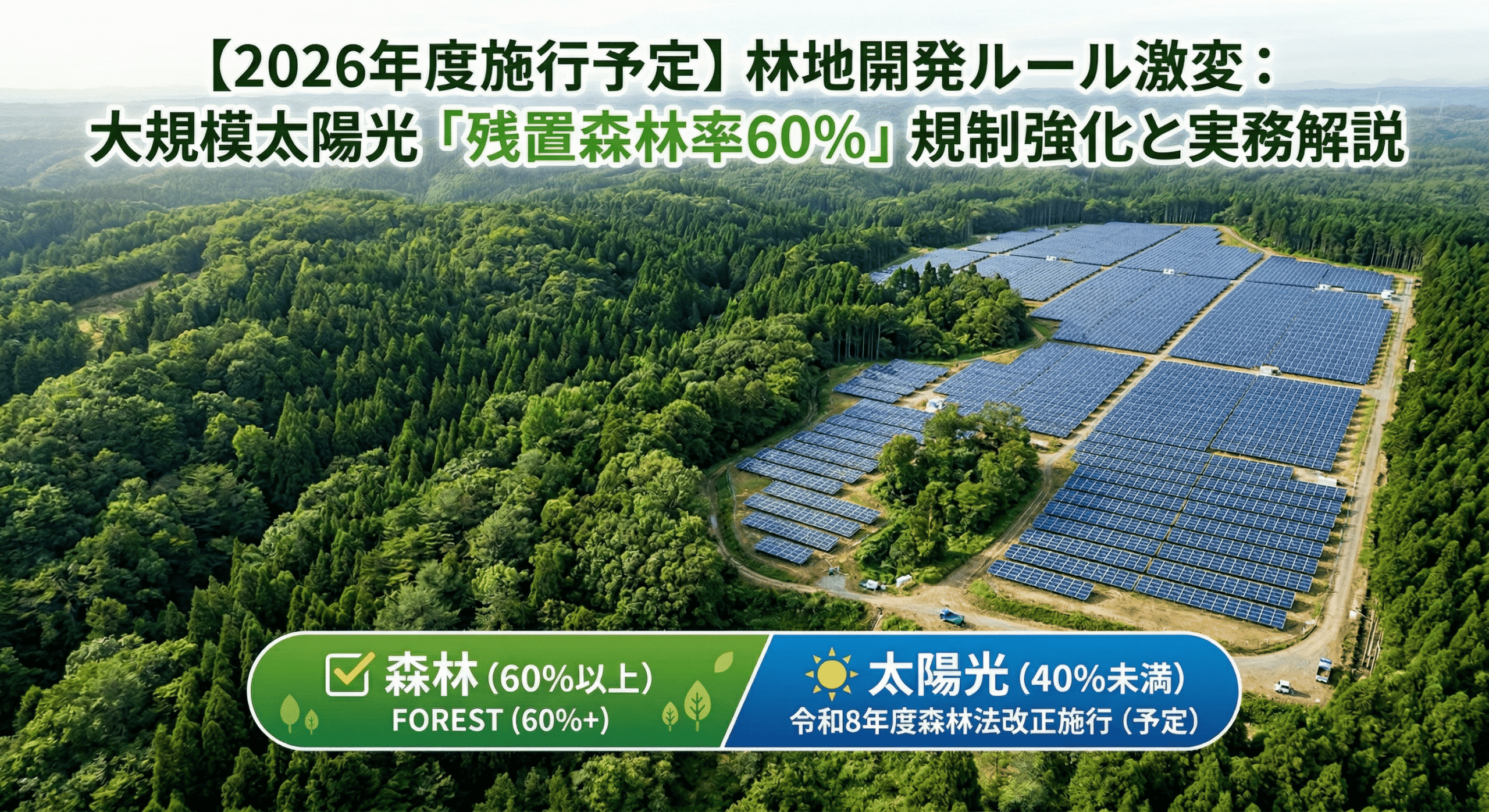
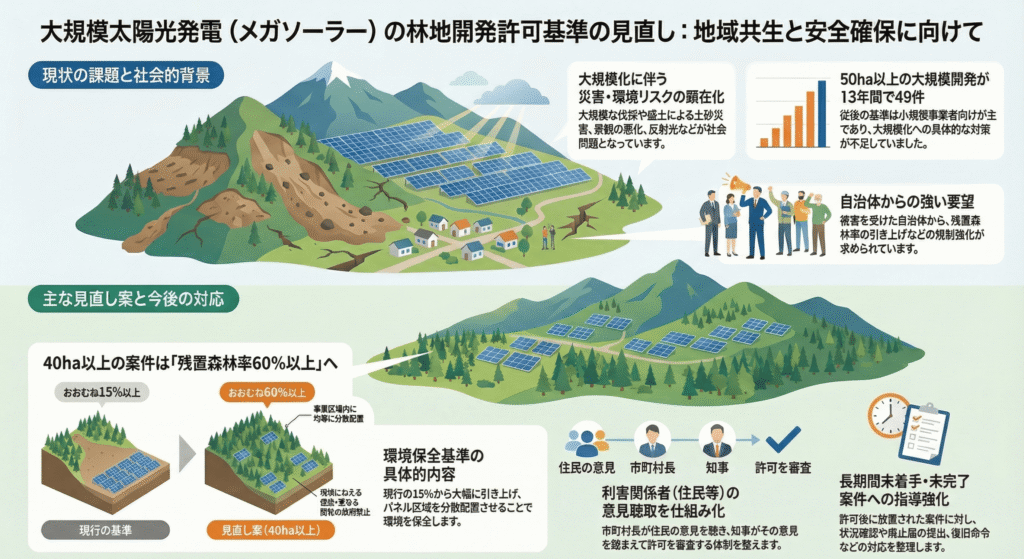
- 🌲 A policy has been announced to significantly increase the remaining forest rate to approximately 60% or more for large-scale solar power generation of 40 hectares or more.
- 🗣️ It will clarify the mechanism by which mayors of cities, towns, and villages can hear opinions from local residents and other "stakeholders" during permit review by the governor, and will increase the importance of building public consensus.
- ⚠️ For abandoned cases that have not been started or completed for a long period after approval, we will provide enhanced guidance on checking the status, reminding people to submit abolition notices, and issuing restoration orders as necessary.
- ⚖️ Due to the revision of the Forest Act in 2025, severe penalties of "detention for up to three years or a fine of up to 3 million yen" will be applied for violations of permit conditions.
✅ Audio summary of this post here

Introduction
This time, we will explain the fundamental review of forest land development permit standards for large-scale solar power generation (mega-solar).
Recently, concerns about disasters and environmental degradation such as landscapes due to the development of mega solar power plants have become a social issue in various places, and many people are worried about the impact on future practical applications.
On December 23, 2025, the government decided at a cabinet meeting to implement a "Measure Package for Large-Scale Solar Power Generation Projects (Mega Solar)."
In response to this, the following was published in February 2026: Interim Summary (Draft) of the Review Committee on Forest Land Development Permit Standards for Solar Power Generation Based on this, we will objectively explain the full range of regulatory tightening faced by businesses from the perspective of practicing lawyers.
I personally am keenly aware of the difficulties and importance of the renewable energy business through my daily legal support, and I hope that this will help you in your business operations.
Overview of the forest land development permit system and its changes to date
The forest land development permit system based on Article 10-2 of the Forest Act aims to prevent disasters and floods caused by uncontrolled development, secure water, and preserve the environment in privately owned forests other than protected forests.
Since the system was established in 1974, it has been subject to several reviews depending on the social situation.
Regarding solar power generation, detailed operating rules were established in 2019, taking into account special characteristics such as rainwater collection, and in 2022 the size required for permission was reduced from over 1.0ha to over 0.5ha.
In addition, they are required to attach documents demonstrating the means and credit required for disaster prevention measures.
Of particular note is the amendment to the Forest Law in fiscal year 2025 (scheduled to come into effect on April 1, 2026).
Until now, the main punishment for this was "unlicensed development," but after the revision, severe penalties of imprisonment of up to three years or a fine of up to 3 million yen will also be applied to "development that violates the permit conditions."
In addition, a mechanism has been introduced that allows the names of those who do not comply with orders to stop or restore development activities to be made public, which is thought to have dramatically increased the importance of compliance (legal compliance).
Impact of 60% residual forest rate on large-scale projects (over 40ha)
The biggest change in this review is the dramatic increase in the standard for large projects with a development area of 40ha or more.
Under current standards, the forest rate (total of remaining and created forests) for solar power generation is approximately 25%, of which the remaining forest rate is 15% or more.
However, the new standard proposal made it appropriate to set the remaining forest rate at approximately 60% or more for projects of 40 hectares or more.
This 40ha threshold is set based on previous cases such as the average area of a golf course, which is approximately 36ha, the average area of a ski resort, approximately 46ha, and Hyogo Prefecture's own standards (40ha or more and 60% or more of remaining forest, etc.).
A significant practical note is that young forests of 15th grade and below are excluded from the calculation of the residual forest rate.
If the forest acquired for development is a young forest, there is a risk that the calculated residual forest rate will not be secured, and extremely detailed research is required at the land selection stage.
In addition, new rules will be applied in the future to distribute panel areas roughly evenly within the business area, so land use efficiency is expected to be significantly reduced compared to the previous period.
Stricter consultation on community coexistence
Mechanisms for consultation in the permitting process will also be strengthened with the aim of preventing local problems.
The Forest Act states that when prefectural governors seek to grant permission, they must listen to the opinions of the mayors of the relevant municipalities, but it will be made clear that in the future, it will be appropriate for mayors to listen to the opinions of those affected by development activities (stakeholders) as necessary.
This means that local voices are effectively incorporated into the review process.
The Governor will review whether the application meets the permit requirements, taking into account the opinions of the relevant city or town mayors heard during this hearing.
This will allow for the dual filter of the governor's judgment and the opinions of city and town mayors to function, and it is believed that it will be an absolute requirement for businesses to continue operations by sincerely explaining their decisions to local residents from the planning stage onwards and by reaching a substantive agreement.
Addressing cases that have not been started for a long period of time and development actions have not been completed
Policies for dealing with cases where construction has not begun for a long period of time while permits have been obtained, or where construction has stalled, will also be tightened.
The governor, etc., who is the licensee, checks with the business operator about the reasons why development has not yet begun and the future prospects, and instructs them to submit a notice of abolition without delay if it is difficult to carry out the project.
In addition, if the facility is abandoned during development and there are concerns about local safety measures, it is appropriate to promptly implement restoration orders for a set period of time.
Although it is not legally possible to apply the new standards retroactively to existing permitted projects, it was clearly stated that it is appropriate to provide guidance to those projects that have not yet been started to be reviewed in a plan that complies with the new standards, with a view to maintaining the public interest functions of forests.
Although administrative guidance does not have legal force, in practice it is virtually difficult to ignore guidance and forcefully start construction, and it seems highly likely that abandoned cases will be subjected to the new standard web.
Lawyers' perspectives and sustainable relationships between renewable energy companies and local communities
The tide of ESG investment is accelerating internationally, and responding to nature positivity (Nature Positive), which staves off and restores biodiversity loss, is becoming the global standard.
This tightening of regulations in Japan is also not just a development restriction, but is also seen as a process to elevate the renewable energy business into an asset that can coexist with local communities.
Tightening forest land development permit standards is likely to increase business costs in the short term.
However, complying with laws and regulations and building good relationships with the region while maintaining high forest retention rates will result in higher ESG scores for your business and protect your long-term asset values.
We believe that the present amendment also has a market-culling aspect for high-quality renewable energy operators to survive. I know there are some points that are not quite there, but as an expert I hope to help businesses manage risk.
Summary
Through the interim compilation (proposal), the rules surrounding large-scale solar power generation have been organized in the following points.
- The remaining forest rate for projects of 40 hectares or more has been increased to approximately 60% or more.
- Clarification of the process for consulting stakeholders through municipal mayors.
- Strengthening guidance and recovery orders for long-term outstanding and incomplete cases.
- Application of penalties (such as imprisonment for up to three years) for violations of permit conditions under the revised Forest Act.
These reviews are being considered on the assumption that they will be implemented from FY2026.
Operators currently planning to do so should now begin preparations, including reconsidering land use plans, scrutinizing the risks of young forests, and strengthening dialogue with local residents.
Responding flexibly and honestly to changes in legislation and regulations is seen as the way to ensure the sustainability of the business.
We sincerely hope that your business will be rooted in the local community and develop into something truly valuable.






Comments