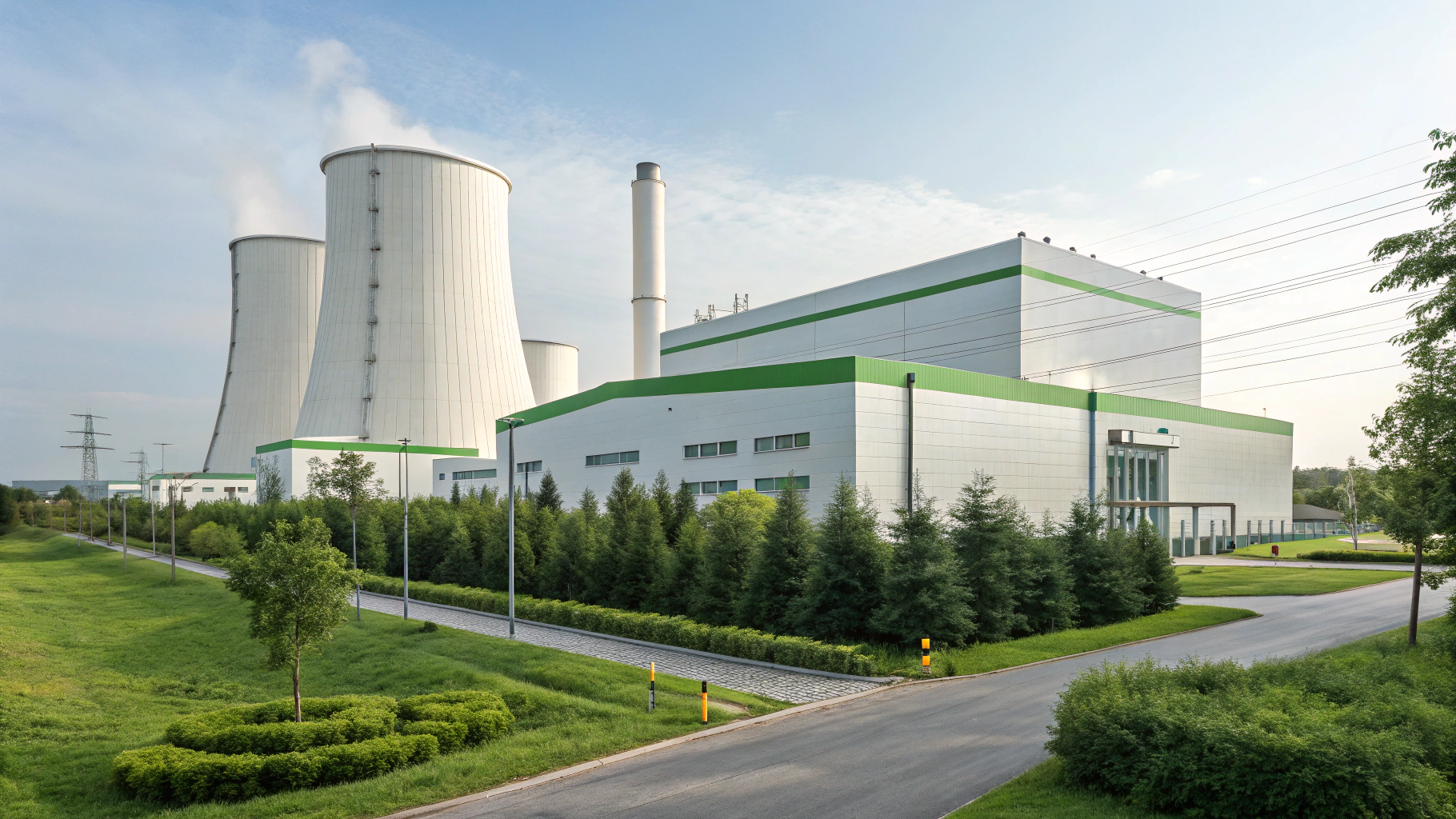
✅ Roughly speaking
- 🌍 US Big Tech Companies Accelerate Nuclear Power Investments as Demand for Power Increases in the AI Era
- 🇪🇺 After the Ukraine War, Europe Reevaluates Nuclear Power from the Perspective of Energy Security
- 🇯🇵 Japan's 7th Basic Energy Plan shifts policy to "maximize the use of nuclear power," but doesn't envision new construction.
- ⚖️ A calm discussion is needed from three perspectives: technical feasibility, economic rationality, and social consensus building.
✅ Audio summary of this post here
Introduction
This time, we will explain the "return to nuclear power" movement that is attracting global attention, and the position of nuclear power in Japan's energy policy.
Since 2024, major US IT companies have one after another announced their investment in nuclear power generation, and the term "return to nuclear power" has been making headlines in domestic and international media.
In September 2024, Microsoft signed a 20-year contract to procure all of its electricity from the Three Mile Island nuclear power plant ( Nikkei Shimbun ), and in October of the same year, Google signed a power purchase agreement with Kairos Power, a company developing next-generation small modular reactors (SMRs) ( article ). Furthermore, in June 2025, Meta announced a 20-year nuclear power purchase agreement ( JETRO article ).
Meanwhile, in Japan, the 7th Basic Energy Plan was approved by the Cabinet on February 18, 2025, and the phrase "reducing dependence on nuclear power as much as possible," which had been included in the plan since the Fukushima Daiichi nuclear accident, was removed, and the plan was changed to a policy of "maximizing the use of both renewable energy and nuclear power" (Agency for Natural Resources and Energy website ).
Can this global trend truly be called a "return to nuclear power," or is it a policy adjustment due to other factors? As a lawyer specializing in renewable energy, I would like to examine this issue from three perspectives: technical feasibility, economic rationality, and social acceptability.
Three major trends occurring around the world
Trend 1: Reconstructing energy security
Russia's invasion of Ukraine in February 2022 is thought to have had a major impact on European energy policy. Forced to break away from its reliance on Russian natural gas, the European Union (EU) is accelerating its transition to renewable energy while at the same time reevaluating nuclear power as the "keystone of energy security" ( International: Two Years After the Ukraine Invasion: Global Energy and Nuclear Situation ).
According to EI statistics for 2024, renewable energy will account for up to 34% of the EU's electricity mix, while nuclear power will also play an important role at 23%, with non-fossil fuel power sources reaching 70% overall ( report ).
In this way, it can be said that the strategy of simultaneously moving away from dependence on Russia and decarbonizing is becoming clearer.
As one of the world's leading nuclear power countries, France is focusing on extending the operating periods of existing nuclear power plants, and in July 2023 began the preliminary licensing process for two 170,000kW small modular reactors (SMRs) ( Small modular nuclear power plants moving forward despite development difficulties and the activities of three European and American companies ).
The UK is also moving forward with plans to build new nuclear power plants.
The emergence of geopolitical risks has once again forced policymakers to consider the classic yet essential imperative of "diversifying energy sources."
Trend 2: Nuclear power as a realistic path to decarbonization
At COP28, 22 countries announced a multilateral declaration to triple their current nuclear power generation capacity by 2050 ( report ).
This is not mere idealism, but appears to be based on realistic calculations aimed at achieving climate change targets.
According to the International Energy Agency (IEA) report "Electricity 2024," global CO2 emissions from power generation are expected to fall by 2.4% in 2024 and fall further in 2025 and 2026 due to increased power generation from renewable energy and nuclear power ( IEA "Electricity 2024" released, nuclear power to play a role in future increase in electricity demand ).
Nuclear power emits almost zero CO2 and, unlike solar and wind power, functions as a stable power source (baseload power source) that is not affected by weather conditions.
It is appropriate to view nuclear power as being reevaluated as a power source that can complement the variability of renewable energy.
However, the binary debate of "renewable energy or nuclear power" is not productive.
The Seventh Basic Energy Plan also clearly states that "rather than a binary debate between renewable energy and nuclear power, it is extremely important to make maximum use of both renewable energy and nuclear power."
Trend 3: Explosive electricity demand in the AI era
The most dramatic change is the rapid expansion of artificial intelligence (AI) and data centers, which is driving up electricity demand.
According to the IEA's forecast, global electricity demand for data centers, AI, and other sources is expected to increase from 460 TWh in 2022 to 800 TWh in 2026 in the base case (" About Electricity Demand ").
Furthermore, some estimates suggest that this could reach approximately 1 trillion kWh by 2030 (" Second Commentary Article: Theme: Future Increase in Electricity Demand and Challenges Due to DX" ).
The recognition that it will be difficult to meet this huge demand for electricity with a stable supply using renewable energy alone is thought to be the main factor driving large US IT companies to turn to nuclear power.
The electricity procurement targets set by big tech companies such as Microsoft, Google, and Meta by 2040 are on a scale that cannot possibly be met by existing power infrastructure (" US tech to source power for AI from nuclear power plants, creating business opportunity for IHI and Hitachi ").
The surge in investment in small modular reactors (SMRs) is likely in anticipation of this increased demand.
SMRs require a shorter construction period than conventional large-scale nuclear power plants, and their modularization is expected to lead to mass production benefits.
Construction of the first commercial SMR in the United States is expected to begin in May 2025, with operations expected to begin in 2030 (" Commercial SMR construction begins in North America, aims to begin operation in 2030 ").
Nuclear strategies of major countries: Four types
Looking at the nuclear strategies of countries around the world, they can be broadly divided into four types.
US model: Two-front strategy: extending the life of existing reactors + developing SMRs
The United States is simultaneously working on extending the life of existing nuclear power plants and developing next-generation SMRs.
As exemplified by the plan to restart Three Mile Island, the government is seeking to increase supply in the short term by restarting shuttered nuclear power plants, while also providing financial support to several SMR projects, including Kairos Power, through tax credits.
French model: A strategy to extend the life of a nuclear powerhouse
As one of the world's leading nuclear power countries, France has made extending the operating period of its existing nuclear power plants a central strategy.
As of 2024, nuclear power will occupy an important position in France's electricity mix, and the country's policy of continuing to rely on nuclear power appears unwavering, both in terms of ensuring energy self-sufficiency and maintaining industrial competitiveness.
China and Korea model: Active new construction
China is expected to generate over 450 TWh of nuclear power by 2024, making it the world's second largest nuclear power producer after the United States (" Global Nuclear Power Generation Capacity Rankings by Country and Trends (EI) ").
We plan to significantly expand our installed capacity over the next 10 years.
South Korea has also clearly stated its strategy to develop the nuclear power export industry, and is using its track record of exports to the UAE as a foothold to increase its presence in the international market.
Japan-style: Limited restart and life extension
So where does Japan fit in?
Japan's strategy, which essentially bans new construction and is limited to restarting reactors and extending the life of existing ones, can be said to be superficially similar to the French model.
However, many people point out that Japan is lagging far behind in terms of building social consensus.
The reality of "maximum utilization" as outlined in Japan's 7th Basic Energy Plan
Changes in policy language and their implications
The biggest change in the Seventh Strategic Energy Plan, which was approved by the Cabinet on February 18, 2025, is the deletion of the phrase "reducing dependence on nuclear power as much as possible," which had been included after the Fukushima Daiichi nuclear accident, and the change to a policy of "maximizing the use of both renewable energy and nuclear power" (" What should Japan do about energy in a rapidly changing world? A look at the latest version of the 'Basic Energy Plan' (Part 2) ").
Regarding this change, the chairman of the Japan Atomic Industrial Forum commented, "It is extremely significant that the government has indicated its intention to make maximum use of nuclear power, given the growing demand for economic security and the expected increase in electricity demand due to the progress of DX and GX."
Specific numerical targets
Looking at specific figures, Japan's nuclear power generation capacity is projected to increase from 13GW in fiscal 2024 to 17GW in fiscal 2030 (" Nuclear power generation forecasts for fiscal 2030/2040: Reality by scenario ").
However, from the 2030s onwards, the operating periods of nuclear reactors will come to an end one after another, and a scenario is presented in which this will decrease to 13GW by fiscal 2040.
Another estimate points out that in a high-end scenario, installed capacity could increase to 25GW by fiscal 2030, but this figure is based on the assumption that almost all existing nuclear power plants will be restarted, so caution is needed regarding its feasibility.
Current status of restart
As of January 2025, there are 14 nuclear power plants operating across Japan.
The total installed capacity of nuclear power plants, including those under construction, is approximately 37 million kW (37 GW), but only 14 reactors with a total capacity of approximately 13.25 million kW (13.25 GW) have been restarted.
In other words, it is appropriate to understand that "maximum utilization" means restarting existing reactors as much as possible and realizing their operation for more than 60 years, and does not envisage expanding capacity through new construction.
Relationship with renewable energy
The Seventh Plan also outlines a policy to increase renewable energy from 40% to 50% of the total by 2040, making it the largest power source.
Nuclear power is positioned as a "stable power source that complements the variability of renewable energy," and as in European countries, this may be seen as a realistic approach that goes beyond the binary opposition of "renewable energy or nuclear power."
However, it must be said that there is still a large gap between the numerical targets set out in the plan and social reality.
A calm assessment of the economic rationality of nuclear power generation
Cost-effectiveness of extending the life of existing reactors
When discussing the economics of nuclear power, it is necessary to clearly distinguish between extending the life of existing reactors and building new ones.
Life extension of existing reactors is considered relatively cost-effective.
Although additional safety measures will be required, the cost of generating electricity is expected to be competitive to a certain extent compared to other power sources, as it is possible to utilize facilities that have already been constructed.
The 2024 calculations of the Power Generation Cost Verification Working Group also assessed that there is a certain degree of economic viability in continuing to operate existing nuclear power plants.
High hurdles for new construction
On the other hand, it must be said that the hurdles to establishing a new facility are extremely high.
According to the Agency for Natural Resources and Energy's power generation cost verification , the additional safety measure costs reported by power companies for all nuclear power plants (16 nuclear power plants, 27 reactors) that have applied to the Nuclear Regulation Authority for compliance review with new regulatory standards as of June 2024 have increased significantly.
US estimates put the cost of a first of a kind (FOAK) fully considered nuclear construction project at around $6,200 per kW (" Nuclear Power Construction Costs May Be Cheaper Than You Think ").
The development period will take more than 10 years, and the interest burden during that time cannot be ignored.
Cost comparison with renewable energy
In contrast, the cost of renewable energy has fallen dramatically.
According to BloombergNEF, the cost of newly installed solar power generation worldwide in 2024 will be a record low of US$36/MWh (megawatt-hour) (" Solar Power to Expand Globally in 2024, Driven by Falling Battery Costs "). Converted to Japanese yen, this is approximately 5 yen/kWh.
In addition, the cost of storage batteries is expected to fall by about 40% by 2024 ("Nuclear power generation to hit record high in 2024 but set to slow down due to lack of investment and aging" https://jp.reuters.com/markets/commodities/VYZ2MAZZCJNRPBUZNSOZEKGIBQ-2025-09-22/ ).
As a result, it is believed that the economic viability of renewable energy is improving rapidly.
Potential and challenges of SMR (Small Modular Reactor)
SMRs, which are attracting attention as the next generation of nuclear power plants, are expected to have shorter construction times than conventional large-scale nuclear power plants and to achieve mass production benefits through modularization.
According to market forecasts, the SMR market is expected to expand from approximately $7.5 billion in 2025 to approximately $16.1 billion in 2034, with a compound annual growth rate (CAGR) of 8.9% (" What are SMRs (Small Modular Reactors)? A thorough explanation of the latest trends and their relationship with prominent companies, AI, and communications infrastructure ").
However, the road to practical application is not an easy one.
In November 2023, US-based NuScale Power announced it was canceling plans to build the first SMR in the United States.
It was scheduled to be operational in 2029, but the reason given is that rising construction costs due to inflation have made it uneconomical (" US scraps construction plan for next-generation small nuclear power plant, with Japanese company also investing ").
The practical application and economic viability of SMRs are still challenges to be overcome, and it is important to recognize that there is still a large gap between technical feasibility and economic feasibility.
Two fundamental challenges that cannot be avoided
Issue 1: Ensuring safety
The Fukushima Daiichi nuclear accident showed that the "unforeseen" can become reality.
After the accident, the Nuclear Regulation Authority introduced new regulatory standards, which significantly strengthened earthquake resistance, tsunami countermeasures, and severe accident countermeasures.
Restarting nuclear power plants requires strict screening, which is one of the reasons for the delay in restarting them.
However, increased regulation is considered a necessary cost.
If safety is neglected during operations, a single accident could cause irreparable damage to society as a whole.
The pursuit of technical safety and the creation of an organizational culture to achieve this can be said to be fundamental prerequisites for the use of nuclear power.
Issue 2: Final disposal of radioactive waste
A more fundamental issue is the final disposal of high-level radioactive waste. Spent nuclear fuel needs to be managed for 100,000 years.
Finland is a world leader in this issue. The final disposal site, "Onkalo" (meaning "cave" in Finnish), built on Olkiluoto Island, buries spent fuel 400-450 meters underground and is scheduled to begin trial operation at the end of August 2024.
This project, which was realized after decades of geological surveys and dialogue with the local community, is attracting attention not only as a technical solution but also as a model for building social consensus.
In March 2025, plans finally got underway to keep spent nuclear fuel lying dormant for over 10,000 years.
Sweden is also proceeding with the construction of a final disposal site, and it can be said that the two Nordic countries are on the verge of demonstrating effective solutions to the "nuclear waste" problem.
Meanwhile, in Japan, even selecting a final disposal site is currently proving difficult.
In addition to investigating the geological conditions, we must also say that there are a number of multi-layered challenges that need to be addressed, such as building trust with local residents, highly transparent information disclosure, and designing a system for long-term responsibility.
Continuing to postpone this issue would be nothing more than an irresponsible imposition of a burden on future generations.
Lack of social dialogue: a unique challenge for Japan
I believe that what is more serious than technical or economic issues is the lack of social dialogue.
It is often pointed out that Japan's energy policy is determined by the "atmosphere."
The mood of "anti-nuclear power" immediately after the Fukushima accident has shifted back to "restarting nuclear power plants is inevitable" due to concerns about power shortages.
There are also voices saying that the shift to "maximum utilization" in the Seventh Basic Plan has not been subject to sufficient national debate.
In fact, public opinion remains divided.
There is a difference in opinion between areas where nuclear power plants are located and urban areas, and opinions differ even between generations.
The fact that a platform for social dialogue to overcome these conflicts has not been established is something that needs to be taken seriously.
The success of Finland and Sweden in building final disposal sites is the result of decades of steady dialogue.
It is said that a multifaceted approach that went beyond technical explanations to include fair distribution of risks and benefits, transparency in the decision-making process, and economic returns to the local community worked.
From the perspective of a lawyer specializing in the renewable energy and energy fields, I sometimes feel that Japan lacks a "legal framework for consensus building."
Although the Environmental Impact Assessment Act and the Nuclear Reactor Regulation Act exist, they are not sufficiently designed to ensure the procedural rights of local residents to ensure their effective participation, nor are they adequately designed to clarify who is responsible in the long term.
Strengthening transparency and accountability in the policy-making process is likely to be the starting point for building trust.
Summary: Thinking in terms of technology, economy, and society
We have confirmed that there are three clear driving forces behind the ongoing global reevaluation of nuclear power: strengthening energy security, a realistic path to decarbonization, and explosive demand for electricity in the age of AI.
This trend should be understood as being based on practical necessity, not emotional reason.
However, technological advances alone will not solve the problem.
It is unknown whether SMRs will be economically viable, and the final disposal of radioactive waste is an issue that will last for generations.
Above all, it must be said that promoting policies without social consensus is unsustainable.
The realistic roadmap that Japan should take can be summarized into the following three points.
First, we must operate existing reactors with safety as our top priority and steadily implement measures to extend their lifespan.
Since building new facilities is socially and economically difficult, maximizing the use of existing resources is a realistic option.
However, ensuring safety is an absolute requirement, and strict enforcement of regulations is essential.
Second, we need to develop a strategy for coexistence with renewable energy.
Rather than positioning nuclear power as a "stopgap," it is important to make it function as a stable power source that complements the variability of renewable energy, and to pursue the optimal mix of the two.
Third, and most importantly, the institutionalization of social dialogue.
Develop transparent and participatory decision-making processes that incorporate mechanisms to represent the interests of local residents, experts, civil society and future generations.
Without this, no energy policy is likely to be sustainable.
The return to nuclear power is not simply a policy backslide.
This reflects the reality that the world, faced with the twin crises of energy security and climate change, is being forced to mobilize all available options.
It seems that now is the time to engage in calm discussions about Japan's energy future from the three perspectives of technological feasibility, economic rationality, and social acceptability.


comment