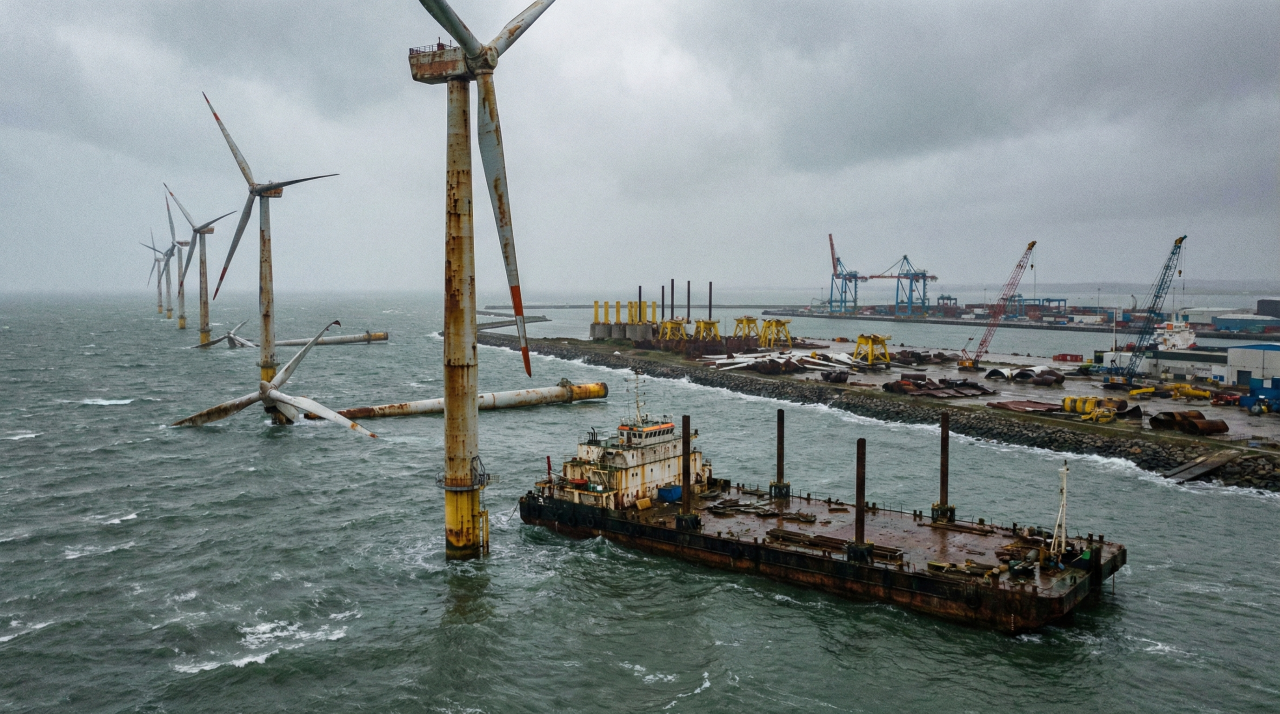
✅ Roughly speaking
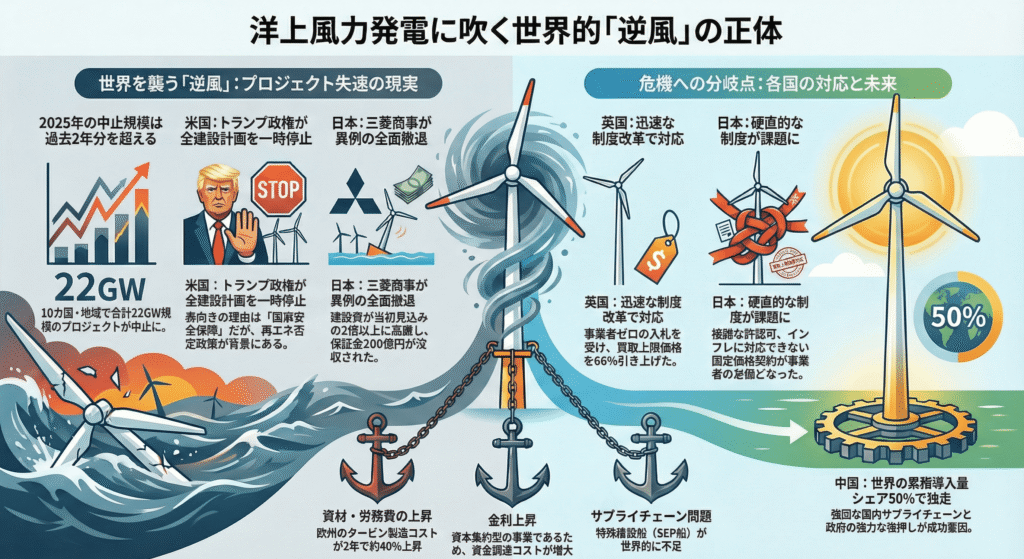
🇺🇸 On December 22, 2025, the Trump administration suspended offshore wind construction across the United States, citing "national security risks." Although they claim radar interference, in reality it is a sign of a negative attitude towards renewable energy
🇯🇵 In Japan, Mitsubishi Corporation has completely withdrawn from the three Akita and Chiba sea areas (1.7GW). Construction costs have grown more than double what was originally expected, leading to an unprecedented confiscation of 20 billion yen in security deposits
🌍 Projects around the world are being canceled one after another. By August 2025, 22 GW of capacity will be canceled in 10 countries and regions, exceeding the capacity of the previous two years. The background is rising costs and supply chain issues
⚖️ This is not a "technological failure" but a "mismatch between institutions and the economic environment." UK responds by raising prices by 66%, Japan also urgently needs institutional reform
✅ Audio summary of this post here
Introduction
This time, we will explain the global "headwinds" surrounding offshore wind power generation.
On December 23, 2025, the Nihon Keizai Shimbun reported that the US Trump administration has suspended all construction of offshore wind farms ( Nikkei Shimbun, December 23, 2025 ).
Earlier, in August 2025, Mitsubishi Corporation announced in Japan that it would completely withdraw from its offshore wind power business off the coast of Akita and Chiba prefectures, shocking the industry.
What is happening now to offshore wind, which has been touted as the "trump card" for decarbonization. As a lawyer, I have worked in the renewable energy sector, and I believe this series of moves is not just a failure of individual projects, but highlights the structural problems that have arisen between institutional design and rapid economic and environmental changes.
This article will summarize the situations in the United States, Japan, and Europe, and consider what went wrong from a legal and institutional perspective, as well as what future responses are needed.
US: Trump administration shocks construction halt
Sudden announcement and why
On December 22, 2025, the U.S. Department of the Interior announced that it was suspending plans for all large offshore wind farms under construction in the United States, citing national security risks.
The target is five construction projects being carried out by American and European companies off the East Coast of the United States.
The Home Office said blades that rotate on offshore wind power interfere with radar systems used for defense and other purposes. Specifically, there are concerns that interference will obscure the target to be detected.
A 2024 report from the U.S. Department of Energy also noted that changing radar settings to reduce this interference could cause missed targets to be detected.
"This will address risks such as vulnerabilities posed by offshore wind projects," Interior Secretary Burgham said in a statement.
The actual political context
However, this "national security risk" reason is questionable.
US President Donald Trump has consistently been critical of wind power.
In past statements, he has claimed that "wind and solar are the fraud of the century" and has increased pressure on the renewable energy business, including announcing the early termination of tax incentives.
According to a CNN report, Trump said at a rally in Wisconsin in April 2025 that wind power is the "most expensive form of energy" and that wind turbines are a "bird graveyard" ( CNN, April 18, 2024 ).
The construction halt is an extension of this anti-renewable energy stance and is considered part of the Trump administration's energy policy, which aims to build new nuclear power plants and extend the life of coal-fired power plants, with the aim of securing electricity for AI (Artificial Intelligence) data centers.
Impact on the market
Following the announcement, the stock prices of the companies involved fell sharply.
Shares in Norwegian oil giant Equinor and Danish offshore wind giant Åsted each fell sharply at one point.
Austed shares were down 16% from the previous weekend's closing price, while shares in Dominion Energy, a major US power company that was hit by new offshore wind under construction, were down 6% as well.
These two companies are not the first to be attacked.
Construction was halted in April and August 2025, but construction had already resumed in both cases, including after a federal judge intervened.
This measure is also likely to face legal challenges.
Employment and industrial impact
In addition to power companies, windmill manufacturer Vestas (Denmark) and US company GE Bernova are also affected.
It also leads to fewer jobs for workers on construction sites with huge offshore wind forces.
The National Marine Industries Association, an industry group, said offshore wind "provides high-paying jobs for thousands of Americans."
"We urge the government to refrain from measures that harm jobs and investment," association president Eric Milito said in a statement.
White House National Climate Adviser (at the time) Ali Zaidi said in an interview with CNN that "the steel in the ground will not be pulled out, it is irreversible," but warned that the industry needed the backing of a friendly administration to mature and succeed.
In fact, industry analysts are pessimistic about the Biden administration's goal of deploying 30 GW (gigawatts) of offshore wind by 2030, saying, "Our latest forecast is about half that, at 15 GW." ( CNN, April 18, 2024 ).
Japan: Structural challenges presented by Mitsubishi Corporation's withdrawal
History and scale of withdrawal
On August 27, 2025, Mitsubishi Corporation announced that it would withdraw from all three successful bids in the first public offering (first round) for offshore wind power in general marine areas.
The project targeted was a total of 1.7 GW in Akita and Chiba, which was awarded at the end of 2021 through a consortium with Chubu Electric Power affiliates and local companies ( Natural Energy Foundation, October 3, 2025 ).
It is highly unusual in Japan for a major trading company or power company to withdraw from a large business that has been awarded a contract after fierce competition, even to the point of paying a huge penalty.
In fact, the approximately 20 billion yen that was set aside as a deposit became national and was ultimately confiscated ( Nikkei Shimbun, August 27, 2025 ).
In addition, Mitsubishi Corporation and others were penalized by not being able to bid in the next public offering either.
The reality of cost explosion
At a press conference, Mitsubishi Corporation President Katsuya Nakanishi cited rising costs due to inflation as the reason for the withdrawal, explaining that "even if the selling price is more than double, we will not be able to recover our investment." ( Nikkei BP, September 22, 2025 ).
In fact, material prices, labor and transportation costs have skyrocketed since bidding, with overall construction costs rising by 20%, according to an analysis by the Natural Energy Foundation.
Some have pointed out that turbine prices, which are said to account for 20% of the total cost, have doubled since then ( Natural Energy Foundation, September 1, 2025 ).
The country's underdeveloped supply chain has led to a high level of import dependency, and the impact of currency fluctuations is thought to have been significant.
In fact, Mitsubishi Corporation's decision to withdraw was explained by saying, "Since winning the bid in 2021, costs have increased significantly due to a combination of global inflation and price hikes by wind turbine manufacturers.
"The construction costs were more than double the amount originally anticipated, and the expenditures, including maintenance and operation costs, were greater than the revenue from electricity sales over the entire operation period, leading to the conclusion that it would be difficult to realize the business plan," the company explained.
Bidding strategy issues
However, it cannot be denied that the initial outlook for the Mitsubishi Corporation Alliance was weak.
Compared to the average bid of the competitors who submitted bids, they bid between 6 and 9 yen less ( Natural Energy Foundation, September 1, 2025 ).
This unusually low bid was questioned even at the time.
The Nikkei BP article raises the question of "why the government selected an abnormal bid price" ( Nikkei BP, September 22, 2025 ).
Structural problems specific to Japan
The loss of time, four years before the withdrawal was announced, was also significant, resulting in delays in the start of operations in the three areas as well as a missed opportunity for fundamental discussion of the bidding system.
The Natural Energy Foundation lists the following as challenges unique to Japan:
Firstly, the complexity and length of the licensing system. It requires procedures that span multiple ministries, and the environmental assessment alone takes several years.
Secondly, there is the issue of cost-sharing for grid construction and port development. In many cases, the public burden is high in Europe, but in many cases it is borne by businesses in Japan.
Thirdly, the lack of construction vessels due to cabotage regulations. As a rule, vessels working in Japanese waters must be Japanese-flagged, and there is a lack of large special vessels needed for offshore wind construction.
Fourthly, the difficulties of seabed ground surveys. It turns out that Japan's seabed geology is complex and requires more time and cost than expected for preliminary investigation.
Concerns about follow-up cases
Thus, what has become increasingly urgent over time is the response to follow-on cases.
Round 2 and 3 operators, who were pressured by price competition and were unable to submit zero-premium bids, are now facing an even tougher environment.
Since the start of operation was an important factor in the selection process from Round 2 onwards, there are already four projects with a start time of less than four years, and the shortest is three years.
If the project goes ahead without any improvements being made, there is a strong possibility that similar disruptions will occur.
Europe: developed countries responding with rapid institutional reforms
UK's zero-bid shock and response
The UK, then under a Conservative government, has carried out a major pricing review by increasing the cap by 66% in its next bid in 2024 after offshore wind operators failed to turn up in the September 2023 bid for Contract for Difference (CfD)5.
Specifically, we have increased the cap price for implantation offshore wind from £44/MWh to £73/MWh ( JETRO, November 20, 2023 ).
This review resulted in the price being increased from 11.63 yen/kWh to 19.30 yen/kWh in Japanese yen ( Natural Energy Foundation, September 1, 2025 ).
However, it has been pointed out that this still does not adequately cover inflation risk, and CfD 7, which will be implemented in 2025, has been increased again, extending the contract period from 15 to 20 years.
In fact, the results of the sixth auction (CfD 6), published in September 2024, saw nine offshore wind projects secure contracts at £54~59 per megawatt hour (MWh).
This is in line with recent global auctions and represents a price level that reflects the effects of inflation and high interest rates ( JETRO, September 6, 2024 ).
Danish response
Denmark is also considering similar institutional changes for tenders after zero tenders have occurred.
When zero bidding occurs in Denmark, detailed hearings with operators identify the necessary reforms and indicate a policy to boldly change the bidding system next time ( Natural Energy Foundation, September 1, 2025 ).
European lessons
These cases show that it is essential to put in place a mobile institutional framework to expand offshore wind power.
Common to European countries is the following approach:
Firstly, when zero tenders or operator withdrawals occur, we immediately carry out a causal analysis.
Secondly, to conduct detailed hearings with businesses to understand the actual situation.
Thirdly, the implementation of institutional reforms quickly, based on the results of the analysis. It has taken concrete measures, such as increasing price ceilings, extending contract periods and reviewing risk-sharing.
Fourth, we must maintain our ambitious implementation goals while adjusting to realistic pricing.
Such a mobile response has succeeded in maintaining industry appetite and investment in offshore wind development, albeit with a temporary stagnation in Europe.
The situation in the United States
Similar problems have occurred in the United States.
In October 2023, Danish energy giant Ørsted (Åsted) announced the cancellation of development of its 2.4GW Ocean Wind 1 and 2 projects off the coast of New Jersey ( The Guardian, November 1, 2023 ).
Austin cited high inflation, rising interest rates and supply chain bottlenecks as reasons.
The cancellation caused the company to post an impairment loss of DKK 28.4 billion (£3.3 billion, or approximately ¥660 billion) ( The Guardian, November 1, 2023 ).
However, some US states have shown flexibility.
New York and others have accepted to rebid previously canceled projects at higher prices.
According to a CNN report, "It was a very positive sign for the industry that these projects were re-bid and accepted at higher prices despite the extremely difficult circumstances." ( CNN, April 18, 2024 ).
The reality of rising global costs
The crisis in numbers
The world is experiencing a series of cancellations of offshore wind power development.
According to a report in the Nihon Keizai Shimbun, by August 2025, tenders for a total generating capacity of 22 gigabits (giga is 1 billion) had been cancelled in 10 countries and regions due to rising costs, exceeding the combined total for the two years 2023 and 2024 ( Nikkei Shimbun, September 27, 2025 ).
Global offshore wind capacity reached 83.2 GW in 2024, but new capacity was 8 GW in the same year, with China accounting for about half of that, while adoption continues to expand in Europe and Asia, although the pace of growth is slowing ( Natural Energy Foundation, October 3, 2025 ).
Factors behind rising costs
According to a report by JETRO, the cost of manufacturing wind turbines in Europe has risen by around 40% in the past two years, as geopolitical changes and the energy crisis have led to rising raw material and international transport costs, as well as electricity prices ( JETRO, April 6, 2023 ).
The main factors behind the rising costs are as follows:
First, there is the rise in material and labor costs. The coronavirus disease (COVID-19) pandemic and Russia's invasion of Ukraine have caused prices of materials such as steel, copper and concrete to skyrocket. Labor costs are also rising due to labor shortages.
Secondly, there is a shortage of turbine parts. According to a CNN report, the US market is primarily manufactured in Europe, with "effectively only three companies supplying the US market," and "lead times continue to be long." Furthermore, the US industry is underdeveloped compared to Europe and Asia, so the problem is that "US projects have less influence in attracting manufacturers' attention" ( CNN, April 18, 2024 ).
Thirdly, the rise in interest rates. Offshore wind is a capital-intensive business with large initial investments and is therefore highly affected by rising interest rates.
Fourthly, exchange risk. In countries with high import dependence, a weaker currency directly increases costs. In the case of Japan, the ongoing depreciation of the yen has significantly increased the cost of imported equipment.
Supply Chain Challenges
The MIT Technology Review notes that the offshore wind industry is "causing a series of project cancellations and postponements due to rising costs and growing supply chain disruptions" ( MIT Technology Review, January 15, 2024 ).
Supply chain issues involve structural challenges, not just temporary disruptions.
Offshore wind installations require a highly complex supply chain, with over 20,000 pieces of equipment and parts.
A wide variety of components must be sourced from around the world, including turbine bodies, blades, towers, foundation structures, submarine cables, and substation equipment.
Furthermore, offshore wind construction requires specialized construction vessels (SEP vessels: Self-Elevating Platform), which are in short supply worldwide.
In Japan in particular, cabotage regulations have restricted the use of foreign-flagged ships, leading to a lack of suitable construction vessels in the country.
China's "One-Man Win" and its Meaning
Overwhelming share
China's offshore wind power is experiencing outstanding growth worldwide.
According to data from the Natural Energy Foundation, new deployments will be 8GW in 2024, with China introducing 4.0GW, half of the total ( Natural Energy Foundation, October 3, 2025 ).
According to a tally by the World Wind Congress (GWEC), China has a 50% share of the cumulative offshore wind deployment, far ahead of the UK (19%) and Germany (11%) ( Nikkei Shimbun, October 25, 2025 ).
According to a report by the Central Television Network, the new installed capacity of offshore wind power in the first ~third quarter (1~ September 2024 was 2.47 million kW, and the cumulative grid connection capacity reached 39.1 million kW.
It is expected to exceed 45 million kW (45 GW) by 2024 ( Chuo Television Network, November 18, 2024, reported by SPC/JST ).
Success factors
There are several factors that contribute to China's overwhelming share.
Firstly, a solid supply chain. China has almost all the manufacturing capacity needed for offshore wind power generation in the country. The entire supply chain exists within the country and is interconnected, including turbine manufacturers, blade manufacturers, tower manufacturers, foundation structure manufacturers, and submarine cable manufacturers.
Secondly, a strong government boost. The Chinese government has implemented mandatory renewable energy procurement, requiring power companies to purchase a certain percentage of renewable energy electricity. It also sets clear adoption targets and promotes the development of offshore wind on a policy basis.
Thirdly, cost competitiveness. According to the ClassNK report, "Technological advances and falling manufacturing costs have made offshore wind more economical and encouraged investment. "China's strong supply chain was established, enabling rapid expansion of construction and installation activities in 2021." ( ClassNK, October 2024 ).
Fourthly, technological progress and large-scale investment. China is actively investing in the development of offshore wind technology and is ahead in the development of larger turbines and floating technology.
Points of concern
On the other hand, there are concerns about China's one-man winning record.
First, increasing supply chain dependency on China increases geopolitical risks. There are also efforts by Western countries to reduce their reliance on Chinese-made equipment, which could spark future trade tensions.
In fact, the Trump administration has imposed a 50% tariff on offshore wind, most of which is manufactured in Europe and China ( Yale Environment 360, October 23, 2025 ).
Secondly, the loss of Western technological dominance. European companies that were once world leaders in offshore wind technology are struggling to compete with Chinese companies.
In fact, according to an IEEJ article, the situation is such that "Chinese offshore wind equipment has finally made inroads in Germany," and the share of Chinese equipment in the European market is also expanding ( IEEJ, August 16, 2024 ).
The future of offshore wind: Between optimism and pessimism
How to view the current situation
How should we assess the current situation surrounding offshore wind power.
On a pessimistic note, the Trump administration's halt to construction, Mitsubishi Corporation's withdrawal, and project cancellations around the world appear to indicate a stalemate in the offshore wind industry.
Some believe the era of fixed-price contracts is over and rising costs have fundamentally undermined business profitability.
However, a more dispassionate analysis would suggest that this is a "correctional phase" that industries inevitably experience during their growth process.
Firstly, there is not a problem with the technology itself. The technology for offshore wind is well established and has been proven to generate electricity stably.
Secondly, the cost escalation is due to temporary factors. The unique circumstances of the COVID-19 pandemic and the war in Ukraine have combined to cause material prices and interest rates to skyrocket at the same time. These factors are likely to normalize in the long term.
Thirdly, many countries are moving to reform their institutions. As the examples of the UK and Denmark show, it is possible to restore industrial sustainability by adjusting bidding systems and pricing to realistic levels.
Fourthly, the need for a long-term energy transition remains unchanged. Offshore wind continues to be an important option in terms of climate action and energy security.
Outlook for 2030
According to the Natural Energy Foundation, global offshore wind adoption is expected to continue to grow ( Natural Energy Foundation, October 3, 2025 ).
However, growth rates may be lower than traditional forecasts.
According to an analysis by S&P Global Commodity Insights, the Biden administration's goal of 30 GW by 2030 for the United States is actually expected to be around 15 GW ( CNN, April 18, 2024 ).
On the other hand, China's adoption is projected to continue to expand. According to a report in the Nihon Keizai Shimbun, China is expected to account for 50% of the world's offshore wind power by 2030 ( Nikkei Shimbun, October 25, 2025 ).
Expectations for floating offshore wind power
Floating offshore wind power is expected to be a growth factor in the future.
Conventional implantation systems can only be installed at depths of around 50m, but floating systems can be installed in deeper waters.
In Japan, the revised "Reenergy Sea Area Utilization Act" was enacted in June 2025, significantly expanding the development of offshore wind power, which was previously limited to general sea areas, into the Exclusive Economic Zone (EEZ), paving the way for the development of floating offshore wind power ( Natural Energy Foundation, September 1, 2025 ).
In the United States, the Bureau of Ocean Energy Management (BOEM) plans to hold up to four lease sales in 2025, including potential locations for floating turbines off the Gulf of Maine and Oregon ( CNN, April 18, 2024 ).
Although the floating system is still technically in development, it may become the dominant offshore wind system in the future.
Japan's challenges from a legal and institutional perspective
What was the problem
When analyzing Mitsubishi Corporation's withdrawal from a legal and institutional perspective as a lawyer, multiple structural issues emerge.
Firstly, the rigidity of the tendering system. Japan's offshore wind tender was conducted in the framework of FIT (Feed-in Tariff, Feed-in Tariff) and was premised on long-term contracts at fixed prices.
However, in a rapidly inflationary environment, fixed-price contracts put operators at excessive risk.
The absence of an inflation adjustment clause or a price review mechanism built in was a major problem.
Secondly, there is the imbalance in risk sharing. The burden on businesses was also too great for infrastructure development that is inherently highly public, such as power grid construction, port development, and undersea ground surveys.
In Europe, the grid is typically constructed by a transmission operator (TSO), whose costs are passed on to transmission fees, but in Japan, operators must lay undersea cables at their own expense.
Third, the complexity of the licensing process.
Procedures such as environmental assessment, fisheries coordination, port use permits, and power grid connections are required across multiple ministries and municipalities, each of which takes time.
Procedural delays directly translate into increased costs.
Fourthly, there is a lack of communication with operators.
In Europe, we have conducted detailed hearings with operators following the results of tenders, which we are using to improve the system.
In Japan, too, the government has said that it will re-bid following Mitsubishi Corporation's withdrawal, but this does not mean that a mechanism for continuous dialogue with operators has been institutionalized.
The institutional reforms needed in the future
In order for Japan to fully promote offshore wind power, the following institutional reforms are considered necessary.
1. A fundamental review of the bidding system
A shift from fixed-price contracts to more risk-diversified forms of contracting is needed. Specifically, the following measures are possible.
- Standardization of inflation adjustment clauses. Introduce price adjustment mechanisms linked to material price indices and exchange rates
- Flexibility in the duration of contracts. Allowing for longer contract terms, such as 20 or 25 years, as in the UK
- Price review mechanism. Include a clause in the contract to review the price at regular intervals
- Appropriate setting of the ceiling price. Reviewing the ceiling price on a mobile basis in response to changes in the market environment, as in the United Kingdom
2. Speeding up and centralizing licensing
Currently, licensing procedures are required across multiple ministries and agencies, including the Ministry of the Environment, the Ministry of Economy, Trade and Industry, the Ministry of Land, Infrastructure, Transport and Tourism, and the Ministry of Agriculture, Forestry and Fisheries. We should create a system that can centralize this and handle it on a one-stop basis.
- Establishment of a license office specializing in offshore wind power
- Concurrent processing of environmental assessments. proceeding in parallel, as far as possible, with the procedures now being implemented in stages
- Setting and adhering to standard processing periods. Clarify standard processing periods for each procedure and ensure that the administration adheres to them
3. Supply chain assistance
We need investment promotion in domestic manufacturing. The Offshore Wind Industry Vision aims for a domestic procurement ratio of 65% or more in 2040, but concrete support measures are needed to make this a reality.
- Capital investment support for domestic manufacturers
- Subsidies for research and development
- Public investment in port development. Development of ports capable of manufacturing, storing, and shipping large parts
- Review of cabotage regulations. Extension of special measures to allow the use of special foreign-flagged ships only during the construction period
4. Redesigning risk-sharing
For the more public areas, the public burden should be increased.
- Public contribution of grid maintenance costs. The cost of laying the submarine cable will be partially or completely covered by the transmission company or the state
- Dispersion of ground survey risks. Detailed seabed ground data will be surveyed and provided in advance by the government
- Standardization of fisheries compensation schemes. Clarify the criteria for calculating compensation and prevent prolonged negotiations
5. Continuous dialogue with operators
Regular cost reviews and an agile response to changing market conditions are needed, following the example of the UK and Denmark.
- Conducting regular business hearings
- Sharing and analysing cost data
- Rapid feedback to institutional improvements
- Transparent disclosure of information
Expectations for the Japanese Central System
Due to a legal change in June 2025, the Japanese version of the Central method was introduced.
This is a method in which the government conducts environmental assessments and ground surveys in advance, secures the system, and then publicly recruits operators.
This formula is expected to significantly reduce the initial burden and risk for operators.
However, to be effective in practice, the country must have sufficient budget and personnel and conduct high-quality preliminary research.
summary
This paper summarizes the global "headwinds" surrounding offshore wind power generation in the United States, Japan, Europe, and China, and analyzes the structural issues behind them.
The Trump administration's suspension of offshore wind construction across the United States is ostensibly due to "national security risks," but is actually driven by a political decision to deny renewable energy.
This is not a technical necessity and may change due to a change in government.
Mitsubishi's withdrawal is not a "failure of offshore wind" but a "failure of institutional design." It is the result of a combination of factors, including abnormally low bid prices, sudden cost hikes, rigid contract terms, complex licensing procedures, inadequate supply chains and risk-sharing imbalances.
The global cost hike is a temporary phenomenon created by the unique circumstances of the COVID-19 pandemic and the war in Ukraine.
Although the cost of manufacturing wind turbines in Europe has risen by 40% in two years, these factors are likely to normalize in the long term.
The UK has implemented bold reforms, increasing the price cap by 66% following the occurrence of zero bidding, and extending the contract period to 20 years.
Denmark is considering a similar response.
These countries maintain industrial sustainability by gaining insight through detailed dialogue with operators and by improving their institutions in a mobile manner.
China has grown to a 50% global share thanks to a strong domestic supply chain, strong government support, and clear adoption targets.
Even if new construction is completed by 2030, it is predicted to account for 50% of the world's total.
However, the geopolitical risks of increasing dependence on China are also a concern.
For Japan to fully promote offshore wind, it needs a fundamental overhaul of its bidding system, faster licensing, supply chain support, redesigned risk sharing, and continuous dialogue with operators.
The Japanese version of the Central Method, introduced in the June 2025 legal reform, addresses some of these issues, and its effectiveness will be closely watched in the future.
The offshore wind industry is currently in a transitional period from childhood to adolescence.
Growing pains are inevitable, but giving up here would be a huge loss in terms of both energy security and industrial competitiveness.
The key is to learn from this "failure," improve institutions, and build a more sustainable industrial base.
Offshore wind is a key technology supporting Japan's energy transition.
Even considering the breadth of its supply chain, rooting this sector in Japan is a powerful force for boosting Japan's industrial competitiveness.
We believe that rapid reform of the legal and institutional framework is the key to saving Japan's offshore wind industry.


comment