Introduction
The following article appeared in the Nihon Keizai Shimbun on February 6, 2025.
Offshore wind power in decline in Japan as well: Mitsubishi Corporation posts 52.2 billion yen loss
As I read this article, I thought it was symbolic of the current problems with offshore wind power in Japan.
So, this time I'd like to summarize the current state of offshore wind power in Japan.
(This is also a long article of 8,500 characters. Please read only the parts that interest you.)
In recent years, efforts to realize a decarbonized society have been accelerating in Japan, and expanding the introduction of renewable energy has become an important policy issue.
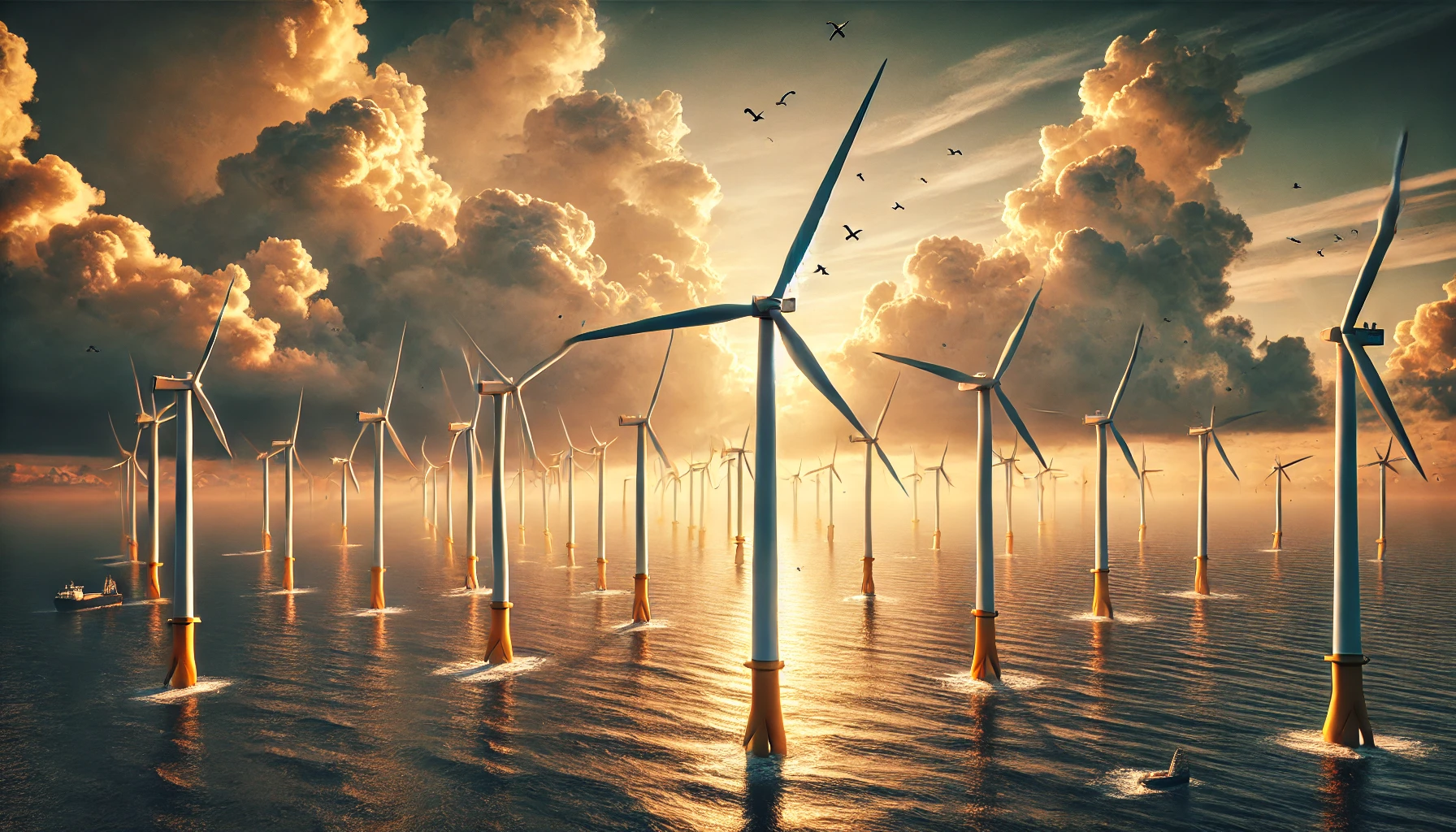
Offshore wind power in particular has great potential as it can take advantage of stable wind conditions and vast ocean areas, and the government is actively promoting its introduction.
However, to realize offshore wind power generation, not only technical and economic challenges but also complex legal regulations must be established. The economic challenges are described in the article above.
In this article, we will first provide an overview of the situation in Europe, the United States, and Taiwan as leading examples of offshore wind power generation around the world, and then summarize the current situation and challenges in Japan.
In addition, we will explain the legal issues in Japan and points that businesses should take note of.
International trends in offshore wind power generation
Leading European examples
Europe is a world leader in offshore wind power generation, with the UK, Germany, Denmark and the Netherlands in particular actively promoting its introduction.
U.K.
The UK is one of the world's leading countries in terms of the amount of offshore wind power it has installed, and has set a target of installing 50GW by 2030.
This success is the result of many years of policy and technical efforts, and is due in large part to the following factors:
Early establishment of a system (introduction of contract for difference (CfD) system)
The CfD system is a mechanism that guarantees a certain level of profit to businesses, and has played a role in increasing the attractiveness of investment while reducing the risk of price fluctuations.
In addition, the government's provision of stable purchase prices has ensured the profitability of projects and created an environment in which many companies can easily enter the market.
National leadership in power grid development
The development of appropriate transmission infrastructure is essential for the success of offshore wind power generation.
In the UK, the state has taken the lead in planning the development of the electricity transmission network, creating an environment in which each project can be smoothly connected to the grid.
This allows operators to focus on generating electricity without having to deal with grid connection issues.
Actively attracting private investment
By ensuring institutional stability and financial support, the UK government has created a market that is attractive to both domestic and international investors.
In particular, the use of public-private partnership schemes and facilitating fundraising have increased the feasibility of projects.
We have also actively engaged in technological development and human resource training to promote industrial development.
The development of such comprehensive policies and systems is believed to be a factor supporting the success of offshore wind power in the UK.
Germany
In Germany, offshore wind power generation is positioned as an important pillar of the energy transition (Energiewende), and development is progressing particularly in the North Sea and the Baltic Sea.
Germany has been promoting decarbonization as part of its energy policy and has been actively working to expand renewable energy. The following are some of the characteristics of offshore wind power generation in Germany:
Public sector to lead grid connection
In Germany, a system has been established in which public authorities take the lead in developing grid connection infrastructure, with transmission operators shouldering the majority of the development costs.
This allows power generation companies to focus on constructing power generation facilities and reduces the uncertainty of grid connection.
In addition, grid expansion plans are drawn up at a national level and projects are coordinated to ensure efficient grid integration.
Ensuring fair prices through a public bidding system
In Germany, new projects are selected through an open bidding system to ensure a fair electricity supply at reasonable prices.
This system promotes price competition and helps reduce the costs of offshore wind power generation.
Securing long-term contracts also reduces risk for investors, supporting sustainable market growth.
Strict implementation of environmental assessments
Germany places great importance on environmental protection, and strict environmental impact assessments (EIA) are required for the development of offshore wind power generation.
In particular, it requires careful assessment of the impact on marine ecosystems and fisheries and the adoption of appropriate environmental protection measures.
To ensure this process goes smoothly, the operator places great importance on consultation with local communities and environmental organisations, and aims for sustainable development.
Thanks to this type of institutional design, Germany is expanding offshore wind power in a planned and stable manner, and is attracting attention as a model case for other countries.
Denmark
Denmark was the first country in the world to develop offshore wind farms and has since established itself as a global leader through continued technological innovation and policy support.
The Danish government has positioned wind power at the heart of the nation's energy supply in its long-term energy policy and is implementing proactive measures to address this issue.
Utilizing the Feed-in Tariff (FIT) system and market-linked support measures
Denmark reduces investment risk by guaranteeing businesses a stable return over a certain period of time, enabling them to plan their business from a long-term perspective.
Also, financial support from the government has made it easier for new entrants to enter the market.
State-led power grid development
By the government taking responsibility for developing the power transmission infrastructure, an environment has been created in which power generation companies can focus on installing power generation facilities.
The government has put in place a long-term grid expansion plan to support the appropriate growth of offshore wind power.
Proper implementation of Environmental Impact Assessment (EIA)
Denmark requires a rigorous Environmental Impact Assessment (EIA) process to minimise environmental impact.
This enables sustainable development while minimizing the impact on marine ecosystems and local residents.
Promoting public-private partnerships
In wind power development, a system has been established in which the government and private sector work closely together to jointly raise funds and develop technology.
This public-private partnership is accelerating the adoption of new technologies and reducing costs.
Promoting innovation
Denmark is home to some of the world's leading wind power technology companies, and government and industry are working together to drive technological innovation.
Active efforts are being made to improve efficiency, including the development of larger turbines and improvements to the seabed foundation structure.
In this way, Denmark has established itself as a global leader in offshore wind power through all-round support of policies, institutions and technology.
Netherlands
Similarly, the Netherlands is actively promoting the development of systems to support the expansion of offshore wind power, with a government-led strategic approach supporting its development. In particular, the following points are cited as key measures:
By having the state take responsibility for grid connection, the burden on developers is reduced, reducing business risks.
In the Netherlands, the government takes the lead in developing the electricity transmission infrastructure, creating an environment in which power generation companies can formulate business plans without being troubled by the uncertainty of grid connection.
This allows developers to focus on installing power generation facilities, making the business more viable.
Adopting a cluster-based development methodology and consolidating multiple projects to optimize cost reduction
To effectively promote the introduction of offshore wind power, the Dutch government is adopting a regional, cluster-based development approach, rather than developing individual power plants one by one.
This approach allows for greater sharing of infrastructure and allows for cost optimization.
It also leads to reduced costs for laying and maintaining undersea cables.
A government-led, long-term bidding system promotes fair competition among power generation companies
In the Netherlands, the government has developed a bidding system with a long-term perspective, providing a fair and transparent competitive environment and improving market efficiency.
Under the government's long-term plan, electricity supply at a fair price is ensured through bidding, creating an environment in which operators can expect stable profits.
Furthermore, the guarantee of long-term contracts also boosts investor confidence, making it easier to raise capital.
Technological innovation and strengthening of industrial infrastructure
The Dutch government is promoting innovation in wind energy technology and supporting the development of domestic manufacturing and supply chains.
This is improving the competitiveness of domestic industries and helping to build a long-term sustainable energy market.
Such comprehensive support measures through collaboration between governments and industry are underpinning the success of offshore wind power in Denmark and the Netherlands.
The Netherlands' strategic approach has enabled efficient expansion of offshore wind power and reduced costs, and its model is likely to continue to attract global attention.
Looking at it this way, Europe can indeed be said to be a leading region in offshore wind power generation.
US adoption trends
In recent years, the United States has been promoting the introduction of offshore wind power generation, primarily along the East Coast.
In particular, New York and Massachusetts have demonstrated leadership, with their state governments providing active support.
Active policy support from state governments
New York and Massachusetts are encouraging offshore wind projects by setting renewable energy targets and offering state-level regulatory relief and financial incentives.
New York State aims to achieve 100% clean energy by 2040, and projects supported by the state government are on the rise.
Meanwhile, Massachusetts has set a goal of having most of the state's electricity supply come from renewable energy sources and is strongly promoting the expansion of offshore wind power.
Stimulating private investment
Proactive state policies have attracted domestic and international investors to offshore wind power projects, encouraging private sector participation.
Many major energy and finance companies are investing, and fundraising for offshore wind power projects is progressing smoothly.
Additionally, the introduction of a power purchase agreement (PPA) system by state governments is also believed to be a factor in ensuring long-term investment stability.
Technological development and infrastructure development
On the east coast of the United States, construction of undersea power cables and port infrastructure is progressing at a rapid pace.
In particular, the ports of Boston and New York are preparing the facilities necessary for the construction and maintenance of offshore wind power plants, and the infrastructure is being established for future large-scale projects.
In addition, technological developments in offshore wind turbines are expected to lead to improved efficiency and power generation.
However, in the United States, the processes of environmental assessment and local consensus building tend to be lengthy, posing a challenge for project delays.
A careful approach to the development plan is required, particularly as it requires consultation with environmental groups and local residents.
In addition, because the laws and regulations governing the construction of offshore wind power generation facilities vary from state to state, operators must properly understand and comply with the regulatory requirements of each state.
Taiwan Success Story
Taiwan is one of the most successful offshore wind markets in Asia, and its success is due to strategic government policies and proactive industry initiatives.
The Taiwanese government has positioned offshore wind power generation as a core part of its national energy strategy and is vigorously promoting the following measures:
Clear policy target (5.7GW by 2025)
Taiwan has drawn up a clear government-led roadmap and set a goal of installing 5.7GW of offshore wind power by 2025. That's this year.
Furthermore, with a view to expanding offshore wind power generation to 15 GW by 2035, the government is implementing policies to support sustainable market growth.
Legislation to attract foreign capital
The Taiwanese government has been developing the legal framework to actively attract overseas offshore wind power developers and investors.
In particular, in order to create an environment that makes it easier for foreign companies to enter the market, measures are being taken to reduce business risks by introducing power purchase agreements (PPAs) with government guarantees.
In addition, the introduction of the feed-in tariff system has established a mechanism that allows power generation companies to earn stable profits over the long term.
Fostering local supply chains
Taiwan is positioning offshore wind power projects as an opportunity for domestic industrial growth, promoting the development of domestic manufacturing and construction industries.
Specifically, the company is increasing investment in industrial sectors such as turbine manufacturing, undersea cable laying and maintenance work, and is promoting collaboration with local companies.
This will promote job creation and technology transfer in Taiwan, and help build a competitive offshore wind market in the long term.
In this way, Taiwan has adopted a comprehensive approach that combines policies, regulations, and industry support to establish a successful model for offshore wind power in Asia.
Current status and challenges of offshore wind power generation in Japan
Current implementation status and government roadmap
Based on the Act on Marine Renewable Energy Utilization, the Japanese government has designated areas to promote offshore wind power generation and is accelerating its introduction, aiming to introduce 10GW by 2030 and 30-45GW by 2040.
To achieve this goal, the government is promoting technological innovation, infrastructure development, and legal reform.
In addition, the Ministry of Economy, Trade and Industry and the Ministry of Land, Infrastructure, Transport and Tourism have taken the lead in setting out policies to encourage more businesses to enter the market by selecting promotion zones and making the bidding system more transparent.
Technical and economic challenges
Offshore wind power in Japan faces the following technical and economic challenges:
Grid connection constraints
The power transmission network is insufficient, and there is a need to strengthen the system to ensure a stable supply of generated electricity.
In particular, in areas where existing transmission infrastructure is inadequate, national and local governments need to work together to expand the transmission network.
High construction costs
The costs of offshore wind power generation are said to be higher in Japan than in Europe, and one of the reasons for this is the immaturity of the domestic supply network.
In addition to reducing costs by increasing the domestic procurement ratio for turbines and foundation structures, it is necessary to promote the efficiency of construction by accelerating technological development.
Adjustment of fishing rights
In areas where offshore wind power plants are being installed, coordination with local fishermen who hold fishing rights is essential, but there are efforts to achieve coexistence with the fishing industry by establishing frameworks for compensation for fisheries and joint use.
Environmental monitoring to minimize the impact on marine ecosystems is also an important issue.
As such, the development of offshore wind power in Japan requires the development of legal systems and cooperation with local communities, and calls for joint efforts by the public and private sectors.
Overview of regulations surrounding offshore wind power generation
Outline of the Marine Renewable Energy Utilization Act
This law establishes promotion zones and introduces a mechanism for selecting businesses through public bidding.
The purpose of this law is to promote the development of offshore wind power in a planned and sustainable manner, and it requires that the selection of operators be transparent and that the impact on the environment and local communities be minimized.
Furthermore, operators are responsible for ensuring a stable supply of electricity from a long-term perspective.
Environmental Assessment Process
Under the Environmental Impact Assessment Act, development takes several years, so a mechanism to speed up the process is needed.
Environmental Impact Assessment (EIA) is carried out from the early planning stages and requires detailed analysis of the impacts of the construction of a wind power facility on marine ecosystems, fishing activities, and local residents.
There are particular concerns about noise, impacts on the marine ecosystem, and changes to the landscape, so it is important to properly evaluate these and gain the understanding of those involved.
To speed up the process, advance coordination and the use of digital technology to streamline the evaluation process are necessary.
Coordination with fishing rights
As mentioned above, in order to move forward with the project, it is essential to reach an agreement with those involved in the fishing industry, and a framework for appropriate compensation and regional coexistence is required.
In Japan, fishing rights regarding the use of marine areas are strongly protected, and the reality is that consultation with fishermen is essential when introducing offshore wind power generation.
Specifically, these could include paying compensation to fishers, developing new fishing techniques to enable coexistence, and introducing programs run jointly by fishers and businesses.
In addition, in order to smoothly reach an agreement with local residents, support from local governments and holding public hearings are also important processes.
Foreign investment restrictions and security
Please note that depending on the progress of the project, etc., there is a possibility that restrictions may be imposed on the entry of certain companies (especially foreign-affiliated companies) in terms of foreign exchange laws and national defense and security.
Many foreign companies are considering entering the offshore wind power generation project market, but the Japanese government is moving to strengthen regulations on certain countries and companies from the perspective of energy security.
In particular, when foreign companies are involved in critical infrastructure, prior screening is required and risks to national security are scrutinized.
This may result in delays to project implementation, so operators need to take appropriate plans and countermeasures.
Japan's Challenges and Potential in Comparison with Europe, the US, and Taiwan
Compared to Europe, the United States, and Taiwan, Japan's offshore wind power generation faces many challenges.
Differences in policy, investment environment, and business schemes have had a particularly large impact, and by analyzing these points in detail, we believe it will be possible to find ways to overcome the challenges in Japan.
Policy
In Europe, the United States, and Taiwan, government support systems are in place, creating an environment that allows businesses to quickly start projects.
In Europe in particular, as mentioned above, efforts are being made to relax regulations, such as by simplifying environmental assessments and giving priority to grid connections, which is helping to make the launch of new projects proceed smoothly.
On the other hand, in Japan, the approval procedures are complicated, and it takes time to complete Environmental Impact Assessments (EIAs) and adjust fishing rights, so the schedule until the start of business tends to be long.
Investment Environment
As mentioned above, power purchase agreements (PPAs) are widespread in Europe, the United States, and Taiwan, creating an environment in which operators can easily secure stable profits.
In the United States in particular, long-term PPAs are often concluded between state governments and power generation companies, creating a market with low risk for investors.
Taiwan is also lowering barriers to entry for operators by introducing government-guaranteed PPAs.
Meanwhile, long-term PPAs are not yet widespread in Japan, and uncertainty in the investment environment remains an issue.
Business Scheme
Overseas, offshore wind power projects are often driven by the private sector, with operators drawing up plans on their own and governments generally providing the necessary systems and infrastructure support.
In particular, as mentioned above, Denmark and the Netherlands have established systems in which the governments are responsible for developing the power transmission network while allowing business operators to freely proceed with projects.
In contrast, Japan has introduced an open bidding system, whereby operators must obtain business rights through a bidding process.
This has resulted in intensifying competition and tougher price wars, while at the same time making it difficult to create flexible development schedules.
Future outlook and legal measures in Japan
The development of offshore wind power in Japan requires the development of a legal environment and flexible regulations. The following points are important for the future outlook:
Possibility of deregulation
Currently, offshore wind power projects in Japan require a long period of time for procedures such as environmental assessments and consensus building with local residents. In Western countries, systems have been established to simplify these procedures while striking a balance between environmental protection and community coexistence. In Japan, too, deregulation measures such as speeding up environmental assessments and simplifying permit procedures are being considered in order to accelerate development. It is also important to streamline procedures for grid connection and increase the availability of the power grid.
Legal risks that businesses should be aware of
The reality is that offshore wind power generation involves a wide range of legal risks, including contractual relationships, environmental regulations, foreign investment restrictions, and coordination with fishing rights.
In particular, regulations regarding the use of marine areas are strict, and you must pay attention to the rules of each local government.
In terms of contracts, as contractual relationships between power generation companies, transmission companies, and investors become more complex, there is a need to clarify risk allocation and responsibilities.
In addition, social factors must be taken into consideration, such as the risk of litigation due to lack of coordination with fishing industry stakeholders and opposition movements by environmental protection groups.
Dispute Avoidance
In offshore wind power projects, we believe that communication from an early stage is important for project operators to avoid conflicts with local residents and fishing industry.
Transparent disclosure of information and the establishment of councils to gain the understanding of the local community appear to be effective measures.
There is also a need to create a mechanism in which national and local governments can act as intermediaries and support consensus building.
In contractual relationships, we believe it is effective to formulate a comprehensive legal strategy to avoid risks and to introduce arbitration clauses and consensus-building mechanisms in preparation for any disputes that may arise.
As such, we believe that strategic responses to deregulation, legal risk management, and dispute avoidance will be necessary to support the future of offshore wind power in Japan.
summary
I have written a lot so far, but the development of offshore wind power in Japan requires the establishment of legal regulations, and we need to design a system unique to Japan while taking into consideration examples from Europe, the United States, and Taiwan.
I hope this article will be helpful to you.




comment