✅ Roughly speaking
- ⚡ Battery Energy Storage Systems (BESS) are becoming a critical infrastructure supporting power systems in the era of expanding renewable energy.
- 📉 However, while contract applications are rapidly increasing in Japan, actual interconnection and operation are still limited.
- 💹 There are likely to be multiple barriers to commercialization, including revenue source bias, waiting for connections, regional agreements, and technical standards.
- 🧭 Going forward, the accuracy of system design and contract practices is expected to have a major impact on the success or failure of the battery storage business.
Introduction
This time, we will explain grid-based storage batteries.
As the adoption of renewable energy continues to expand, ensuring the stability of the power system has become an unavoidable issue.
Solar and wind power are the main sources of decarbonization, but as the output fluctuates depending on the weather, without the ability to adjust to accommodate this, the more power introduced, the more difficult it becomes to operate the system.
That's where grid-based batteries are becoming more prominent.
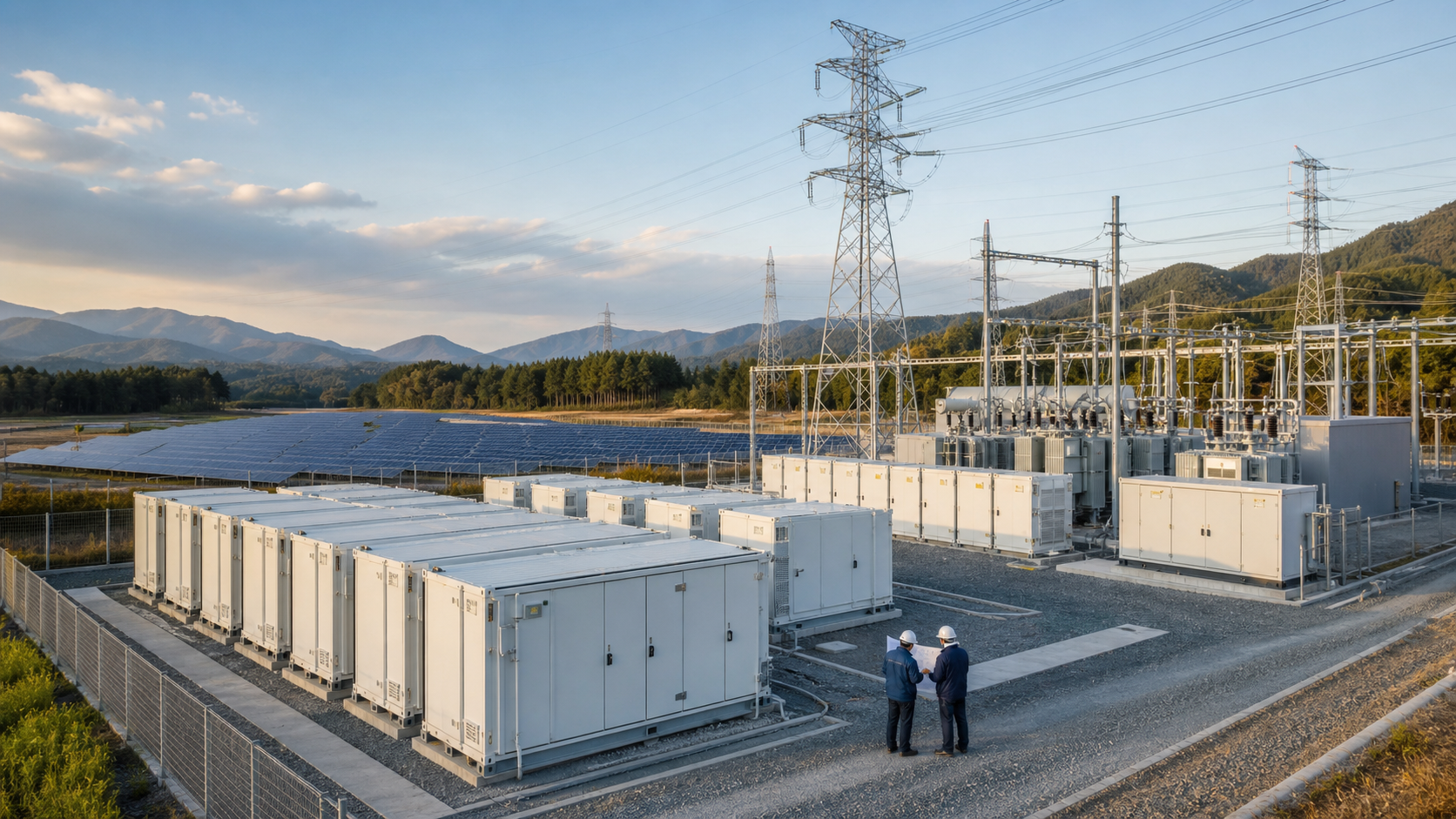
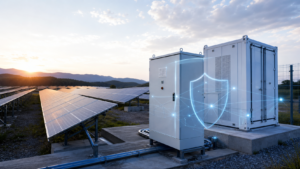
A grid battery is a large storage facility that is directly connected to the power transmission and distribution network (grid) and is used to adjust the supply and demand balance of electricity.
Although it simply uses electricity and discharges it when needed, in reality it is a facility that plays extremely multifaceted roles, such as frequency regulation, ensuring power supply, absorbing power fluctuations, and alleviating grid congestion.
It can also be seen as a being that can change the very design philosophy of the power system.
However, while expectations are high, institutional and business friction is already evident on the ground.
This time, we will clarify why grid-based batteries are important, and then summarize the challenges hindering business expansion in Japan and practical implications for the future.
Why grid-based batteries are attracting attention
Traditional power systems have been designed with the understanding that storing electricity on a large scale is difficult.
Therefore, the general principle is "simultaneous equal quantity," which always matches supply and demand.
However, as the proportion of variable renewable energy (Variable Renewable Energy, VRE) increases, the cost of maintaining this principle will rise rapidly.
There is excess sunlight during the day and a lack in the evening.
The supply varies greatly between windy and non-windy days.
There are limits to the structure that can compensate for all these fluctuations with firepower.
At this stage, grid batteries will no longer be merely "backup equipment," but will become a core piece of equipment that supports the flexibility of the power system.
This is because it functions not only as a short-term supply and demand adjustment, but also as a supply force for a certain period of time, and in some cases can contribute to easing constraints on the power grid.
In the era of mass adoption of renewable energy, the position of storage batteries as one of the infrastructure projects is expected to increase even further in the future.
Current situation in Japan – High expectations, but implementation is still limited
In Japan, where we are at our feet, expectations for grid-based batteries are extremely high.
However, the pace of actual implementation is still limited compared to the magnitude of expectations.
First, the magnitude of expectations is reflected in the application figures.
As of the end of September 2025, applications for grid battery contracts nationwide (excluding Okinawa) reached approximately 24 million kW (Source: Agency for Natural Resources and Energy, "Response to Rapid System Interconnection of Power Generation and Other Equipment, Including System Batteries" (February 9, 2026) ).
This is about 3.9 times the year-on-year increase, a significant increase compared to the only 1.1 times increase in solar power generation during the same period (Source: Marubeni New Power "What is a grid battery? Background to the surge in adoption and 『air-pushing』 countermeasures ).
The number of connection review requests is also expected to surge in fiscal year 2024, about six times the number in the previous year (Source: SOLAR JOURNAL: "Applications for connection of grid-based batteries are increasing dramatically" ).
On the other hand, the number of cases that actually resulted in interconnection and operation is very small compared to the number of applications.
For example, battery connections that have been implemented with the "additional early interconnection measures" to enable early grid connection have accounted for only about 3% of the total capacity, about a year after the system was introduced (Source: Agency for Natural Resources and Energy (February 9, 2026) ).
The contract applications are said to include many cases with uncertain prospects for commercialization, raising concerns about so-called "flying" (Source: Agency for Natural Resources and Energy (February 9, 2026) ).
The figures show that while there is very strong interest in the battery storage business, there is a major blockage somewhere between case formation, connection, construction and start of operation.
In other words, Japan has not yet escaped the "expectation-first" stage.
Walls hindering business expansion① Waiting for connections and backlogs
Given the significant gap between contract applications and production, the first issue we need to address is the system connectivity problem.
It appears that some of the submitted cases are not likely to be commercialized or will not progress for a long period of time.
When these cases become stagnant, businesses that really want to move forward quickly end up lining up behind them, and the system framework is not being utilized effectively.
In response to this issue, the government is taking measures to combat "air-clearing."
Specifically, provisional measures such as increasing the guarantee amount at the time of contract application and reviewing the rules for installment payments of construction cost contributions will be applied to cases for which contract applications are received from April 2026 onwards (Source: Agency for Natural Resources and Energy (February 9, 2026) ).
This issue is not merely procedural, but affects investment decisions themselves.
For cases where the connection date cannot be read, it becomes difficult to assemble equipment procurement, financing, and EPC (Design, Procurement, Construction, Engineering, Procurement, and Construction) contracts.
Therefore, transparency in connection reviews and streamlining prioritization are considered to be issues at the heart of investment potential rather than battery storage policies.
Walls that prevent business expansion② Revenue source bias
Another major issue is the bias in the revenue model.
Current grid batteries tend to rely heavily on supply-demand regulation markets, particularly the value paid for their regulation power, ΔkW (delta kilowatts, or standby and response capacity) (Source: Agency for Natural Resources and Energy, "Profitability Analysis of Supply-Demand Adjustment Markets for System Storage Systems" (November 11, 2024) ).
This is understandable as an early phase market, but as a business foundation it's an unforgiving side.
This is because a high degree of reliance on a specific market makes it easily affected by institutional changes and price fluctuations.
In fact, in supply-demand adjustment markets, discussions are underway regarding the optimization of recruitment volumes and the review of price caps, and there is no guarantee that the high price levels will continue (Source: Agency for Natural Resources and Energy, "About Supply-Demand Adjustment Markets" (December 12, 2025) ).
The strength of grid batteries lies not in their single value, but in the fact that they can be monetized by layering multiple values.
The idea of accumulating revenue across multiple layers is necessary, including supply and demand adjustment, capacity value, arbitration in the wholesale electricity market (utilizing price differences on the Japan Electric Power Exchange 〔JEPX〕), the addition of renewable energy, and, in the future, the value of avoiding grid congestion.
Unless this area grows, it is unlikely that batteries will remain "equipment to be invested in because of the system" and become "assets to be invested in because of the market."
Walls hindering business expansion③ Regional agreements and environmental risks
Since grid batteries are not power generation equipment, they may appear to have little regional coordination at first glance.
However, in practical terms, it's not that simple.
Battery storage facilities have issues that local residents are likely to be sensitive to, such as noise associated with power conditioning systems (PCS) and cooling equipment, perceived discomfort in the landscape, concerns about disaster prevention, and concerns about fire.
In recent years in particular, local scrutiny of renewable energy equipment in general has become stricter, and it is becoming increasingly common for businesses to not proceed simply because "there are no legal issues."
In this regard, even in battery storage cases, if we do not provide explanations to residents, disaster prevention measures, noise control measures, and share emergency response flows from an early stage, we may stumble significantly in the later stages.
From a legal standpoint, I believe that regional agreements should be treated not as “voluntary agreements”, but as a de facto business foundation.
Barriers to business expansion④ Immature technical standards and evaluation systems
Even if batteries are the same "batteries," their value will vary greatly depending on the application, time frame, and level of response performance required.
Therefore, if the system does not have appropriate technical standards and performance evaluation rules in place, even excellent equipment will not be properly evaluated.
In particular, for functions that are deeply involved in system stabilization, future institutional development is expected to directly impact business performance.
This point is more of a market design issue than a problem for equipment manufacturers.
To translate technological innovation into business, a set of rules is needed to enable performance and a market that pays for it.
If this situation remains ambiguous, it seems unlikely that investors or financial institutions will be able to move boldly.
Walls that hinder business expansion⑤ Supply chains and economic security
The battery storage business is both an energy policy and an industrial policy.
When the supply destinations for cells and key components, which account for a significant portion of equipment costs, become unbalanced, they become more susceptible to price fluctuations, supply constraints, and geopolitical risks.
Especially in large-scale projects, this must be considered in terms of supply responsibility, performance assurance, maintenance systems, and the continuous supply of replacement components.
The more cases we have in the future, the less we can get away with thinking, "I just need to buy it cheaper."
How you design your entire supply chain, including the distribution of sources, contractual guarantees, and the effectiveness of your maintenance structure, is likely to determine the stability of your business.
Perspectives that will be important in future practical work
Looking at this point, it becomes clear that the issue of grid-based batteries is not simply about introducing equipment.
Institutional design, contracts, finance, regional coordination, and supply chains are all intertwined.
In that sense, it is likely that at least the following three points will be important in future practical work.
The first is to design the project with the assumption of multi-layered revenue.
Cases that rely on a single market tend to be vulnerable to institutional changes, and the valuations of financial institutions tend to be less stable.
The second is to look at connectivity, licensing, and local response together from the initial stages.
Even if the line is established, it will stop due to residents' needs.
Even after the equipment is decided, there is a dispute over maintenance responsibility.
These discrepancies are likely to result from poor design in the early stages.
The third is to view batteries as an independent infrastructure asset, rather than as an appendage of the reenergy project.
When you switch between these, the contract design, financing, and risk allocation change quite a bit.
summary
Grid batteries are a vital infrastructure supporting power systems in the era of mass adoption of renewable energy.
Rather than being a single-function facility for supplying electricity, it can take on multiple functions, such as supply and demand regulation, ensuring supply capacity, and responding to grid constraints, which is expected to further enhance its position in the future electricity market.
However, while contract applications are piling up significantly in Japan, actual interconnection and operating capacity are still small, and revenue streams are unevenly distributed.
There are many barriers that need to be overcome, such as connectivity systems, regional agreements, technical standards, and supply chains.
Conversely, from here on out, it seems we are not at the stage of discussing whether batteries are important or not, but rather at the stage of figuring out how to make the business a viable one.
When systems, markets, and contractual practices come together, we believe that grid batteries will be the first truly game-changer.



comment