✅ Roughly speaking
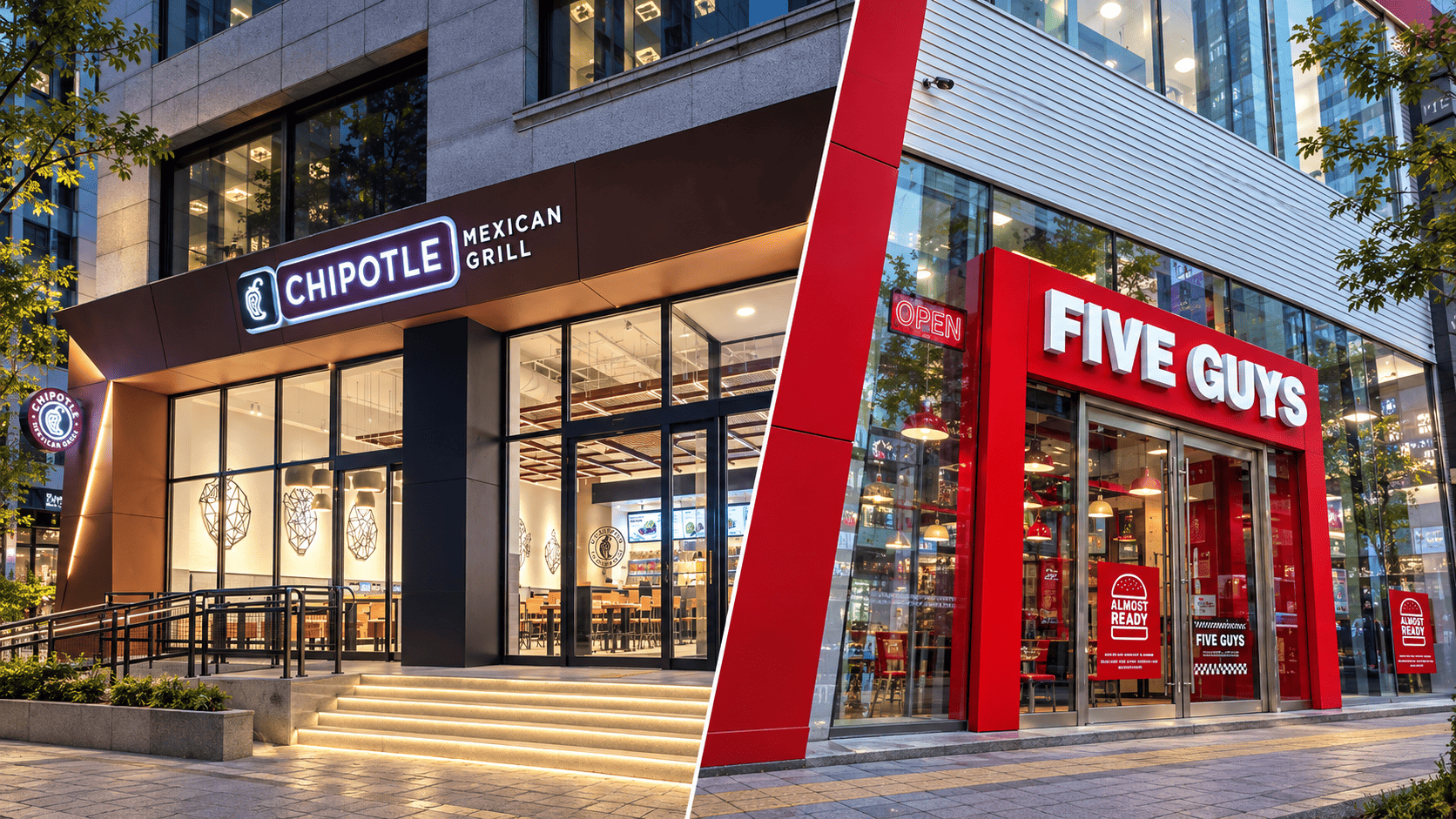
・🇰🇷 When I visited Seoul the other day, I saw Chipotle and Five Guys and wondered why they weren't in Tokyo yet.
・🍔 In the background, there are not only simple differences in food culture, but also the presence of Korean companies that have discovered overseas brands and expanded locally.
-🇯🇵 Japan is a huge dining market, but with so many existing options, it is not an easy market for overseas brands.
・💡 But if you change your perspective, the market entry support itself, "bringing the next Chipotle or Five Guys to Japan," can be one business.
Introduction
This time, I will explain the differences between Japan and Korea among overseas food restaurants that I felt during a recent business trip to Seoul.
When I go abroad, I like to see local restaurants.
Rather than being a famous restaurant, I'm more concerned with things like, "This chain doesn't exist in Japan."
The other day, while walking around Seoul, I noticed Chipotle Mexican Grill (hereinafter referred to as "Chipotle"), a Mexican fast-casual chain originating from the United States.
A well-known chain in the United States, they offer burritos, tacos, and burrito bowls where you can choose your own fillings.
I used to frequent this store when I lived in the United States, and it's one of the stores I always visit when I'm on a business trip to the US.
On the other hand, you won't see Chipotle in Tokyo.
Furthermore, Seoul is also home to Five Guys, a hamburger chain originating from the United States.
Five Guys also does not yet have a retail store in Japan.
So a simple question arose.
Why these American food-eating brands are coming to Seoul before Tokyo.
After doing a little research, it seemed that cultural theories such as "Korea prefers American culture" were not enough to explain the situation, and that there were significant differences in the companies and business structures that supported overseas brands entering the market.
And, upon further reflection, this doesn't seem to be just a story about the restaurant industry.
This also gave me an opportunity to think about the job itself: "entering the market" by bringing overseas products and services to Japan.
The Chipotle I saw was the first store in Asia
After some research, I found that Chipotle was a fairly timely store.
Chipotle official announcement According to the report, Chipotle opened its first Asian store on September 2, 2026, on Gangnam-daero in Seocho-gu, Seoul. This happened just last week.
And it's not just about opening one store in Korea.
Chipotle has positioned South Korea as a "reference market," or benchmark market, for expanding its business in Asia in the future.
The Korea business will be operated through a joint venture with South Korea's Sangmidang Holdings (formerly SPC Group).
Sangmidang Holdings provides knowledge and store management experience in the Korean restaurant market, and is responsible for ingredient sourcing, cooking methods, employee education, and store management.
Also, Chipotle The company plans to open two more stores in South Korea by the end of 2026 and expand into Singapore in 2027 We have made this public.
Therefore, the Seoul store is not simply one of our overseas stores.
For Chipotle, stores are designed to create a model for the Asian market
That has the meaning.
I find it very interesting that the strategy is to first choose South Korea, rather than Japan, which has a huge dining-out market, and then create a model there before expanding into Asia.
A similar structure can be seen in Five Guys
If you also look into Five Guys, you'll see a similar structure.
Official Hanwha documents According to Five Guys, they expanded into South Korea in 2023.
The company operating in South Korea is Hanwha Galleria, a subsidiary of the South Korean Hanwha Group.
Hanwha Galleria's department store business is its main focus, and it handles a wide range of products, including direct procurement and exclusive sales of overseas brands, as well as food and beverage businesses.
According to Hanwha company documents, the company will introduce Five Guys to South Korea in 2023 and will operate eight stores, including Gangnam and Yeouido, as of 2026 .
The important point here is that Five Guys did not board the train to South Korea alone.
Korean companies that understand the Korean market and have capabilities in real estate, brand business, and store operations are becoming "the ones bringing Five Guys to Korea."
Sangmidang Holdings also plays that role at Chipotle.
Additionally, Sangmidang Holdings has a track record of introducing several international dining out brands to Korea, including Shake Shack.
So this is not just a coincidence for one company.
There are companies in South Korea that bring overseas brands
This was the most interesting thing I was looking into this time.
When it comes to expanding into overseas dining brands, it's easy to focus on whether the food will be served locally.
But just as important is Who will bring the brand to the site That's the point.
When an overseas brand enters Korea, the Korean company will perform the following functions, for example:
・Negotiations with brand headquarters
・Securing potential store locations
・Employee recruitment and education
・Food procurement and logistics network construction
・Local marketing
・Daily store operations
From our overseas headquarters perspective, we don't need to build all of this ourselves from scratch.
Moreover, companies like Sangmidang Holdings and Hanwha Galleria not only have the financial resources but also the existing know-how in retail, food and beverage, real estate, and brand businesses.
In other words, Korea has Finding brands that are growing globally, securing expansion rights in Korea, and growing brands locally There are players who conduct this as a business.
This is a little different from the cultural explanation that "Korean people like American brands."
It's an industrial structure story where there are companies that connect brands and markets.
Seoul is easy to create initial buzz about
Another thing that comes to mind is Seoul's urban structure.
In South Korea, consumption, media, and youth culture are concentrated in the Seoul metropolitan area.
Setting up a flagship store, especially in a place like Gangnam, makes it easier to reach office customers, young people, tourists, and those who share information on social media all at once.
Chipotle Mo Five Guys They also established their first store in Korea in Gangnam.
Of course, Tokyo also has strong business areas such as Shibuya, Shinjuku, Marunouchi, Roppongi, and Ginza.
However, due to its sheer size, both the consumption space and the flow of information are dispersed across multiple regions.
The strategy of "having a flagship store in Gangnam and creating buzz throughout Korea first" may be relatively easy for overseas brands to portray.
However, this does not mean that if you go to Seoul, you will definitely succeed.
The topic of discussion and the long-term benefits are two different things.
So why don't you come to Japan
However, it's not as simple as saying, "There are no companies in Japan that introduce overseas brands."
There are many examples of overseas brands being introduced in Japan.
Shake Shack has also expanded into Japan, and if it expands beyond food and beverages, it is not uncommon for Japanese companies to introduce overseas brands.
Furthermore, there are no particularly high institutional barriers to foreign companies conducting business in Japan.
JETRO Information As stated above, foreign companies can conduct ongoing business in Japan through the establishment of Japanese corporations, registration of branches, and joint ventures with Japanese companies.
Of course, when actually operating a restaurant, it is necessary to address individual issues such as food hygiene, labeling, employment, imports, and store development.
However, I think it's difficult to explain why Chipotle and Five Guys aren't available in Japan with just one regulation.
Even so, Tokyo isn't always the first destination.
One reason for this may be that the Japanese restaurant market is already very mature.
Even just for hamburgers, there are numerous chains and independent shops both domestically and internationally.
Furthermore, restaurants serving the same types of food are not the only places that are truly fierce competitors for international food brands.
If you're thinking about having lunch in Japan, you have the following options:
・Beef bowl
・Ramen
・Soba, udon
・Curry
・Set meal
・Bento
・Convenience store
Moreover, you can expect above-average quality across a wide range of price points.
This is a pretty tough market for international dining brands.
Setting higher prices simply because something is "popular in the US" doesn't guarantee that customers will continue to come.
Price isn't the only challenge in the Japanese market
Five Guys features product attention to detail, including using potatoes that are cooked to order and cut in-store.
Therefore, this brand is prone to higher prices than typical fast food.
If you bring this model straight to Japan, you need to be careful about whether you will be able to accept consistently high prices simply because it is a famous burger overseas.
The same goes for Chipotle.
In the United States, burrito bowls are one of the lunch choices that office workers and others make on a daily basis.
However, if the price becomes higher than the existing lunch price in Japan, the extent to which it becomes a regular part of everyday food is another matter.
In addition to price, there are many challenges in adapting to the Japanese market.
・Ability to source raw materials stably in Japan
・To what extent to recreate the taste and brand experience of the home country
・Changing product quantities and menus to suit Japanese consumers
- Ability to absorb high rents and labor costs
・Can it be moved to everyday use rather than just a temporary topic
Therefore, I don't think it's a matter of "Japanese people don't like foreign food."
Rather, Japan is a huge and attractive dining market, but it is also a challenging market for new entrants due to the wide range of consumer choices available It seems more accurate to think of it that way.
Still, there are quite a few overseas brands that have not yet entered Japan
On the other hand, we can also look at this situation from a different angle.
When I go abroad, I come across a lot of brands that are so famous, I wonder why they don't exist in Japan.
It's not just Chipotle or Five Guys.
There are some restaurant brands that have already opened multiple stores overseas and established a certain business model, but have not yet fully entered the market in Japan.
From this perspective, there is no need to "wait for overseas brands to come to Japan."
Rather, from the Japanese side, It would be interesting to bring this brand to Japan You can also think about it and move.
The idea of finding the "next Chipotle" in the early stages of growth
Naturally, it's not easy to go and get the rights to expand into Japan after Chipotle becomes a global giant.
Your competitors will also be large corporations.
I think what's actually interesting is the stage that comes a little before that.
For example, the following overseas brands:
- A certain number of stores are operated in the home country, and the business model has been proven
・A certain level of brand recognition has been achieved
・Starting overseas expansion
・The rights to expand into Japan have not yet been decided
・The menu is relatively simple
・You can set reasonable price ranges even in Japan
In other words, Look for Chipotle and Five Guys when they were still in their early stages of growth That's the idea.
Although business models have already been proven overseas, no one has brought them to Japan yet.
If we can support our expansion into the Japanese market at this stage, we have the potential to create significant business value.
However, it cannot be determined based solely on superficial conditions such as the number of stores.
It is necessary to verify, one company at a time, whether or not they have the right to operate in Japan, the contract terms, the required capital, the cost structure, the trademark, the supply network, etc.
You don't need to run your own restaurant
Here's something I found even more interesting.
When you do this kind of business, you don't necessarily have to be a restaurant owner yourself.
For example, we will discover overseas brands and consider the possibility of expanding into Japan.
We will then negotiate with our overseas headquarters to find Japanese restaurant operators and investors.
If necessary, we will establish a Japanese corporation or joint venture (hereinafter referred to as "JV") and enter into master franchise agreements (Master Franchise Agreements) and area development agreements (Area Development Agreements).
Actual store operations may be handled by companies with experience in restaurant management.
In this case, the value we offer is not "the ability to make hamburgers."
Ability to connect overseas brands with the Japanese market
Yes.
For example, the following features are possible:
・Discovering overseas brands
・Research into the Japanese market
・Negotiations in English with overseas headquarters
・Selection of store operators on the Japanese side
・Coordination with investors
・JV composition
・Negotiation of contracts such as franchise agreements
・Trademarks and other intellectual property support
・Confirmation of food regulations and labeling
・Collaboration with experts in real estate, logistics, and human resources
From the perspective of overseas companies, finding each of these partners individually would be a considerable burden.
Therefore, if we can provide a system like the "Japan Market Entry Platform" that summarizes the functions necessary to enter the Japanese market, it could become a business.
Revenue isn't just about store profits
When supporting market entry, the revenue stream is not limited to store profits.
For example, the following combinations are possible:
・Rewards for support in market research and entry planning
・Success rewards for introducing partners and store operators
- Compensation for professional services such as contract negotiations, company formation, and regulatory response
・Investment interest in JV, which operates in Japan
- Compensation for ongoing business development and brand management
However, the actual amount of compensation you receive will depend on negotiations with the brand headquarters, Japanese operators, and investors.
Attention must also be paid to constraints and conflicts of interest in franchise agreements.
Therefore, rather than assuming a grand nationwide expansion from the start, I think it is more realistic to first search for candidate brands, confirm the expansion rights in Japan and the intentions of headquarters, and verify their profitability.
Summary
The starting point this time was a simple question: "Why do Seoul have Chipotle and Five Guys, but Tokyo doesn't."
Upon investigation, there isn't just one reason.
・There are Korean companies that continuously discover overseas brands
- Local companies take on funding, stores, personnel, logistics, and marketing
・Easy to create buzz from flagship stores in Seoul
・There are many options for dining out in Japan, making it difficult for new entrants
These factors are thought to overlap.
Therefore, we should not simply conclude that "Korea prefers American culture."
Rather, what is noteworthy is the presence of companies that stand between overseas brands and the domestic market, enabling them to expand.
And this also presents a business opportunity for Japan.
Instead of chasing after brands that have already become famous, find the next international brand to grow early on.
The brand will combine businesses, investors, and experts who understand the Japanese market, providing them with the necessary capabilities to enter the market.
If we can do that, we should be able to make entering the Japanese market a business without having to run a large number of stores ourselves.
From a restaurant I found on a business trip, I unexpectedly saw a new form of business.





Comment