
✅ Roughly speaking
- 🌏 There are many mid-sized companies that are considering overseas expansion but are stopping for "reasons why they can't do it"
- 💊 The "excusitis" pointed out in the famous book "The Magic of Thinking Big" published in 1959 also applies to overseas expansion
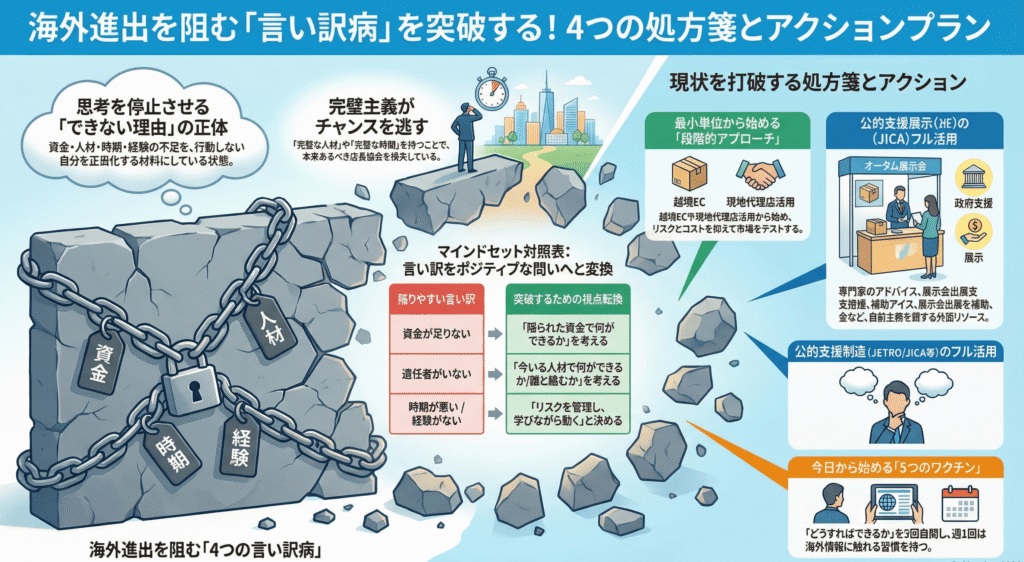
- 🔍 Explaining the identity of the four major excuses of "funds", "human resources", "timing", and "lack of experience" and specific ways to deal with them
- ✅ From "just thinking" to "moving" with a practical action plan using the public support system
✅ Audio summary of this post here
Introduction
In this article, we will explain the "thinking traps that prevent overseas expansion" and how to break through them for managers and business managers of medium-sized companies who are considering overseas expansion but are unable to take the first step.
As a lawyer, I have been involved in supporting domestic and foreign companies to expand overseas, and I have witnessed the reality that many blue-chip companies stand still with "reasons why they can't do it."
There are many companies that have technical and product capabilities, but miss opportunities because "the time is not good" or "there are no human resources".
In this article, we will apply the concept of "Excusitis" advocated in the famous book "The Magic of Thinking Big" published in 1959 and still read around the world, to the context of overseas expansion, and even explain specific ways to deal with it.
What is the "Excusitis" that prevents overseas expansion?
The Magic of Thinking Big's Obstacles to Success
In his book The Magic of Thinking Big, Dr. David J. Schwartz cites "Excusitis" as the biggest factor that prevents people from achieving their goals.
This "excuse disease" refers to a psychological state in which you look for "reasons why you can't" and convince yourself not to act by justifying it.
Dr. Schwartz points out that there are four main types of the disease.
- Health Excusitis ("Health Excusitis")
- "Intelligence Excusitis"
- Age Excusitis ("Age Excusitis")
- Excuse of Luck ("Luck Excusitis")
These excuses can have a profound impact not only on individual careers but also on corporate decision-making.
Overseas Publishing "Four Excuse Diseases"
Applying this concept to the context of overseas expansion, the "excuse disease" that medium-sized companies tend to fall into can be classified into the following four categories.
- Financial Excusitis — "Not enough money"
- "Human Resource Excusitis" — "Not the right person"
- "Timing Excusitis" — "It's a bad time"
- "Experience Excusitis" — "No Overseas Experience"
Below we will look at the identity of each excuse and specific countermeasures.
Excuse (1): "Insufficient funds"—Financial Excusitis
The identity of this excuse
The belief that "overseas expansion requires a huge amount of money" is one of the most common excuses.
Certainly, if you want to build a large manufacturing base or set up a local subsidiary from scratch, you will need a reasonable amount of money.
However, behind this excuse, it is often believed that the reality of "not knowing exactly how much money you need" or "not knowing your financing options" is often hidden.
Prescription: Step-by-Step Approach and Diversification of Financing
✅ Specific Action 1: Start with the smallest unit
Overseas expansion does not necessarily have to start with the establishment of a local subsidiary.
A step-by-step approach is possible:
- Start with a local agency contract (outsource sales to a local company)
- Test sales on cross-border e-commerce (using our own website and overseas e-commerce platforms)
- Establishment of a representative office (main purpose is market research and information gathering, lower cost than local subsidiaries)
In particular, JETRO (Japan External Trade Organization) provides support for digital sales channel development with low initial investment, such as sales support on an online catalog site dedicated to overseas buyers called "Japan Street" and an overseas e-commerce site called "JAPAN MALL".
✅ Concrete Action 2: Utilize Public Assistance Systems
There are several public systems in Japan that support the overseas expansion of small and medium-sized enterprises.
-
JETRO (Japan External Trade Organization) Overseas Expansion Support
JETRO assigns experts to trade information centers nationwide to provide support for exhibiting at overseas trade fairs and exhibitions, holding business meetings with overseas buyers, and conducting market research. -
Overseas Expansion Advisor System of the Small and Medium Enterprise Infrastructure Development Organization
The Small and Medium Enterprises Organization provides free consultations by experts with extensive experience and support for the preparation of overseas business plans. -
JICA (Japan International Cooperation Agency) Small and Medium-sized Enterprises and SDGs Business Support Projects
JICA provides the "Small and Medium-sized Enterprises and SDGs Business Support Project (JICA Biz)" to support the creation of businesses that contribute to solving problems in developing countries. There is a support menu according to the stage, such as needs confirmation surveys and commercialization demonstration projects. -
Global Framework for Manufacturing Subsidies
The manufacturing subsidy has a "global quota" for efforts to increase domestic productivity through overseas business, and can receive subsidies of up to 30 million yen. -
Overseas expansion support subsidies for each prefecture
Some local governments may have their own overseas expansion support systems. We recommend checking with your local government.
✅ Specific Action 3: Collaboration with Partner Companies
You don't have to cover everything yourself. Collaboration strategies such as
- Business alliance with a Japanese company that has already established a local presence
- Establishment of a joint venture with a local company
- Utilization of local networks for trading and logistics companies
Important perspective shift
Thinking about "what can be done with limited funds" rather than "how much is needed" makes it possible to take the first step in overseas expansion.
Excuse (2): "There is no suitable person"—Human Resource Excusitis
The identity of this excuse
The excuse of "no one who is fluent in English, has overseas experience, and understands our business" is a typical pattern.
However, this excuse may be too much of a "perfect person." Also, it seems that there are many cases where thinking stops on the premise that "I am not in the company".
Prescription: 3 strategies of "raising", "borrowing", and "assembling"
✅ Specific Action 1: "Nurturing" Strategy
If you don't have the perfect talent, you have the option of nurturing them.
- Dispatch existing employees to the site for short-term training (1 to 3 months)
- Use of online language training (use of corporate programs)
-
Participation in JETRO's Small and Medium Business Overseas Business Human Resource Development School
JETRO offers two courses: the "Training School" for developing overseas business for small and medium-sized enterprises, and the "training school" for those who have already exported their skills.
✅ Specific Action 2: "Borrow" Strategy
It is also helpful to use the help of an outside expert.
- Utilization of external consultants (lawyers, accountants, overseas expansion consultants)
- Consultation with local members of the Japanese Chamber of Commerce and Industry
-
Utilization of the Small and Medium Enterprises Organization's Overseas Expansion Advisor
At the Small and Medium Enterprises Organization, experts with extensive practical experience provide free consultations. - Immediate Recruitment in Professional Human Resources Business (Prefecture)
✅ Specific Action 3: "Assemble" Strategy
There is also a way to complete it in-house and partner with a partner.
- Partnerships with local partner companies (utilizing local human resources and know-how)
- Active use of local recruitment (local human resources who can speak Japanese, Japanese living locally)
- Outsourcing (outsourcing legal, accounting, marketing, etc. to local experts)
-
Utilization of JETRO's Local Support Platform for Overseas Expansion of Small and Medium-sized Enterprises
JETRO has established the "Small and Medium-sized Business Overseas Expansion Local Support Platform" composed of local partner organizations to support the facilitation of local business activities.
Important perspective shift
Rather than "waiting until there is the perfect person", the idea of thinking about "what can be done with the current talent" and "who can do it" will be a breakthrough.
[Excuse (3)] "It's a bad time now" - Timing Excusitis
The identity of this excuse
Excuses about timing, such as "exchange rate instability", "political uncertainty", and "uncertainty of the future of the economy", sound the most convincing.
However, the reality is that "perfect timing" never comes.
Behind this excuse is likely a tendency to overestimate risks and underestimate opportunities.
Prescription: "Ready now" "Set withdrawal line"
✅ Specific action 1: Start collecting information "now"
While you wait for the actual expansion, you can start gathering information now.
-
Regular check of JETRO's overseas research reports
JETRO's website provides information on the latest local economic conditions and business environment from approximately 70 overseas offices around the world. - Participation in a field trip (JETRO, sponsored by the Chamber of Commerce and Industry)
- Online interaction with local Japanese networks
-
Watch JETRO's International Business Information Program
Since 2000, JETRO has been distributing an international business information program called "The World is Now - JETRO Global Eye" through the Internet and other means.
✅ Specific Action 2: "Try" with a small start
You can do small testing before making a big investment.
-
Test marketing (exhibiting at exhibitions, participating in online business meetings)
JETRO supports exhibiting at overseas trade fairs and exhibitions in the Japan Pavilion, and holds domestic business meetings with overseas buyers. - Pop-up store for a limited time
- Short-term contract with local agency (1-year renewal, etc.)
✅ Specific Action 3: Set the withdrawal line in advance
It is important to set withdrawal criteria in advance to manage risks.
- Set quantitative withdrawal criteria (e.g., withdraw if you don't turn a profit within 2 years)
- Clarify the upper limit of initial investment (e.g., up to ○○ million yen in the first year)
- Plan for phased investment (Phase 1→ Phase 2→ Phase 3 and phased evaluation)
Important perspective shift
Rather than "waiting for the perfect timing", the mindset of "moving while managing risk" is the key to seizing opportunities.
Excuse (4): "I have no overseas experience" - Experience Excusitis
The identity of this excuse
Excuses based on lack of experience, such as "I don't have experience in operating overseas bases like a large company" or "What if I fail?" are especially strong when expanding overseas for the first time.
But we must not forget about the fact that every enterprise had its "first steps".
Behind this excuse seems to be "perfectionism" and "excessive fear of failure".
Prescription: "Move forward while learning" "Weaving in failure"
✅ Specific Action 1: Learn from other companies' examples
Even if you're new to your company, you can learn from companies that are already successful.
- Research on JETRO's Successful Overseas Expansion Cases
JETRO publishes successful cases of overseas business of small and medium-sized enterprises, and you can learn how to deal with practical issues, such as how to find "human resources to lead overseas business" and "local business partners". - Participation in JETRO Seminars
- Benchmarking examples of overseas expansion of other companies in the same industry
- Research on the Small and Medium Enterprise Agency's "Overseas Expansion Case Study"
✅ Specific Action 2: Have an expert "accompany you"
Lack of experience can be compensated for with professional support.
- Consulting contract with a lawyer or accountant who is familiar with overseas expansion
- Contract with a local consultant (initial escort support)
-
Utilization of JETRO's New Exporting Countries Consortium
JETRO provides hands-on support from experts in collaboration with local governments and financial institutions nationwide. - Exchange with mentor companies (matching with senior companies through JETRO, etc.)
✅ Specific Action 3: A culture that tolerates "small mistakes"
It is important to position it as a "learning opportunity" rather than avoiding failure altogether.
- Positioning as an experimental project (not risking the fate of the entire company)
- Regular review meetings (discuss progress, issues, and improvement measures on a monthly basis)
- Shared Failure Culture (Sharing Learnings from Failures Internally)
Important perspective shift
The key to success is not "I can't do it because I don't have experience", but a positive attitude of "I will continue to learn because I have no experience".
Overseas Publication "Excuse Disease Vaccine" - 5 Actions to Start Today
Dr. Schwartz advocates concrete actions as a "vaccine" against excuse disease.
If you arrange it for overseas publishing, it will be the following five.
✅ Vaccine 1: Ask yourself "how can I do it?" three times
When faced with a problem, he recommends getting into the habit of asking yourself "how can I do it" at least three times, not "why I can't do it".
Example
- ❌ "I can't do it because I don't have the funds."
- ✅ "How can I do it with limited funds?" What are the financing options?" How to proceed step by step?"
✅ Vaccine 2: Once a week, get information about overseas expansion
Set aside 30 minutes every week to read articles, reports, seminar videos, etc. related to overseas expansion.
By continuing to be exposed to information, the "reasons why you can't do it" will decrease.
The JETRO website offers a "My Page" function to receive new information tailored to your interests.
✅ Vaccine 3: Talk to experienced people once a month
One person a month talks to the managers and people in charge of companies that have achieved overseas expansion.
You can be introduced by JETRO, the Small and Medium Enterprises Organization, the Chamber of Commerce and Industry, industry associations, etc.
✅ Vaccine 4: Update local information quarterly
Once every three months, we review the latest information on the target market (economic trends, regulatory changes, competitive conditions, etc.).
We will use JETRO's overseas research reports, local media, and inquiries to experts.
✅ Vaccine 5: Review your expansion plan once every six months
Every six months, review your overseas expansion plan and reconsider what you can do in the current situation.
The situation is constantly changing. What was impossible six months ago may be possible now.
Summary: From "just thinking" to "moving"
The biggest barrier to overseas expansion may not be the market or regulations, but the "excuse disease" within ourselves.
The Magic of Thinking Big teaches us the power of thinking big.
Rather than looking for "reasons why you can't do it", thinking through "how to do it" will surely open the way.
The four excuses, their prescriptions, and the five vaccines introduced in this article are concrete actions that can be implemented today.
Why not start with small steps such as "contact the JETRO website once a week for overseas expansion information" and "talk to experienced people once a month"?
Overseas expansion is by no means a privilege only for large companies.
We believe that by leveraging the mobility, flexibility, and expertise that a mid-sized company possesses, we can achieve success in new markets by "thinking big."
Japan has a full range of public systems in place to support the overseas expansion of small and medium-sized enterprises, such as JETRO, the Small and Medium Enterprises Organization, and JICA. There is no reason not to take advantage of these.
As a lawyer, I have witnessed the difference between "companies that have taken a step forward" and "companies that have remained stagnant" while supporting many companies to expand overseas.
The difference may not have been ability or funds, but "way of thinking".
Please start taking the first step in your company's overseas expansion today.









comment