1. Introduction
This time I will explain about "green iron."
In recent years, with growing interest in sustainability, there is a growing demand for corporate activities to take into consideration environmental, social and governance (ESG) factors.
Among these, reducing carbon dioxide (CO2) emissions has become a key issue that is directly linked to a company's competitiveness and brand value.
The steel industry is said to account for approximately 7-9% of global CO2 emissions, making decarbonization an urgent task. Against this background, the development and use of "green steel" has attracted attention.
Green steel is also becoming an important option in corporate supply chains.
Many people may not have heard much about green iron until now, but we will explain its overview, overseas trends, the significance of its introduction, and the challenges it poses. We will also consider how it can be used as a business strategy from an ESG perspective.
2. What is green iron?
Green steel refers to steel products whose manufacturing process significantly reduces CO2 emissions.
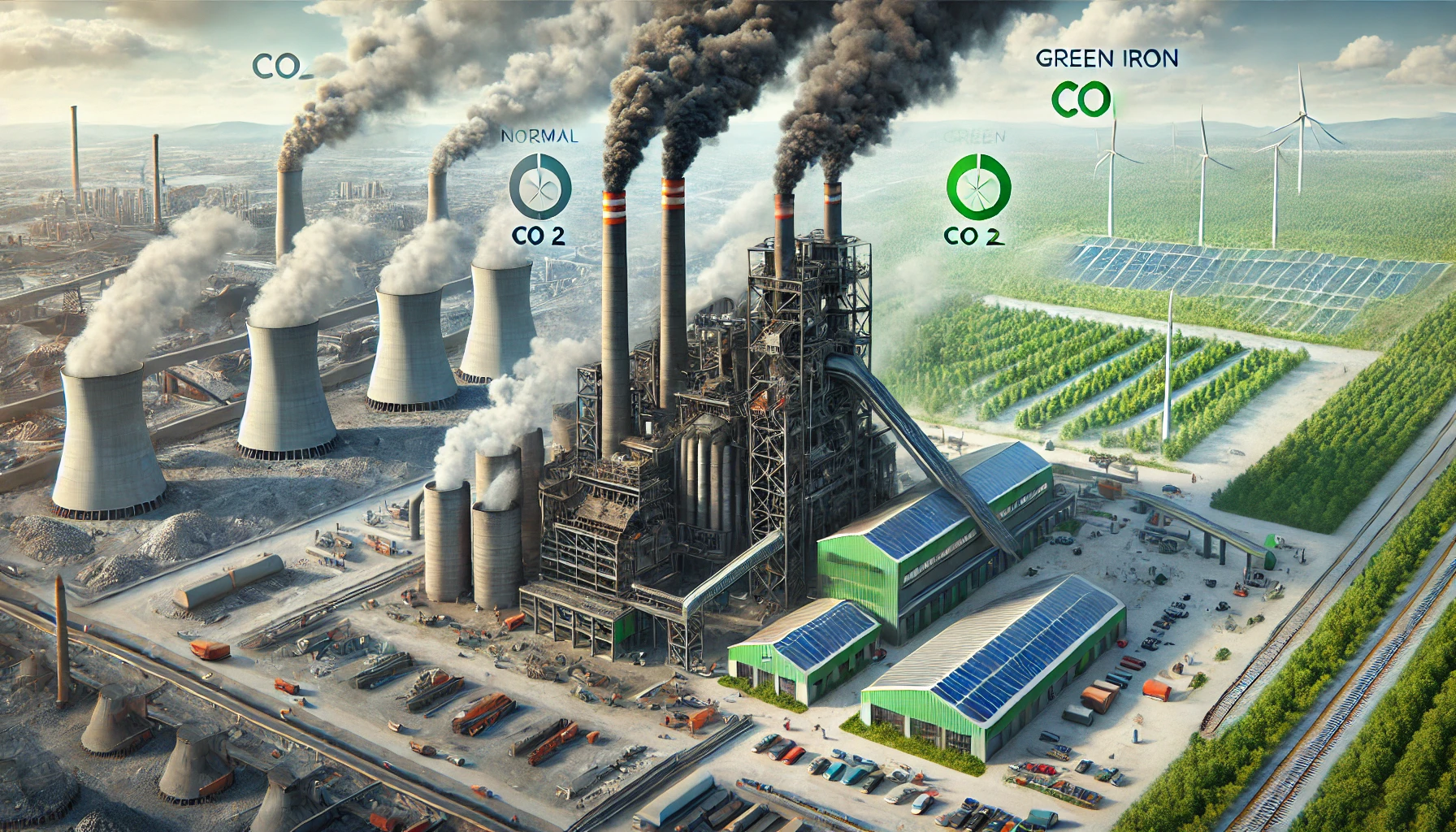
Conventional steel production relies on a reduction process using blast furnaces, which uses large amounts of coal (coke) and emits large amounts of CO2.
On the other hand, green iron reduces the environmental impact by using the following techniques:
(1) Hydrogen reduction ironmaking
This technology uses hydrogen instead of conventional coal to reduce iron ore.
This allows for carbon-free steel production as water (H2O) is emitted instead of CO2.
However, issues such as a stable supply of hydrogen and the cost of production remain, and efforts are currently underway to develop technology and reduce costs.
(2) 電炉 (EAF, Electric Arc Furnace)
This is a method of melting scrap iron using electricity.
In particular, when combined with renewable energy, it is possible to significantly reduce CO2 emissions.
The key points in introducing an electric furnace are a stable supply of scrap iron and quality control.
(3) Carbon Capture and Storage (CCS) Technology
This is a technology that captures CO2 generated during the steel production process and stores it underground.
This method is expected to be a promising short- to medium-term measure because it can reduce CO2 emissions while using existing blast furnaces, but there are issues with cost.
(4) Biomass reduction
This is a method that aims to achieve carbon-neutral steelmaking by using biomass fuels instead of conventional coal.
However, a stable supply of biomass and improved reduction efficiency are required.
3. Introduction of Green Steel and Business Strategy
The introduction of green steel will not only address environmental issues, but will also contribute to ensuring economic competitiveness and improving the company's brand.
Traditional steel manufacturing emits large amounts of CO2 and is considered a high-risk business amid calls for measures to combat climate change.
On the other hand, promoting the use of green steel could lead to improved regulatory compliance, improved investor and consumer evaluations, and more sustainable corporate management.
(1) Improved evaluation from the perspective of ESG investment
In recent years, ESG investment has expanded rapidly, with investors placing great importance on companies' environmental measures.
By utilizing green steel, companies can concretely demonstrate a reduced environmental impact, which can lead to improved ESG scores.
Particularly in large capital markets, meeting ESG standards has a significant impact on the investment decisions of institutional investors.
(2) Low carbonization of the entire supply chain
Steel is the foundation material for many industries and is used in a wide range of sectors, including automotive, construction and manufacturing.
Therefore, by introducing green steel, companies can promote decarbonization throughout their entire supply chain.
This is a key element in providing a sustainable product to the company's trading partners and customers.
(However, compared to option (1) above, it may be a bit more difficult for many companies to incorporate this into their business.)
(3) Improving competitiveness by reducing carbon footprint
As international regulations, such as the EU's Carbon Border Adjustment Mechanism (CBAM), become stronger, reducing carbon footprints is directly linked to maintaining corporate competitiveness.
By adopting green steel, companies can reduce carbon tax burdens and ensure price competitiveness in the international market.
I plan to write a separate article on carbon footprints.
(4) Improving brand value and gaining consumer support
As the number of environmentally conscious consumers increases, offering sustainable products will help increase your brand's value.
By actively promoting the use of green iron, you can improve your company's image and differentiate yourself in the market.
4. Challenges of Green Iron
There are several major challenges to the widespread use of green iron, and solving these will likely be essential to its widespread use.
Specifically, despite progress in technological innovation and policy support, challenges remain, including costs, infrastructure, certification systems, and supply chain transformation.
(1) Cost Issues
Currently, producing green steel is more expensive than the traditional steelmaking process.
In particular, hydrogen reduction steelmaking, as described in 2.(1) above, requires the development of hydrogen production costs and supply networks, and unless costs are reduced, widespread adoption is likely to be difficult.
(2) Necessity of infrastructure development
The construction of a large-scale hydrogen supply network is essential for the widespread adoption of hydrogen reduction steelmaking.
However, hydrogen infrastructure is currently not in place, and there is a need to establish mass production technology for green hydrogen and expand its distribution.
(3) Unification of certification systems
Green iron standards and certification systems vary from country to country and region to region, making it unclear which standards companies need to meet.
It is necessary to establish uniform international standards, and cooperation between companies and with regulatory authorities is required.
(4) Coordination across the supply chain
Efforts are needed not only from the steel industry, but from all companies that use steel, including the automotive, construction, and energy industries.
Cooperation between companies and policy support are essential, and cross-industry initiatives need to be promoted.
5. Summary
Green steel will help decarbonise the steel industry and play an important role in companies' ESG strategies.
Especially in light of strengthening international regulations and changes in the market, it is expected to become an essential element for companies to maintain and improve their competitiveness.
In the future, it will be necessary to establish a sustainable manufacturing process while overcoming cost and technical challenges.
By adopting green steel, companies can not only reduce their environmental impact, but also create new business opportunities and contribute to a sustainable future.
It will be important to keep a close eye on future trends and think strategically about how to incorporate them into your company's supply chain.


comment