
Introduction
This time I will explain about JCM.
The Joint Crediting Mechanism (JCM) is an international framework led by the Japanese government for reducing greenhouse gas (GHG) emissions.
Under this scheme, Japan and partner countries will cooperate to promote the introduction of energy-saving and renewable energy technologies, and the resulting GHG reductions will be recognized as credits between the two countries.
In recent years, as ESG investment expands and efforts to achieve carbon neutrality accelerate, the use of JCM credits is becoming an important option for companies.
In this article, we will explain the JCM system, the latest system trends, how to obtain and utilize it, success stories, and legal points to note.
What is the JCM?
The JCM is an emission reduction scheme promoted by Japan as part of international climate change measures.
This is a mechanism in which Japan and partner countries jointly implement projects aimed at reducing GHG emissions, and the results of these reductions are recognized as credits.
For companies, it has become an important tool that can not only be used as a means to meet international emission reduction obligations, but also provide economic incentives.
Basic Concept and Mechanism of the JCM
The basic mechanism of the JCM is for Japan to provide advanced low-carbon technologies and for partner countries to introduce them, thereby achieving GHG reductions in a mutually beneficial manner. For Japan, this system supports the sustainable development of partner countries while contributing to its own decarbonization policy.
The general mechanism is shown in the table below.
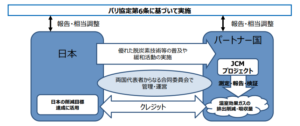
(Reference: JCM Equipment Subsidy Program/Co-Innovation Program Public Call for Proposals April 12, 2021 )
GHG reductions are recognized as credits that can be traded on the international market, making it an advantageous system for companies as well.
Furthermore, through the JCM, the Japanese government aims to strengthen its leadership in international climate change measures.
A major feature of the JCM is that it goes beyond simply providing funds; it also involves technology transfer and capacity development.
This will simultaneously promote economic growth and decarbonization in partner countries, creating a sustainable business environment in the long term.
Cooperation with Partner Countries
As of 2025, the JCM has concluded agreements with more than 25 partner countries, with countries in Southeast Asia, Africa, Latin America, and elsewhere actively participating.
In particular, in countries such as Indonesia, Vietnam and Thailand, numerous renewable energy and energy conservation projects are being developed and cooperation between Japanese companies and local governments is being strengthened.
Through cooperation with these countries, the Japanese government is providing technical assistance and project funding. For example, energy efficiency projects are promoting the introduction of high-performance boilers and energy-saving lighting systems, which have resulted in significant GHG reductions.
In addition, to ensure the transparency and credibility of the JCM, the Japanese government is working with international organizations and third-party certification bodies to audit and verify projects.
This has resulted in JCM credits being internationally recognized, expanding the possibility of mutual recognition with other countries.
Benefits for businesses
For companies, using JCM credits has the following advantages:
These may not be benefits unique to the JCM, but they can be achieved through the JCM.
Promoting a carbon neutral strategy
Through the JCM, emissions reduction targets can be achieved and companies' sustainability strategies can be strengthened.
Improving international market competitiveness
Building an environmentally conscious business model will lead to the promotion of ESG investment and improved evaluation from business partners.
Financial incentives
Clean technologies can be introduced with the help of subsidies, tax incentives, and financial assistance from the government.
Promoting overseas market development
Through projects that utilize the JCM, it is possible to enter emerging markets and strengthen relationships with local governments and companies.
Improved corporate branding
By promoting decarbonized management, we can demonstrate our contribution to global environmental initiatives and increase our corporate value.
In this way, the JCM is not simply a means of reducing emissions; it is a system that is directly linked to corporate growth strategies and strengthening competitiveness, and we encourage its active use.
Latest System Trends
The JCM has attracted particular attention among international emission reduction schemes, and its role is becoming increasingly important due to recent regulatory reforms and policy trends.
In particular, as its position under the market mechanisms of the Paris Agreement has been clarified, changes have been made to the operation of the JCM and the process of issuing credits, making it easier for more companies to utilize it.
Position of the JCM under Article 6 of the Paris Agreement
As shown in the diagram above, the JCM is recognized as one of the frameworks related to Article 6 (market mechanisms) of the Paris Agreement (which has recently been in the news due to U.S. President Trump signing an executive order to withdraw from the agreement), and is expected to play an important role in the future international carbon credit market.
Article 6 of the Paris Agreement encourages the integration and utilization of international carbon markets, and the JCM is positioned as part of this effort.
This creates a mechanism through which Japan can provide advanced low-carbon technologies and work with partner countries to reduce greenhouse gas emissions.
The JCM has become an effective tool for achieving each country's reduction targets (Nationally Determined Contributions), and is being utilized particularly in developing countries as a form of technology introduction and financial assistance.
The credits generated between partner countries and Japan are expected to be used for trading in international markets and for complying with domestic environmental regulations.
Recent changes to regulations and guidelines
In 2024, the JCM's operating rules were partially revised to improve the transparency of the credit issuance process and strengthen third-party verification, standardize project monitoring methods, tighten data management, and strengthen reporting requirements.
This has increased the credibility of the credits, making it easier for more companies to take advantage of the JCM.
In addition, the methodology for measuring reductions has been revised to improve the efficiency of JCM projects and expand the range of applicable technologies.
This will enable the JCM to be applied to new industries and technology fields, increasing the possibility of a wider variety of projects being approved.
Government support and subsidy information
The Japanese government continues to offer subsidies of up to 50% to JCM projects. These subsidies cover part of the costs of technology introduction, capital investment, and project operation, creating an environment in which companies can more proactively utilize the JCM.
In addition, the low-interest loan system for private companies provides low-interest loans for projects aimed at reducing the environmental impact, thereby easing the financial burden on companies.
In particular, preferential conditions have been set for renewable energy businesses and energy conservation projects, and mechanisms have been put in place to encourage companies to invest.
In addition, the Japanese government is providing expert advisory services to companies utilizing the JCM, strengthening support from project launch to implementation and credit utilization.
In particular, for small and medium-sized enterprises, this type of specialized support can help them avoid situations where they don't know what they don't know, and it could even serve as a catalyst for them to join the JCM.
How to obtain and use JCM credits
In order to obtain and utilize JCM credits, we believe it is important to understand the process of selecting appropriate projects, complying with registration procedures, and issuing and trading credits.
Below, we will briefly explain the steps that companies can take to effectively obtain and utilize JCM credits.
Project registration process
To start a JCM project, the following procedures must be followed:
Feasibility Study (FS)
To verify the feasibility of the project, we will carry out studies including environmental impact assessment and technical assessment.
Applicable methodologies will be selected and the feasibility of introducing necessary equipment and technology will also be considered.
Submitting your application
An application form detailing the project will be submitted to the partner country's government and the JCM managing organization.
At this time, you will be required to estimate the amount of GHG emissions that can be reduced, as well as provide a financial plan and technical specifications.
Methodology Approval
The reduction techniques (methodologies) used in the project must be reviewed and officially approved by the JCM Management Body.
Simplified procedures are possible when using methodologies that have been adopted in the past, but additional review is required when new technology is introduced.
Project Registration
Once all reviews have been completed and the project has been approved, it will be officially certified as a JCM registered project.
After this, we move to the actual project implementation stage.
Process for issuing credit cards
After a project is registered, credits will be issued in the following order:
Monitoring
Project operators are required to regularly monitor their GHG emission reduction performance and report to the JCM Management Organization.
Measurement methods and data collection processes are strictly defined, and proper records are required.
Third-party verification
An independent certification body (Designated Operational Entity) will examine the submitted reduction performance data and report the result of certification to the JCM Management Body.
Issuing credits
Once certification is complete, JCM credits will be issued according to the amount of reductions.
The credits will be used to help companies fulfill their GHG reduction obligations, carbon offset, emissions trading, etc.
Legal points that companies should take note of
We believe that companies involved in JCM projects should take note of the following points:
Contractual responsibility allocation
It is necessary to clarify the responsibilities for project management and operation, and to clearly allocate risks in contracts with partner companies and the government.
Handling of intellectual property rights
It is important to establish patent and license agreements in advance to protect the technology and know-how used in the project.
Tax implications
It is necessary to understand in advance the tax burden associated with JCM credit transactions and the tax incentives available in the local country, and to make appropriate declarations and plans.
Compliance with Environmental Regulations
Projects are required to be operated in a manner that complies with the environmental regulations of the target country, and attention must be paid to penalties if violations are discovered.
In this way, by understanding the process from the JCM project registration procedure to credit issuance and legal considerations, and by making careful plans, it is possible to lead the project to success.
Promoting JCM projects using private funds
JCM projects can be expanded more widely by utilizing private funds in addition to government support.
In particular, there are an increasing number of cases where the JCM is used as part of corporate social responsibility (CSR) activities and ESG investments.
Below, we explain the measures to promote JCM projects that utilize private funds.
Guidance on structuring projects centered on private funds
Traditionally, government support has been the main focus, but recently, JCM projects have also been formed with private funding.
On the other hand, for private companies to launch a JCM project, they need to carefully consider many factors, such as diversification of funding, technical cooperation, and legal risk management.
Specifically, it will be necessary to utilize a variety of financing methods, such as private investment funds, green bonds, and bank loans, to ensure the sustainability of projects.
In addition, when starting up a business, cooperation with the government of the target country and international organizations is essential, and it is important to establish appropriate contractual structures and consensus.
Success stories
Specific examples of successful projects include the following:
Biomass power generation project in Indonesia
This project was implemented as a joint venture with local companies, with Japanese companies providing financial and technical support, and has achieved an annual reduction in CO2 emissions of 300,000 tons by utilizing local agricultural waste to generate electricity.
Energy Efficiency Project in Vietnam
A major manufacturing company has taken advantage of the JCM to introduce technologies to improve the energy efficiency of its factories, successfully reducing CO2 emissions by 50,000 tons per year, and this has been recognized as part of the company's environmental management strategy.
Solar power generation project in Thailand
Japanese companies are working with local companies to install solar panels on the roofs of their factories, reducing energy costs through self-generation and earning carbon credits.
Risk management and legal considerations
When private companies proceed with JCM projects, they need to be aware of the following risks:
Funding risks
To reduce financing uncertainty, it will be necessary to negotiate with multiple lending institutions to secure diverse and stable funding sources.
Risk of policy changes in partner countries
Because local government environmental policies may change, contracts should include flexibility clauses.
This is something to be particularly careful about in emerging countries, where the risk of policy change is high.
Compliance Risk
It is necessary to establish an appropriate management system while receiving advice from experts so that we can respond to changes in environmental regulations and tax systems in each country.
Business continuity risk
Building trusting relationships with local companies is essential to the long-term success of the project, and a strategy for strengthening collaboration is required.
Taking these points into consideration, prior risk assessment and appropriate strategy formulation are essential to ensure the success of a JCM project.
Latest news and case studies
The JCM scheme continues to evolve as a key component of international climate change action, attracting increasing interest from companies and government agencies.
Below, we will introduce the latest news related to the JCM and some success stories from Japan and abroad, and briefly introduce how the system is actually being used.
Recent JCM-related news
The scope of application of the JCM is expanding, with new JCM agreements being concluded with African countries in 2024. In particular, support for the introduction of renewable energy is being promoted in countries such as Kenya, Nigeria, and South Africa, and several projects have been launched with technical cooperation from Japanese companies.
The Japanese government is also strengthening frameworks for technology transfer and financial assistance to these countries, and has launched new policies to promote projects utilizing the JCM.
Furthermore, revisions to the international rules related to the JCM system are being discussed, in particular with regard to mutual recognition of credits and increased transparency in the evaluation of partner countries' contributions.
This is creating an environment in which Japanese companies can utilize JCM credits more effectively.
Examples of initiatives by domestic and international companies
An increasing number of Japanese companies are actively taking advantage of the JCM. For example, one major energy company has achieved a reduction of 100,000 tons of CO2 emissions per year through a biomass power generation project in Indonesia.
Additionally, in Vietnam, major manufacturers are using the JCM to introduce energy-saving equipment, thereby contributing to reducing the companies' carbon footprint.
Furthermore, there are an increasing number of cases of cooperation with European companies, and global emission reduction schemes utilizing the JCM are progressing.
In this way, by utilizing the JCM, Japanese companies are in a position to promote decarbonization in global supply chains and improve their international reputation.
Industry Trends and Future Outlook
The JCM market is expected to expand further in the future due to the strengthening of the Paris Agreement framework.
In particular, the integration of carbon credits into the international market through the JCM is progressing, which may create new business opportunities for companies.
Furthermore, with progress in intergovernmental negotiations, there are moves to simplify the certification process for JCM projects.
Furthermore, demand for JCM projects is growing in emerging countries, with interest in renewable energy and energy efficiency projects growing especially in Asia and Africa.
This opens the way for Japanese companies to proactively utilize the JCM and contribute to sustainable economic development.
summary
We believe that JCM credits are an effective means of supporting companies' carbon neutral strategies and contributing to the achievement of international emission reduction targets.
We hope that you will deepen your understanding of the JCM system and how to utilize it, and put it to practical use.









comment