✅ Roughly speaking
- ⚡ The upper limit price for combined commodities, primary adjustment power, and secondary adjustment power① in the supply-demand adjustment market has been reduced from the actual supply-demand price on September 1, 2026 to 10.00 yen/ΔkW for 30 minutes (Source: About the Power Supply and Demand Adjustment Power Exchange (EPRX) ΔkW Upper Price Limit ).
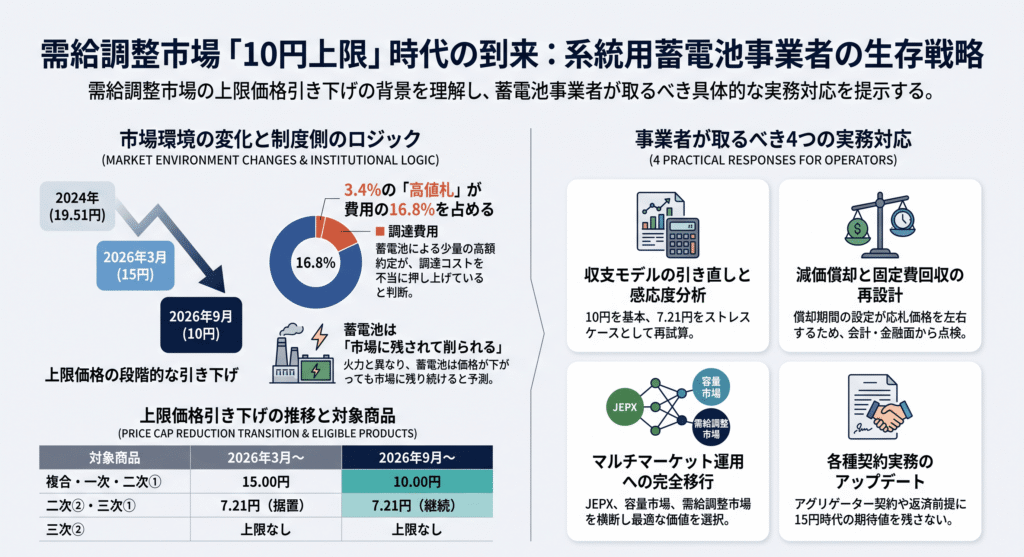
- 📉 This is not a one-off price reduction, but a milestone in a gradual reduction of 19.51 yen (2024) → 15 yen (March 2026) → 10 yen (September 2026), and the system does not say "stop at 10 yen" (Source: Agency for Natural Resources and Energy, 4th Working Group on Stable Electricity Supply, Document 6 ).
- 🔍 The core of the reduction is the cost structure, with high price allocations near the upper price limit accounting for approximately 16.8% of procurement costs, even though they were only about 3.4% in volume, and it has been explained that many of these high price tags were filled with batteries (Source: Document 6 ).
- 🔋 For grid battery storage operators, this is likely to be a time when they will not only switch their income and expenditure model assumptions to 10 yen, but also rethink their capital policy and bid strategy, going beyond why their bid unit price will be higher (the relationship between depreciation periods and fixed cost recovery).
Introduction
This time, we will explain the reduction in the upper price limit in the supply-demand adjustment market from the perspective of a grid battery storage operator.
Starting with the actual supply and demand period on September 1, 2026, the upper limit prices for compound commodities, primary adjustment power, and secondary adjustment power① in the supply and demand adjustment market have been reduced to 10.00 yen/ΔkW for 30 minutes (Source: EPRX ).
The "yen/ΔkW·30 min" referred to here is not a unit of value paid for the amount of electricity actually delivered (kWh), but for the ability to wait and react as a regulating force (ΔkW).
In other words, what has been implemented this time is the upper limit of the portion that the battery earns by "being on standby."
What you really need to read about this point is not the "price has fallen" aspect.
There are two reasons why the system moved the upper limit at this time, and why the revenue assumption, which relies on high price adjustments near the upper limit, will become less effective in the future.
Below, we will use the confirmed figures in the primary data to delve into the logic of the system and the actions that battery storage operators should take.
What's decided – Set a fixed price on the price list
First, check the confirmed numbers.
According to the price cap table published by the Electric Power Reserve eXchange (EPRX) on July 30, 2026, the price cap trend is as follows (Source: EPRX ).
The combined product, primary adjustment force, and secondary adjustment force① was reduced from 19.51 yen (effective from April 2024) to 15.00 yen (effective from March 14, 2026), and then to 10.00 yen (effective from September 1, 2026).
On the other hand, the secondary adjustment force ②and tertiary adjustment force① will remain unchanged at 7.21 yen, and the tertiary adjustment force② will continue to have no upper limit.
It is important to note here that the explanation "secondary adjustment force② is not included in this case" means.
This does not mean that the price is yet to be determined, nor does it mean that it will remain at 15 yen.
Regarding secondary adjustment capacity ②and tertiary adjustment capacity①, the results of the 96th Institutional Review Working Group meeting have been resolved, and the current 7.21 yen will remain in place for the time being (Source: EPRX ).
The forum that decided on this reduction was the 4th Electricity Stability and Supply Working Group meeting held on July 14, 2026 (Document 6, "On Supply-Demand Adjustment Markets," Agency for Natural Resources and Energy) (Source: 4th Power Stability Supply WG ).
It is safe to maintain a two-tiered approach: the primary information in the figures is the EPRX price list, and the background to the decision is the meeting materials of the Agency for Natural Resources and Energy.
Why it was lowered – "Improved, but not enough competition"
The reasons for the reduction are written quite frankly in Document 6.
The starting point is the market changes after the day-ahead trading of composite goods in March 2026 (Source: Document 6 ).
Comparing the period before and after the day-ahead trading, the "shortage rate," which is the lack of bids relative to the volume offered, improved from 14.6% to 5.3% for composite goods, and from 46.3% to 16.1% for primary adjustment force.
Looking at the numbers alone, the market is clearly improving.
However, Document 6 concludes that while the amount of bids exceeded the amount offered on a one-day basis, there were still times when shortages occurred on a 30-minute frame basis, making it "difficult to assess that the competitive situation in the market has improved."
In other words, the system's assessment is that "improvements have been made, but it cannot yet be said to be competitive."
Furthermore, the system's biggest problem was the distortion of the cost structure.
For composite products, the amount of high values exceeding 14 yen/ΔkW·30 minutes is only about 3.4% of the total amount of period③④ in terms of volume.
However, that small amount of high-value contracts accounted for approximately 16.8% of the total procurement costs.
Before trading the previous day, this ratio was even higher, at 35.0% of costs compared to 6.2% of volume.
The small price tag disproportionately drives up the overall procurement costs.
While market prices themselves are free, accountability regarding the appropriateness of costs is not free, as procurement costs are ultimately widely recovered through entrusted fees.
It is natural to read that lowering the upper limit price is a check from the cost side to limit this "small amount, high cost" commitment.
Why storage batteries are priced near the upper limit
What grid battery operators cannot overlook is the fact that many of their high price tags were filled with batteries.
Document 6 names batteries as a power source that often has bids near the upper price limit, and goes into the reasons why (Source: Document 6 ).
The main reason is that batteries account for a large proportion of fixed costs.
In particular, if the depreciation period is set short, the depreciation expense for that fiscal year will be large.
Under the supply-demand adjustment market guidelines, fixed expense recovery is calculated up to the amount obtained by subtracting other market revenues from fixed expenses, including depreciation expenses, for the current fiscal year. Therefore, the shorter the depreciation period, the more fixed expenses that should be recovered in that year, which is a factor in the increase in the bid unit price.
The accounting depreciation period varies from business to business, and is generally set at around 6〜20 years, based on tax law periods, manufacturer's warranty periods, etc.
This is extremely important in practical terms.
The fact that the battery was priced near the upper limit was not simply a bullish price, but a consequence of the fixed cost recovery mechanism and amortization design.
Therefore, the measure to lower the upper price limit from 15 yen to 10 yen is a change that directly reduces the "earnings ceiling" for battery storage, and the impact is greater for cases where the depreciation period is kept short.
It is not enough to simply replace the assumption of the income and expenditure model with 10 yen; it is necessary to simultaneously check the method of setting the depreciation period for the company's business and the assumption of recovering fixed costs.
Asymmetry in bidding behavior – batteries are "left behind and cut down"
If the price cap is lowered, who will behave and how.
Document 6 shows that, as a result of business interviews, the bidding behavior is asymmetrical depending on the power supply type.
It is said that firepower and pumping often calculate bid prices based on opportunity costs, and many people refrain from bidding on the market if the price exceeds the upper limit.
On the other hand, many people responded that they would continue to bid on batteries and VPPs (Virtual Power Plants) even if the bid price was lowered, after comparing their profitability with other markets.
This asymmetry speaks to the intention behind the current system design.
If the upper limit is lowered, some of the thermal and pumping power will be removed from the market, but this can be replaced by procurement using surplus power, and it has been stated that there will be no immediate disruption to ensuring coordination.
In other words, from the institutional perspective, even if the upper limit is lowered, battery storage and VPPs will remain on the market, while the high gross profit margins will be reduced.
For battery storage companies, this is not about being "driven out of the market," but rather about being "left behind and having the ceiling of price caps lowered."
That's why, rather than competing on a single market, the design power of which panels to use to capture value across wholesale electricity markets (JEPX, Japan Wholesale Electricity Exchange), capacity markets, and supply-demand adjustment markets is more crucial than ever to competitiveness.
"10 yen is a passing point" – Gradual reductions were announced
This 10 yen increase is not a sudden measure.
Document 6 clearly states that at the 110th Institutional Review Working Group meeting, if there is no improvement in the competitive situation in the market after trading the previous day, the upper limit prices of primary, secondary①, and combined products will be gradually reduced from 15 yen to 10 yen, 7.21 yen, etc. (Source: Document 6 , 110th Institutional Review Working Group ).
This reduction is an extension of this phased policy.
Document 6 states that even after the reduction, in order to ensure an appropriate competitive environment and sufficient opportunities for contracts, the overall state of market competition and the procurement of adjustment power, including outside the market, will be continuously reviewed, and the amount of offers and the price limit will be reconsidered as necessary (Source: Document 6 ).
In other words, 10 yen is designed as a passing point, not a goal.
For grid battery operators, the practical solution is not just to consider "how to adapt to 10 yen."
It seems likely that the question is to get ahead of the question of how to create an investment and capital policy that can be passed at 10 yen or at the next level, 7.21 yen.
Practical implications for businesses and investors
Based on this, we will summarize the practical responses of grid battery storage operators and the investors and financial institutions that support them.
Firstly, we need to readjust our balance of payments.
A 33% drop in the upper price limit will not result in a 33% drop in sales, but optimistic cases that strongly anticipate high price reductions near the upper price limit will be difficult to pass through.
It is realistic to conduct a sensitivity analysis using 10 yen as the base case and 7.21 yen as the stress case.
Secondly, there is the design of the depreciation period and fixed cost recovery.
As mentioned above, the shorter the depreciation period, the more fixed costs will be recovered for that year, and the higher the bid unit price will be, making it more difficult to make a settlement.
When the upper price limit falls, this relationship directly translates into revenue, so it is necessary to examine the accounting amortization period, the presentation of DSCR (Debt Service Coverage Ratio, principal and interest repayment coverage), and the prerequisites for rendering in conjunction.
Thirdly, we need to transition to a multi-market operation.
We need to rearrange our operational structure and revenue plan from an idea that only looks at how much we can get in the supply and demand adjustment market to an idea that cuts across the JEPX, capacity market and supply and demand adjustment market to determine which pieces to go for which value.
Fourthly, there is contract practice.
If contracts with aggregators, management contracts, and explanatory materials for sponsors and lenders implicitly drag down expectations from the 15 yen era, there will be discrepancies in compensation design, KPIs, and repayment assumptions.
Price revisions make contracts outdated before they are actually implemented.
We believe that the appropriate course of action now is to reflect price assumptions, contract rate assumptions, and multi-market operation assumptions across the board in income, expenditure, contract, and investment decisions.
summary
This time, the upper limit price for the combined commodity, primary adjustment force, and secondary adjustment force① in the supply-demand adjustment market has been reduced from the actual supply-demand amount on September 1, 2026 to 10.00 yen/ΔkW for 30 minutes (Source: EPRX ).
The background to this is a cost structure in which the shortfall rate improved after trading the previous day, but no bids were received and the contract continued to be made near the upper price limit, with a small amount of high contracts (3.4% in volume) accounting for approximately 16.8% of procurement costs. The system is gradually lowering the upper price limit to correct this (Source: Document 6 ).
And many of those high-priced bills were for batteries, which were due to the heavy fixed costs and short depreciation periods.
That is why this review is a change that will reduce the "earning ceiling" for battery storage operators, and it is thought that it should be within reach not only of correcting income and expenditure, but also of reviewing depreciation design, capital policy, multi-market operations, and contract assumptions.
Rather than saying that the system has changed, the system has said, "Update the assumptions that depend on high value execution."
I believe that viewing 10 yen as a milestone and considering how to create a project that will not collapse even at 7.21 yen will be a condition for moving from being swayed by system changes to being able to incorporate them.








comment