✅ Roughly speaking
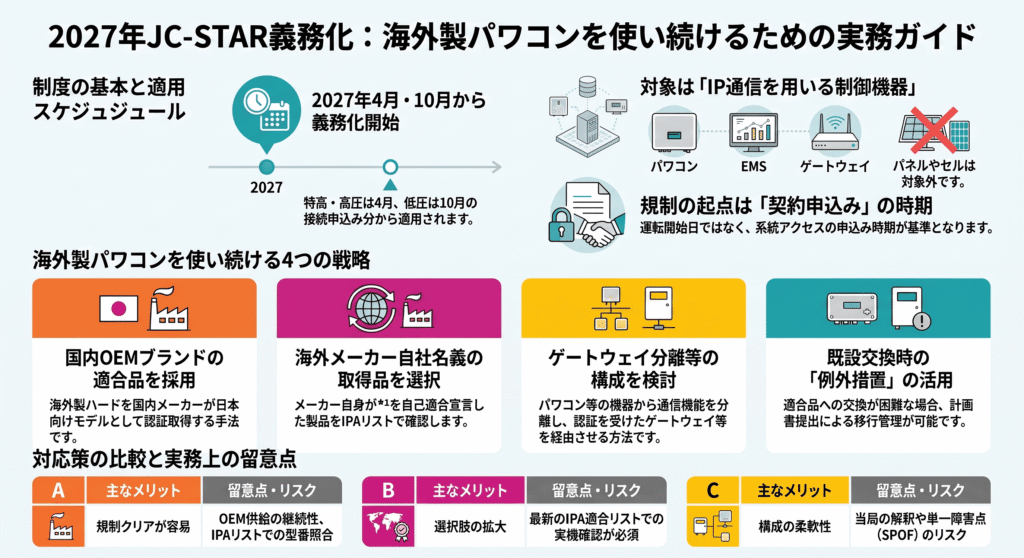
- 🔐 From the contract application for system connection in April 2027 (extra high and high pressure) and October of the same year (low pressure less than 50kW) onwards, obtaining JC-STAR★1 for communication and control equipment will become a de facto mandatory requirement for system connection (Source: Agency for Natural Resources and Energy "Cybersecurity Measures for Distributed Power Sources" ).
- 🎯 The target is "control equipment that uses IP communication," including power conditioners (PCS), energy management systems (EMS), gateways, etc. Panels and cells themselves are not included (Source: Agency for Natural Resources and Energy Electric Power SWG Document 5 ).
- 🌏 The realistic path to continuing to use overseas-made PowerCon is mainly to adopt packaging that has received ★1 from a domestic OEM brand, or to choose products that have been acquired under the company name by an overseas manufacturer. Gateway isolation and non-IPization require careful consideration of their institutional positioning.
- ⚖️ ★1 is a self-declaration of conformity method, and acquisition itself does not guarantee complete security. That is why it is believed that equipment selection should be designed to include contracts, guarantees, and supply chain risk allocation (Source: IPA JC-STAR System Details ).
✅ Audio summary of this post here
Introduction
This time, we will explain what to do if you want to continue using overseas-made power conditioners (PCS, Power Conditioning System) even as JC-STAR becomes fully mandatory.
Overseas-made power cons are attractive due to their price competitiveness and specific technical aspects, and there are many people who want to continue adopting them in practice.
On the other hand, with the revision of the grid code (system interconnection technical requirements) in 2027, obtaining JC-STAR★1 for control equipment will become a "pass of way" for system interconnection.
Therefore, this article will first accurately determine what will be made mandatory using primary information, and then organize the options that allow for the continued use of overseas-made power cons in a legal manner, as well as the legal and practical considerations for each.
The overall picture of the system itself is described in a separate article: What are the cybersecurity measures for distributed power sources. Organize the impact of JC-STAR requirements on solar, storage, wind, and fuel cells " I organized it.
This article then focuses on one point: how to preserve overseas products.
Please note that this article is a general compilation of information and does not recommend any specific avoidance measures.
Since the interpretation of the system may change in future operations or notifications, we recommend that you consult with the relevant general power transmission and distribution operator, IPA, or expert on each individual case.
First, get the premise right
Before considering countermeasures, we will examine the outline of the mandatory implementation.
JC-STAR is a security compliance assessment and labeling system for IoT products operated by the Information Technology Promotion Agency (IPA) under the policy of the Ministry of Economy, Trade and Industry (Source: IPA JC-STAR ).
There are levels ★1 to ★4, where ★1 is the minimum label indicating that a common baseline requirement (16 items) is met, ★1 and ★2 are self-conformity declaration methods, and ★3 and ★4 are third-party evaluation and certification methods (Source: IPA JC-STAR System Details , IPA ★1 Conformity Criteria and Evaluation Procedures ).
Of these, ★1 is the problem in lineage interconnections.
The timing of application is determined in stages for each power supply category (Source: Agency for Natural Resources and Energy Overview Document ).
For solar power and battery storage, the maximum high and high pressure will be as of April 2027, and the minimum pressure (less than 50kW) will be as of October 2027.
Wind power will be available from April 2027 (early application limited to gateway firewalls, etc. for the time being), and fuel cells will be available from April 2028 (PCS-based models are eligible).
And importantly, the regulation begins on the "application for contract for route access" rather than the "connection date (start date of operation)" (Source: Summary Materials ).
For high-pressure projects that require time to develop, it is necessary to plan for compliant equipment from the design and procurement stage in 2026.
For existing equipment, if the contract application was completed before the requirement was made, it will not be applied retroactively and operation can continue as is (Source: Summary Materials ).
Why overseas power consoles won't work as is
This is the starting point for countermeasures.
The requirements apply not to power generation equipment in general, but to control equipment that uses IP (Internet Protocol) communication (Source: Electric Power SWG Document 5 ).
Power capacitors are core devices that communicate with the outside world to receive output control commands and remotely monitor power generation and charging/discharging, and control power generation and charging/discharging.
In other words, a power controller is the equipment that is at the very heart of the requirements.
The reason why overseas-made power cons "don't go through as is" isn't a matter of performance or nationality, but rather the fact that the product (or the system that includes it) doesn't have the JC-STAR★1 label.
On the other hand, even if the hardware is made overseas, it is likely that if the appropriate entity obtains ★1, it can continue to be used legally.
Therefore, in the next chapter, we will consider countermeasures from the perspective of "who will acquire it and in what configuration."
Four ways to continue using overseas power cons
Countermeasure A: Adopt packages that have obtained ★1 status from domestic OEM brands
This is the most realistic path.
This method involves domestic sales and manufacturing companies acquiring ★1 high-performance hardware from overseas manufacturers as a "model for Japan" and adopting packaging that is supplied under the domestic brand name.
In this case, since the conformity label is issued under the name of the domestic brand, it is expected that the system can be interconnected without any legal issues.
It is thought that the advantage will be that it can benefit from the prices and technology of overseas manufacturers while also being able to easily comply with regulations.
On the other hand, there are two practical caveats.
Firstly, there's the hassle of matching.
IPA's list of compatible products is registered under "acquired domestic brand name and model number" rather than the overseas manufacturer name, so you must always check the IPA's list of compatible products to see which brand and model number the actual aircraft you plan to use is acquired under (Source: IPA JC-STAR compliant product list ).
Secondly, there is the perspective of supply continuity and supply chain.
OEM supply is susceptible to changes in agency agreements and supplier policies, and as will be discussed later, the supply chain for critical infrastructure equipment also involves economic security considerations.
Countermeasure B: Choose ★1 products acquired by overseas manufacturers under their own name
Another correct approach is for overseas manufacturers to choose products that have received ★1 status under their own name.
★1 is a self-conformity declaration system, and the system design allows even overseas manufacturers to apply and obtain the certification (Source: IPA JC-STAR System Details ).
Given the size of the Japanese market, it is expected that major overseas manufacturers will increasingly pursue acquisitions under their own names in the future.
The verification procedure is the same when taking this path.
Even if the sales materials say "JC-STAR compatible," that's not enough; you need to match the registration number, equipment, model number, validity period, and status with the actual machine in the IPA's list of compatible products (Source: IPA Compatible Products List ).
Please note that the manufacturer that has acquired the product changes from time to time, so we will not list any specific company names in this article.
Please be sure to check the latest IPA list.
Countermeasure C: Gateway isolation architecture
As a technical twist, it is sometimes discussed to separate unacquired power contacts from the internet and place a ★1 acquired EMS or gateway in the foreground as a "checkpoint."
This idea itself can be seen as being consistent with establishing a system where the requirements fall on "control devices that use IP communications."
Currently, wind power is being applied early, limited to gateway firewalls, etc., and the idea is to control key points of communication (Source: Summary Materials ).
However, there are two important points to note about this configuration.
Firstly, there is the regulatory position.
The Agency for Natural Resources and Energy's reorganization states that even equipment outside the scope of the scope is subject to requirements if it has control functions for power generation equipment, or if it integrates with major component products without going through gateways, etc. (Source: Electric Power SWG Document 5 ).
In other words, power contacts with communication capabilities may not be considered exempt from the scope of the application if they simply stop communication using soft settings.
Secondly, there is the issue of a single point of failure (SPOF).
When control is aggregated to one gateway, a failure in that one gateway directly leads to a complete loss of control of the entire system.
Therefore, this configuration requires careful consideration not only in terms of its theoretical legality, but also in terms of both the interpretation by the authorities and the design of redundancy.
Countermeasure D: Non-IP/serial communication configuration
Another step is to choose a power controller that does not have IP communication capabilities and operates solely through serial communication such as Modbus.
Since the requirements apply to products that use IP communications, it can be argued that truly non-IP devices may be exempt from the ★1 mandate.
However, this path tends to be costly in terms of practical work.
The inability to remotely update firmware (OTA, Over-the-Air) requires on-site work for each defect or vulnerability response, increasing O&M (Operation & Maintenance) costs.
Furthermore, it is said that some overseas manufacturers require cloud connectivity as a condition for long-term warranties, and in such cases, there is a risk that if they choose to operate non-IP services, they will not be able to receive the warranty.
From a security perspective, non-IP does not eliminate the need for cyber countermeasures, and physical access management and operational management during maintenance are still required.
Existing/exchange and "exception measures"
When you want to continue using overseas power cons, one of the biggest practical problems is replacing equipment on existing facilities.
Existing equipment will not be retroactively applied if the contract application was completed before the requirement was made, but if IP communication equipment is replaced after April 2027, the replacement equipment will generally require a ★1 acquired product (Source: Summary Materials ).
Furthermore, even if one unit is replaced due to a malfunction, compatibility issues with existing equipment may necessitate extensive replacements of other devices.
In the event of this "excessive burden," exceptional transitional measures will be provided.
Specifically, this method involves submitting a plan in a prescribed format after consulting with the local general power transmission and distribution operator on an individual basis (Source: Summary Materials ).
The plan requires at least three points:
Firstly, there is the reason why it is difficult to replace the product with the one that was acquired at that point (the specific details of the excessive burden).
Secondly, after indicating the planned year for extensive repracing and repowering, the goal is to ultimately acquire all of the equipment being replaced.
Thirdly, in the meantime, we need to implement certain cybersecurity measures.
It is accurate to understand that this is not a "exempt from exchange" system, but rather a conditional transition management that "provides reasons, promises future adaptation times, and provides alternatives in between."
If you continue to use an overseas-made power controller, it is a practical preparation to have an update plan in advance that incorporates this exception.
Lawyer's Perspective – Turning Equipment Selection into a "Contract"
The decision to continue using overseas-made power cons is not only a matter of technology selection, but also of contract and risk allocation.
Firstly, there is the guarantee of conformity.
In EPC (Design, Procurement, Construction, Engineering, Procurement and Construction) contracts and equipment sales contracts, it is considered that the contract should clearly state that the equipment in question has obtained JC-STAR★1 certification and which registration number and model number should be used to verify this.
Secondly, there are the procedures to be taken when the label expires.
The IPA's list of compliant products assumes status such as valid, as well as deferred expiration, expiration, voluntary withdrawal, and cancellation (Source: IPA Compatible Products List ).
It is necessary to design in advance the terms for sharing responsibility and providing alternative equipment in case the label expires or is cancelled after delivery.
Thirdly, there is the continuity of OEM supply.
If Response A is adopted, the lifeblood of the case will be whether the supply of domestic brands continues or whether compliance is maintained when the source of supply changes.
Fourthly, there are supply chains and economic security.
Regarding control equipment on the power grid, which is critical infrastructure, there are situations where subsidy requirements and security issues surrounding government procurement and critical infrastructure are involved, separate from JC-STAR compliance (Source: Electric Power SWG Document 5 ).
When adopting hardware manufactured overseas, especially in a specific country, it is desirable to have a system in place that can be explained to sponsors and lenders, including this perspective.
Practical Checklist
Finally, we will outline the steps that businesses that wish to continue using overseas-made power cons should take now.
Firstly, we need to take inventory of the equipment.
Check whether the PCS/EMS/gateway you plan to adopt or are using will be IP communicating and whether its model number is listed on the IPA's list of compatible products.
Second, the trigger is worked backwards.
For high-pressure cases, we will examine whether the contract application can be completed before April 2027, or whether a switch to a compliant product is required.
Thirdly, there is the inquiry regarding the OEM structure.
When adopting products made by overseas manufacturers, we will consult with the agency to determine the suitability of the domestic brand based on that product, and then match it with the registered name on the IPA list.
Fourthly, we are preparing for exchange and exception measures.
In existing cases, we anticipate that future fault replacements may make it difficult to replace the product with a suitable one, and we will consider whether or not to consult with the local general power transmission and distribution operator and submit a plan.
Fifth, reflection on the contract.
We will translate statements of conformity guarantees, label expiration procedures, supply continuity, and supply chain security into EPC, buy and sell, O&M, and finance contracts.
summary
With the 2027 grid code revision, JC-STAR★1 will become the de facto pass for lineage interconnections.
However, this is not simply a matter of "overseas power cons becoming unusable."
Since the requirements depend on whether or not there is a conformity label for control equipment that uses IP communication, it is believed that there is still a way to continue using overseas-made hardware legally, such as by acquiring it under a domestic OEM brand or by overseas manufacturers themselves under their own names.
On the other hand, gateway separation and non-IPization carry corresponding risks in terms of interpretation, maintenance, and assurance by authorities, and should not be easily treated as "regulatory loopholes."
Ultimately, what works is a model number check on the IPA's list of conforming products and a contract design that incorporates conformity, expiration, continuity of supply, and security.
The choice to continue using overseas-made products is entirely justified.
For this reason, I believe we should start working backward from the "contract application" period, which is the starting point of the system, and prepare now to translate equipment selection into contracts and capital policies.








comment