✅ Roughly speaking
- 🚗 Tesla's Supervised (FSD) is available for eligible vehicles in South Korea, but the same feature is not available in urban areas in Japan.
- 👀 Even under the name FSD, it is a driver assistance that is constantly monitored by the driver, not "fully autonomous driving" where people are allowed to doze off or look away.
- ⚖️ The difference in timing of provision cannot be explained solely by Japanese regulations. Vehicle specifications, local compliance, and corporate deployment decisions also need to be considered.
- 🌱 We believe that safely bringing new technologies to society requires looking at both the prudence of adoption and the cost of waiting for adoption.
Introduction
This time, we will use the availability of Tesla's driver assistance function, FSD (Supervised), in Japan and South Korea as a clue to explain the power of making new technologies usable in society.
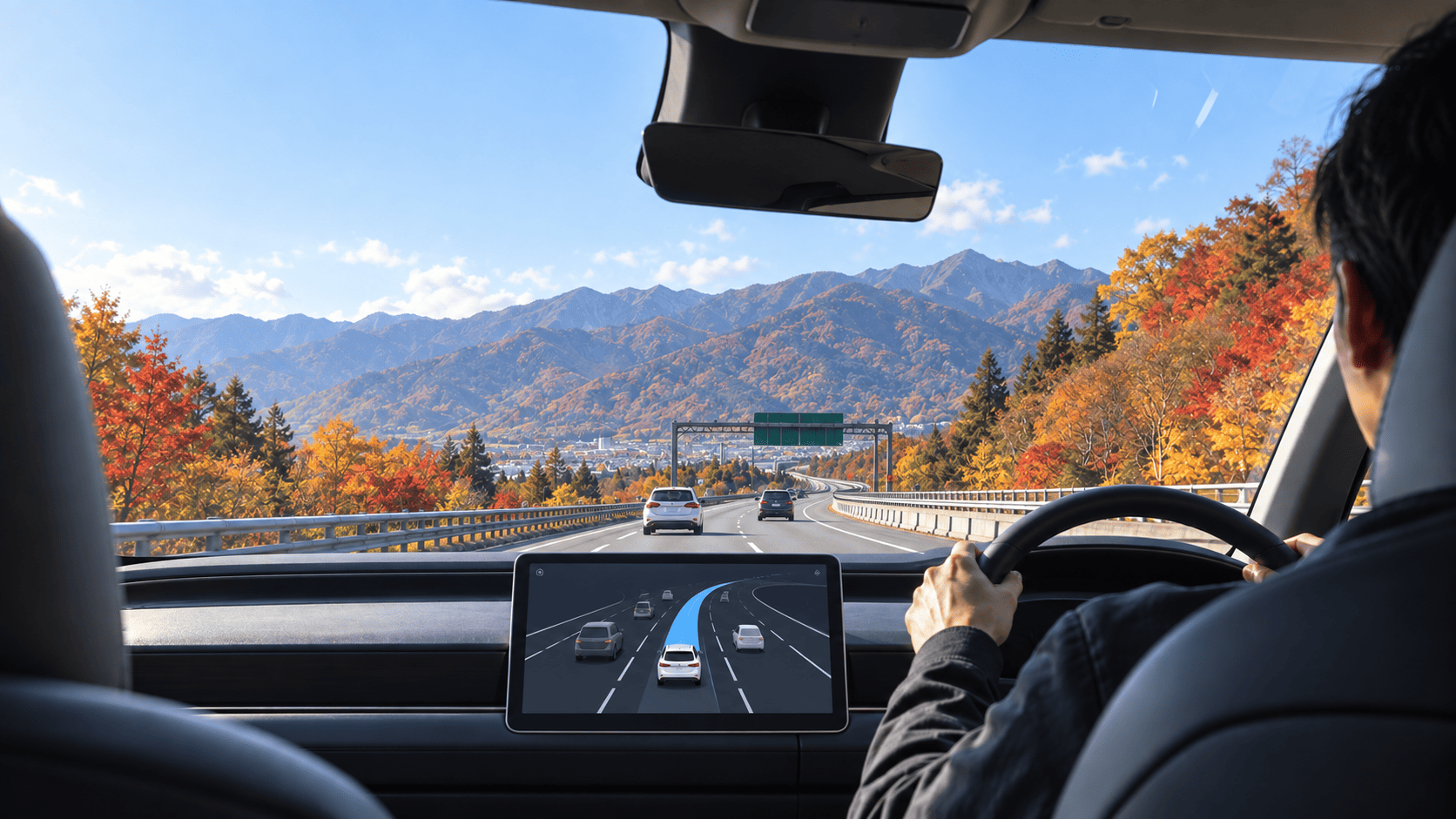
The other day, I drove from Tokyo on Tesla towards Matsumoto, where my parents live.
Using the current driver assistance features on the highway (which come standard and are incredibly useful) makes long-distance driving much easier.
On the other hand, if the operation becomes monotonous, drowsiness may also become a concern.
Along the same way, I felt that human concentration has its limits, and that we must avoid overconfidence to the extent that it is a useful feature.
Previously, An article comparing the expansion of overseas dining brands into Seoul and Tokyo I wrote. There were also quite a few Tesla cars in Seoul.
So, I thought that simply because products born overseas are superior, they don't reach the market; instead, there needs to be a leader to bring them in and make them usable.
This question is an extension of that.
However, I do not intend to explain the expansion of restaurants and the provision of driver assistance functions, which directly impact safety, using the same system.
So I was curious about Full Self-Driving (Supervised). Hereinafter referred to as "FSD (Supervised)").
When many people learn that the same feature is available in Korea but not yet available in Japan, they may be tempted to think, "It's because Japan's system is slow."
However, after reviewing the documents, it seems difficult to dismiss them in one word.
Things that can be used in Korea and things that cannot be used in Japan
The target of service in Korea varies depending on the vehicle
Tesla's Guide to Korea South Korea is included in the FSD (Supervised) service area.
While the features are intended for a wider range of traditional highway-centric driver assistance, such as driving along navigation lines and dealing with intersections, Tesla itself has declined to say that some of the features in the US demo video it is posting may not be available in South Korea.
Therefore, it cannot be said that "South Korea functions exactly the same as the United States."
Monthly usage information for Korea The document also specifies the conditions for the corresponding on-board computer, and states that available functions will vary depending on the vehicle configuration, software, region, vehicle model, and year.
This doesn't mean "All Korean Tesla can be used."
The same guide explains that currently available features do not make a vehicle self-driving, but rather require drivers to be alert and ready to drive themselves at any time.
See the options available in Japan and the features that actually work
On the other hand, Tesla Japan Terms of Use It states that the city-based autosteer, or FSD (Supervised), which is part of the FSD package, is not deployed in Japan.
Even if you see the option "Full Self-Driving Capability" displayed in Japan, it doesn't mean that you can immediately use the urban driving assistance provided in South Korea.
This isn't a story about "Japan doesn't have driver assistance."
The features I used on long-distance driving and the FSD (Supervised) I'm comparing this time need to be considered separately.
Furthermore, this comparison is based on publicly available information at the time of writing, and the software availability situation may change in the future.
Not treated as a permit issue for "fully autonomous driving"
The first thing to be careful about in this topic is the impression you get from the name.
Supervised (FSD) is an advanced driver assistance program that assumes continuous monitoring by the driver.
Level 2, where the driver is responsible for ensuring driving safety, and Level 3, where the system is responsible for driving under certain conditions, are: Ministry of Land, Infrastructure, Transport and Tourism's review of autonomous driving levels But they are distinguished.
If we replace this comparison with a picture of autonomous driving being unlocked and not unlocked without the driver having to monitor it, we miss the starting point of the argument.
Rather, from my own driving experience, I feel that as support becomes more advanced, it's important to clarify "what is left to the car and what you have to keep watching."
Ministry of Land, Infrastructure, Transport and Tourism also calls for caution regarding excessive credit for driver assistance Yes, it is.
We believe that expectations for convenience and future safety, as well as the remaining responsibilities of drivers at this time, should be discussed simultaneously.
Why the timing of the service is different between Japan and Korea
Regulations are involved, but they cannot be the sole cause
Tesla Japan Terms of Use The article states that the availability and scope of FSDs depend on regulations at the national and regional levels.
However, this does not immediately mean that "specific Japanese laws prohibit the Korean version of FSD" or that "Japanese authorities have rejected the application."
The publicly available documents I reviewed alone were insufficient to identify the details of the application in Japan, the progress of the review process, or the definitive reasons for its non-development.
In terms of the system, we want to see how the vehicle and software specifications align with Japanese safety standards and traffic rules, and how to design warnings to drivers and restrictions on functions.
The explainability of accidents and the handling of driving data can also be practical issues to consider.
However, I believe we should not definitively determine a causal relationship without reviewing the evidence that any of these factors are the current, undeveloped "causes."
Here, it is necessary to distinguish between "it cannot be provided under the system," "it can be provided if the conditions are met, but the verification has not yet been completed," and "it is possible under the system, but the company has not decided to provide it."
Because each requires different evidence.
For example, to identify specific legal obstacles, it is necessary to verify the correspondence between the specifications of the target function and the applicable standards.
If the review process is delayed, then the facts and progress of the application and review process are necessary.
If we put these together using only the word "regulation," it becomes impossible to see what changes could be made to implement them.
When and which products a company puts in are another variable
For Korea Usage Guide As shown, delivery involves in-vehicle hardware, software, and regional feature settings.
Tesla's decisions regarding suitability for the transportation environment in Japan, the systems that can be used for verification, and the stage at which products should be offered also seem to be variables that should be considered.
However, I have not been able to verify from the public documents why Tesla prioritized South Korea over Japan, nor what the details of the discussions with the authorities of both countries were.
If we limit the unit of comparison to "country" in the first place, differences in vehicle models, equipment, software, and the range of functions offered will be hidden.
To what extent the vehicles covered in South Korea and those sold in Japan have the same specifications.
What kind of verification is necessary when adapting features for South Korea to the Japanese road environment.
Comparing only the delivery date without checking these points does not measure the speed of the system.
Furthermore, even if institutional preparations are in place, how companies decide the order in which to allocate personnel and funds to local response is another matter.
Sales prospects, the number of compatible vehicles, and the burden of on-site verification are likely to influence business decisions.
However, we haven't been able to find any documentation that shows what Tesla actually focused on, so these are items that should be looked into, not explanations of why.
The explanation that existing automakers prevented its introduction and that the South Korean government provided special accommodations cannot be adopted without supporting evidence.
While we can observe differences in the timing of implementation, we cannot observe the percentage of causes.
We also want to check the road environment, data, and user understanding
Compliance with lane markings, intersection shapes, and signage operations can also be subject to verification in order to provide driving assistance on-site.
However, I haven't checked comparative data that suggests Japan's roads are more complex than South Korea's and therefore haven't been developed.
This is a product design question: which local scenes should be targeted for functionality and which should be left to the driver.
When using driving footage or driving data for development and verification of defects, it is necessary to check the data to be acquired, where it is stored, whether it has been provided by a third party, and any explanations given to the user.
Again, this is not to conclude that either Japan or South Korea's personal information system created the difference in provision this time.
First of all, if you don't know the specific data flow, you won't be able to narrow down the legal issues that apply.
Finally, what can be provided is not the same as what can be used safely.
How drivers understand "Supervised" and how they interact with usage conditions and warnings will be relevant to operations after implementation.
While it would be beneficial to verify what actually happened in the markets we previously provided, we would like to avoid generalizing safety solely based on usage history in South Korea at this time.
How to measure "social implementation ability"
The social implementation skills I'm referring to here are not the ability to invent superior technologies, but rather the ability to create the conditions for their safe use, to conduct necessary checks between companies and governments, and to translate them into actual use.
However, based solely on the fact that this feature was first provided in South Korea, it is impossible to assess the overall system in South Korea as superior to that in Japan.
This is because we did not compare products, road conditions, or the business decisions of companies in a balanced manner.
When working in legal practice, it can feel like the choice between loosening regulations or making them stricter misses important questions.
What can be provided if you check.
Perhaps there is a clear path forward from review and demonstration to general use.
If problems are found after provision, how to change the functionality and inform users.
Once again, I believe that asking these questions is more practical than competing to see who can speed up each country.
If safety issues are overlooked in the rush to implement the system, it's not just the users who will bear the burden.
It also affects other road users.
On the other hand, if the conditions for safe use are in place but no path to implementation is in sight, users may miss out on opportunities to reap benefits and learn from actual operations.
Neither cost can be compared solely through abstraction.
That's why I think it's important to visualize what remains unconfirmed and who will verify it and how.
Summary
In South Korea, FSD (Supervised) is offered to eligible vehicles, but in Japan, the same feature has not yet been introduced for urban areas.
However, we cannot conclude from this that "Japan's regulations are poor" or that "South Korea is progressing both technologically and institutionally."
What should be compared are the functions and conditions that can actually be used, the responsibilities that remain with the driver, and the decisions made by both the system and the company that will provide them.
When driving towards Matsumoto, I felt the convenience of driver assistance and the tension that comes with it.
I want to look at the reasons for waiting for new technologies and the reasons for carefully checking them.
I believe this Japan-Korea gap is not so much a factor to score for either country, but rather a concrete example of how to balance safety with the speed of implementation.

Comment