✅ Roughly speaking
- 🔋 The maximum CEV subsidy for EVs was increased to a maximum of 1.3 million yen from January 2026, but the revision was prompted by an agreement between the Japan and the US on tariff negotiations rather than decarbonization targets, raising questions about the consistency of the GX policy
- 📊 EVs account for only about 2~3% of new car sales in Japan, and with a large gap at the global average (about 27.7%), it is unclear whether subsidies alone will be able to fill this gap
- ⚠️ There are structural risks to subsidy-dependent adoption models in Germany, where EV subsidies were suddenly cut off at the end of 2023, causing sales to fall 37% compared to the same month last year
- 🏢 Foreseeability of subsidies and transparency of evaluation criteria are essential for companies to develop EV adoption plans, and improvements to the system design are required
✅ Audio summary of this post here
Introduction
This time, I would like to consider the Clean Energy Vehicle Adoption Promotion Subsidy (CEV Subsidy), which was revised in January 2026, from the perspective of its effectiveness as a GX (Green Transformation) policy.
On December 18, 2025, the Ministry of Economy, Trade and Industry announced a review of the CEV subsidy cap ( Ministry of Economy, Trade and Industry "Review of the CEV Subsidy Subsidy Limit" ).
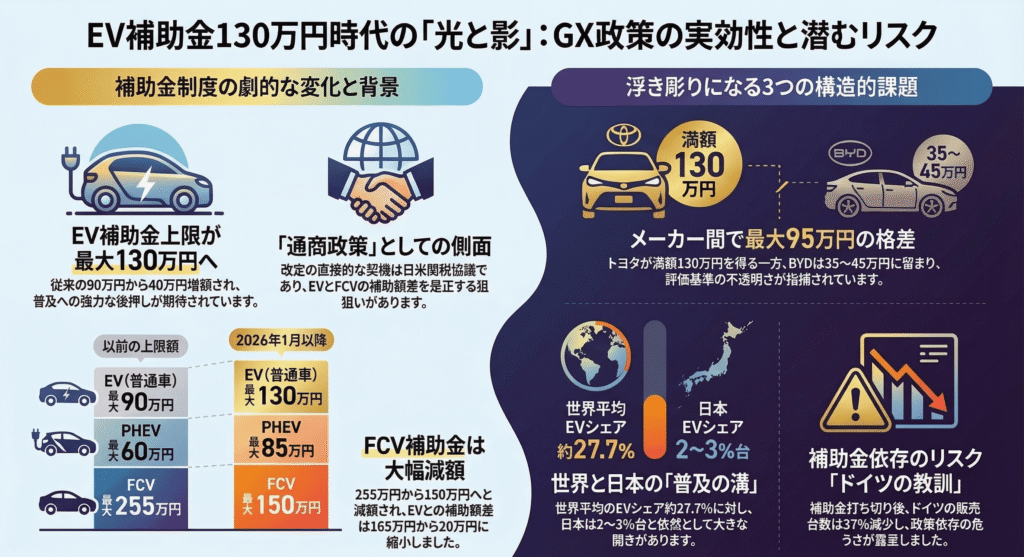
The maximum subsidy amount for EVs (electric vehicles) has been increased by 400,000 yen, from a maximum of 900,000 yen to a maximum of 1.3 million yen, while PHEVs (plug-in hybrid vehicles) have been increased from a maximum of 600,000 yen to a maximum of 850,000 yen.
On the other hand, FCVs (fuel cell vehicles) have been reduced by 1.05 million yen, from a maximum of 2.55 million yen to a maximum of 1.5 million yen.
At first glance, this revision appears to be a powerful boost to EV adoption.
However, when we try to evaluate the system as a GX policy, we find that the immediate background to the revision was the "agreement on Japan-US tariff negotiations," that there is a large disparity in subsidy amounts between manufacturers, and that a new tax on EVs is planned Several structural points emerge.
In this paper, we will summarize the revised CEV subsidies and then consider the issues surrounding the design of the system from multiple angles, focusing on the question, "How far can this subsidy system contribute to Japan's decarbonization goals through the widespread adoption of EVs."
Background to the revision of CEV subsidies – GX policy or trade policy
Summary of revisions
First, let me briefly summarize the overall picture of the revision.
According to a statement from the Ministry of Economy, Trade and Industry, the review is based on the policy that "in light of the agreement reached in the Japan-US tariff negotiations, the subsidy cap will be set at the standard vehicle price for each type multiplied by a certain percentage, with the aim of leveling the competitive conditions between types." ( Ministry of Economy, Trade and Industry presentation materials ).
The revised maximum subsidy amounts are as follows:
- EV (standard car): Maximum 900,000 yen → Maximum 1.3 million yen (increase 400,000 yen)
- Light EV: Maximum 580,000 yen (stationary)
- PHEV: Maximum 600,000 yen → Maximum 850,000 yen (increase 250,000 yen)
- FCV: Maximum 2.55 million yen → Maximum 1.5 million yen (down 1.05 million yen)
This revision applies to vehicles newly registered as new after January 1, 2026.
In addition, for FCVs that will be reduced, the current subsidy amount will be maintained within fiscal year 2025 to avoid adverse changes in the middle of the fiscal year, and the new maximum amount will be applied from fiscal year 2026 onwards.
The significance of the Japan-U.S. tariff negotiations as the catalyst for the revision
It is noteworthy that the direct motivation for this revision was not the "GX promotion" itself, but rather the "agreement on Japan-US tariff negotiations."
The United States, which has Tesla, which is highly competitive in EVs, has traditionally viewed the large difference in subsidy amounts between EVs and FCVs (up to 900,000 yen for EVs and 2.55 million yen for FCVs) as a problem ( Japan Automobile Chamber of Commerce ).
The FCV is represented by Toyota Motor Corporation's "MIRAI," and is an area where Japanese manufacturers have a technological advantage.
From the US perspective, there was likely a recognition that generous subsidies to FCVs were creating an unfavorable competitive environment for US-made EVs such as Tesla.
With this revision, the difference in the subsidy limit between EVs and FCVs has been significantly reduced from 1.65 million yen to 200,000 yen.
The results suggest that the goal of accelerating the adoption of EVs as a decarbonization policy was, if not more, to solve trade problems between Japan and the United States.
Of course, it is not a problem in itself that GX policy and trade policy are achieved simultaneously.
However, the outlook for future institutional operation and continuity will vary greatly depending on the "primary objective" of the policy.
This is because measures introduced as trade policies can easily change as the trade environment changes.
This is something that companies should keep in mind when developing their EV adoption plans, as it can be seen as a long-term commitment to EV adoption.
The reality of disparities between manufacturers – The light and dark that the "total evaluation" method creates
Disparities of up to 950,000 yen
What is particularly noteworthy about this revision is the large difference in subsidy amounts between manufacturers.
According to a report in the Nihon Keizai Shimbun on March 7, 2026, Toyota's bZ4X will receive the full price of 1.3 million yen, while China BYD (Biyadi) will only receive 350,000 to 450,000 yen for all models, with a maximum disparity of 950,000 yen.
The Tesla has also been revised to 1.27 million yen, an increase of 400,000 yen from the previous model, clearly demonstrating the significant increase between domestically produced and American cars.
Audi in Germany also increased its subsidy amount for some models (up to a maximum of 320,000 yen more than before, to about 1,008,000 yen), while many European cars, such as BMW in Germany, Volkswagen in Germany, and Volvo Cars in Sweden, did not see any significant changes in their subsidy amounts Hyundai Motors in South Korea also had limited increases, although some models had increases.
Structure of evaluation criteria and transparency issues
The evaluation criteria for determining the amount of CEV subsidies consist of two main components.
The first is a vehicle model rating (out of 100) such as "vehicle performance."
The second is company evaluations (out of 100) such as "development of charging infrastructure" and "development of maintenance personnel."
The subsidy amount will be determined in stages according to the number of points earned out of a total of 200 points ( Ministry of Economy, Trade and Industry "How to Determine Evaluation Criteria and Subsidy Amounts" ).
While this mechanism itself seems reasonable, questions have been raised about its practical operational aspects.
Tofukuji Atsugi, president of BYD Japan, told Nikkei that the company received a zero in the "improvement of charging infrastructure" category, even though it is currently installing fast chargers at dealerships across the country.
Furthermore, when the Ministry of Economy, Trade and Industry was contacted to inquire about the reasons for the evaluation, no detailed explanation was received (Nihon Keizai Shimbun, March 7, 2026).
An analyst at S&P Global Mobility, Yoshiaki Kawano, also analyzed, "Since the changes were made after the Japan-U.S. tariff negotiations, it cannot be denied that they will be perceived as preferential from the government's perspective" (article from the same day).
If EV adoption is to be achieved as part of GX policy, EVs from any manufacturer should contribute essentially the same amount to decarbonization.
Of course, there is some rationality in making differences in company evaluations in terms of improving charging infrastructure and developing maintenance personnel.
However, if the evaluation process is opaque, it cannot dispel suspicions that it is ultimately favoring (or treating) manufacturers in certain countries in a negative light.
This opacity is also likely to affect the international credibility of GX policy.
How subsidies will boost EV adoption – Data on the current location of the Japanese market
The reality is that EV share is approximately 2~3%
In order to evaluate the policy objectives of CEV subsidies, it is necessary to accurately understand the current state of EV adoption in Japan.
According to a tally by the EVsmart blog, domestic EV (BEV and PHEV combined) sales for the full year 2025 were approximately 101,863 units, accounting for 2.66% of all new vehicles.
This is a further decrease from 2.76% last year (2024), marking the second consecutive year of decline ( EVsmart Blog ).
Meanwhile, January 2026 data shows that EV share has recovered to 3.28% ( EVsmart Blog Same as above ).
This appears to be the result of the combination of the effect of increasing subsidies and the timing of the introduction of new vehicles, and positive developments can be seen in the short term.
The gap with the world
However, if we put the figures in an international context, Japan's lag is still significant.
Marklines tallies that global EV sales for the full year 2025 will increase 18% year-on-year to approximately 18.12 million units, accounting for 27.7% of total new car sales ( Carconnect ).
China accounts for over 70% of the total with approximately 12.96 million vehicles, and Norway's BEV share exceeds 90% in some months, making the difference from Japan's share (2~3%) more than ten times.
The Japanese government has set a goal of "achieving 100% electric vehicles through new passenger car sales by 2035" ( Ministry of Economy, Trade and Industry Green Growth Strategy ).
This "electric vehicle" also includes hybrid vehicles (HVs), so the share of all electric vehicles, including HV, is already over 50%.
However, only BEVs and PHEVs that require external charging are in the 2~3% range, so from a decarbonization perspective, improving the ratio of BEVs is particularly important.
Structural challenges that subsidies alone do not solve
While increased subsidies will help lower the barrier to EV purchase, price is not the only factor preventing EV adoption in Japan.
The first point is the issue of charging infrastructure.
Previous article As mentioned above, although Japan's charging infrastructure is steadily expanding, there are still challenges to be resolved, such as the issue of standardizing charging standards (the coexistence of CHAdeMO and NACS) and the difficulty of installing charging equipment in apartment buildings.
The government aims to have 300,000 charging infrastructure units, including 30,000 public fast chargers, by 2030 ( Ministry of Economy, Trade and Industry Automotive and Battery Industry ), and there is currently a significant gap between this goal and it.
The second point is the question of the car model range of domestic manufacturers.
As the EVsmart blog points out, imported vehicles accounted for more than half of registered BEVs in EV sales in 2025 ( EVsmart Blog ).
In 2024, only two new EVs were introduced by domestic manufacturers: the Nissan Clipper EV and the Honda N-VAN e:, limiting the number of domestically produced EV options available to consumers.
Toyota's improved bZ4X and Honda's N-ONE e: will be introduced from the second half of 2025, and the lineup is expected to be further expanded in 2026. However, unless it is accompanied not only by subsidies but also by the supply of EVs that consumers are willing to purchase, it is unlikely that widespread adoption will proceed.
German lessons – What subsidy cuts brought to the market
Sudden cancellation and its consequences
As an overseas case study, the outcome of EV subsidy policy in Germany is instructive.
The German government has been operating an EV purchase subsidy system called the "Environmental Bonus" (Umweltbonus) since 2016, and doubled the subsidy amount in 2020, which has led to a rapid acceleration in EV adoption.
The share of BEVs rose from about 2% in 2019 to 14.4% in 2022, reaching about 31% including PHEVs ( JETRO (Japan External Trade Organization) Business Briefs ).
However, on December 16, 2023, the German government suddenly announced the end of the subsidy system.
The background was that the unused budget for COVID-19 countermeasures (approximately 60 billion euros) was diverted to the Climate Change Fund, which was ruled unconstitutional by the Federal Constitutional Court, making it impossible to secure the budget ( Nikkei Shimbun, December 17, 2023 ).
The consequences of this sudden cancellation were severe. According to a report by MIT Technology Review, German EV sales in July 2024 are down 37% compared to the same month last year ( MIT Technology Review Japan Edition ).
Sweden and New Zealand, which have also implemented similar subsidy cuts, have also reported stagnation or decline in sales.
Implications for Japan – The need for an "exit strategy"
The German case illustrates the structural risk that if subsidies have a significant effect on boosting EV sales, but their effect depends on "subsidized" demand, then one policy change can significantly shrink the market.
Japan's CEV subsidies are also designed to apply from January to March 2026, with a new subsidy system expected to be established from April 2026 onwards.
While the system, which is updated annually, is flexible, it can also be difficult for businesses and consumers to read the future.
If EV subsidies are to be positioned as a decarbonization policy, it is important to clearly state not only the amount of subsidy for a single year, but also the outlook for the medium- to long-term system, and an "exit strategy" for how to achieve a market environment in which EVs will ultimately be selected even without subsidies.
Questioning consistency as a GX policy – The contradiction between "accelerator and brake"
Increasing EV subsidies and introducing an EV weight tax
While the increase in CEV subsidies is discussed in the context of promoting GX, there are also moves that raise questions about consistency when looking at the overall policy from a bird's-eye view.
According to reports, the government and ruling party have solidified their policy of introducing a new weight-based tax burden (the so-called "EV weight tax") on EVs and PHEVs from May 2028 ( Japan Automobile Chamber of Commerce ).
EVs tend to have heavier vehicle weights compared to gasoline-powered vehicles due to their heavier batteries. While weight-based taxation can be understood in terms of a fair share of road maintenance costs, it has been pointed out that the picture of providing subsidies to promote the spread of EVs on the one hand while taxing them on the basis of weight on the other is one in which "the accelerator and brake are pressed at the same time."
Trade issues surrounding charging standards
Previous article We covered the Japanese EV charging standards (J1772, CHAdeMO, and NACS) in detail in, and the issue of these charging standards also illustrates the complexity of policy surrounding CEV subsidies.
Currently, Japan's charging equipment subsidy system covers CHAdeMO-standard fast chargers, but the US is reportedly calling for Tesla-led NACS-standard chargers to be included in the subsidy ( Japan Automobile Chamber of Commerce ).
The government is said to be considering scrutinizing the compatibility, safety, and level of penetration of communications, but no conclusions have been reached.
The development of charging infrastructure is one of the "two wheels" of EV adoption, and the issue of standards directly relates to consumer convenience.
The outcome is likely to vary considerably depending on whether this debate is pursued from a purely technical point of view or whether it is dragged into the context of trade negotiations.
In order to maintain its consistency as a GX policy, it seems that a clear distinction must be made between trade imperatives and judgments as a technology policy.
The desire for institutional design from a company's perspective – transparency and foreseeability
The relationship between EVization of company vehicles and subsidies
For companies engaged in international trade, the EVization of company and commercial vehicles is an increasingly important topic in the context of ESG (Environmental, Social and Governance) responses and reducing the carbon footprint on the supply chain.
European trading partners and global companies are increasingly being asked to disclose Scope 3 (greenhouse gas emissions across the supply chain), and switching their vehicles to EVs is positioned as one of the concrete emission reduction measures.
In this context, the use of CEV subsidies is a major factor that determines the cost of EV adoption for companies.
However, there are several factors that appear to be present in the current institutional design that make it difficult for companies to plan.
Ensuring transparency
Firstly, transparency in the evaluation criteria.
As mentioned above, the detailed scoring criteria and scoring basis for the overall rating out of 200 that determines the subsidy amount have not been fully disclosed.
When companies select vehicles, it is difficult to predict in advance how much subsidy will be paid to which car models from which manufacturers.
Transparency in the evaluation process is essential for manufacturers to develop appropriate strategies.
A report (published March 7, 2026 in the Nihon Keizai Shimbun) in which BYD President Tofukuji said, "If it means it's no good because it's a Chinese manufacturer, please say so," succinctly illustrates the manufacturer's frustration with the opacity of the evaluation criteria.
Increased foreseeability
Secondly, the foreseeability of the system.
CEV subsidies are essentially designed on an annual basis, with the subsidy amount for the following year only being determined at the end of the fiscal year.
When companies develop medium-term vehicle replacement plans (typically with a three- to five-year span), the inability to see future subsidy levels can slow down their decision-making to adopt EVs.
As the German case shows, sudden changes in subsidy policy cause major disruptions to markets.
In Japan, it is thought that by providing a detailed medium-term outlook for subsidies (for example, a three-year direction) in advance, it may be possible to encourage companies to implement EVs in a planned manner.
Consistency with decarbonization targets
Third, consistency with the overall decarbonization policy picture.
Companies are required to disclose their emission reduction targets and specific actions in their ESG reports, consolidated reports.
While EV adoption is a powerful tool, there is also a risk that stakeholders will question the sustainability of reduction plans that rely on subsidy schemes if it is unclear whether the purpose of the subsidy scheme is decarbonization or trade policy.
We believe that it is crucial for governments to clearly position CEV subsidies as GX policy and provide a roadmap for long-term institutional design to support decarbonized business management.
Summary
The CEV subsidy revision, which increased the maximum subsidy limit for EVs to a maximum of 1.3 million yen, can be evaluated as a boost to the spread of EVs.
Part of the effect is seen in the figure that EV share recovered to 3.28% in January 2026.
However, some structural challenges have been highlighted when viewed in terms of its effectiveness as a GX policy.
First, since the direct motivation for the revision was the Japan-US tariff negotiations, there are situations in which the consistency of decarbonization policy is being questioned.
Secondly, it is considered that there has not been sufficient explanation given to the transparency of the evaluation criteria, which has led to disparities of up to 950 000 yen between manufacturers.
Third, there is a "axle and brake" contradiction between increasing EV subsidies and introducing a future EV weight tax.
Fourth, as the German case shows, there are structural weaknesses in the subsidy-dependent diffusion model.
EV subsidies are merely a transitional policy tool.
Ultimately, the goal should be to create a market environment where EVs are chosen by consumers even without subsidies.
We believe that this requires steadily improving charging infrastructure, increasing transparency and disclosure of evaluation criteria, clearly distinguishing between the objectives of trade policy and decarbonization policy, and ensuring the foreseeability of systems that allow companies to plan for the long term.
The current situation in Japan, where EVs account for only 2~3% of new car sales, means that there is a big upside to this.
Many new EVs are expected to be introduced by domestic manufacturers in 2026, which, combined with the support of CEV subsidies, could be the opportunity for the EV market to begin to move in earnest.
To maximize its potential, we believe that there is a need for a convincing institutional design that does not waver from the GX policy axis.








Comments