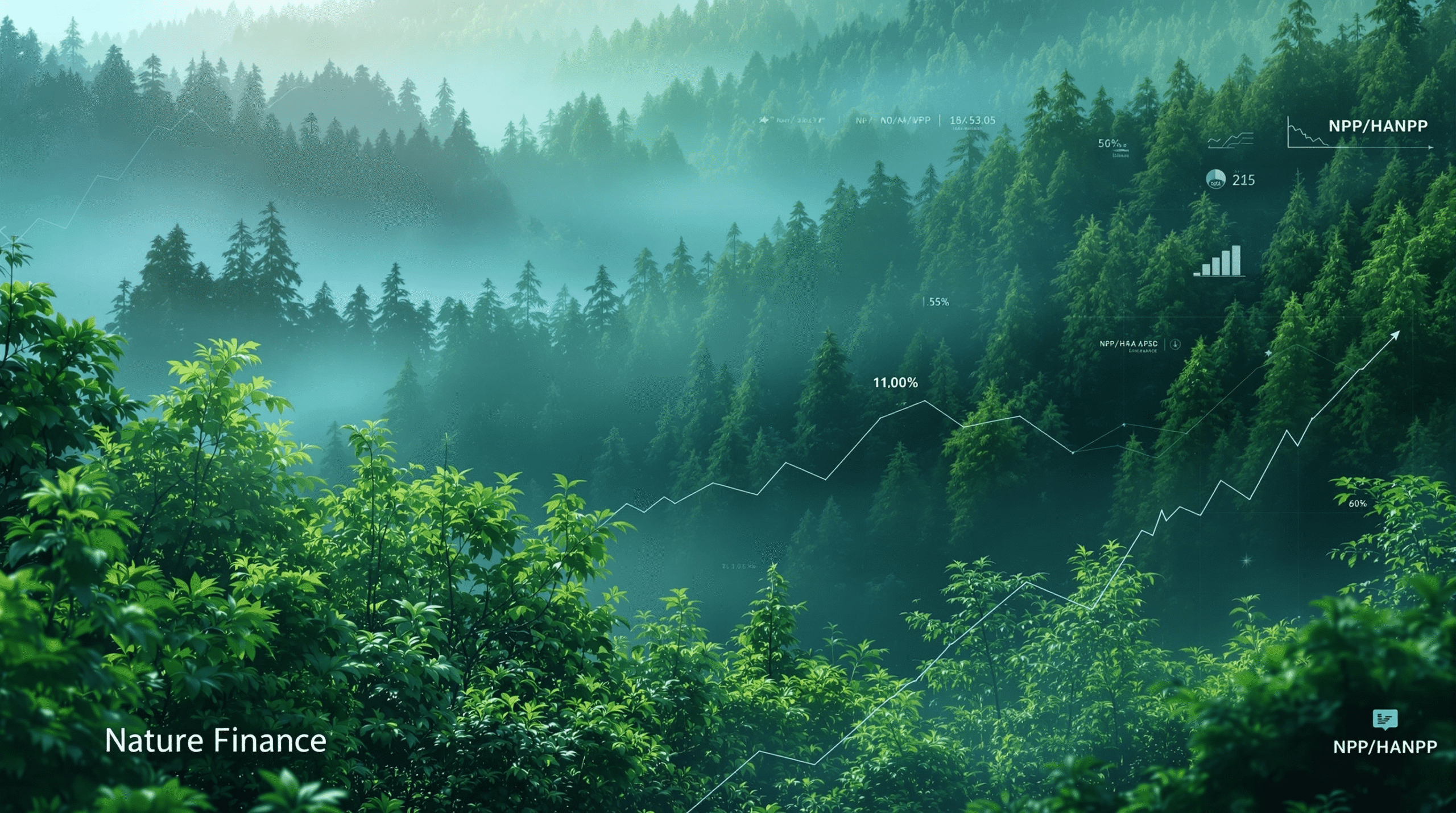
✅ In brief – Financial institutions are accelerating investment and financing to achieve nature positive by 2030. Nippon Life Insurance Company has published a scientific evaluation method – quantifying the impact on nature using indicators called NPP (the amount of carbohydrates produced by plant photosynthesis) and HANPP (the amount used by humans). As TNFD disclosure progresses, companies are required to engage in dialogue linking natural capital to growth strategies.
Introduction
This time, we will explain Nature Finance's evaluation methodology.
In October 2025, an interesting article was published in Nikkei ESG ( "Nature Finance" Accelerating ).
The article reports that financial institutions are accelerating investment and lending to achieve the global goal of becoming "nature positive," which aims to halt the loss of nature and turn it into a positive by 2030.
Of particular note is that Nippon Life Insurance, which has approximately 80 trillion yen in assets under management, announced Nature Finance's evaluation methodology in August 2025.
In addition, the Japan Credit Rating Agency, Ltd. (JCR) and Rating and Investment Information, Inc. (R&I) also announced methods and guidelines for assessing the eligibility of nature finance in July and August of the same year, suggesting that a practical framework for nature finance is beginning to take shape.
The background to this movement is the Kunming-Montreal Biodiversity Framework (GBF), which was adopted at the 15th Conference of the Parties to the Convention on Biological Diversity (COP15) held in December 2022.
The GBF has set 23 specific targets, including the "30 by 30" goal of conserving more than 30% of land and oceans by 2030. Target 15 calls for companies to assess their impacts on biodiversity and disclose information about them, and Target 19 calls for the mobilization of $200 billion per year.
In addition, in September 2023, the Task Force on Nature-related Financial Disclosures (TNFD) published its final recommendations, establishing a framework for companies to disclose information on natural capital.
According to a survey by WWF Japan, as of July 2025, there were 611 companies worldwide that had announced they would disclose TNFD information (TNFD adopters), of which 180 were Japanese companies, the highest number in the world.
While these international frameworks are being established, a fundamental issue remains in the workplace: how to evaluate activities that contribute to the restoration of nature. While there is a clear indicator in the field of climate change, namely GHG emissions, no common evaluation scale has been established in the field of nature due to its complexity. The evaluation methodology announced by Nippon Life Insurance is attracting attention as it represents one solution to this issue.
What is Nature Finance?
Nature finance refers to investing in nature-related projects.
Specifically, it provides funding for projects such as forest conservation and regeneration, biodiversity conservation, and ecosystem restoration in the form of loans, impact finance, and bonds.
The acceleration of this movement is due to the successive publication of international guidelines between 2024 and 2025.
The Principles for Responsible Investment (PRI) and the International Capital Market Association (ICMA) have published guidelines on nature, and a practical framework for nature finance has been established.
In particular, ICMA published " Sustainable Bonds for Nature: A Practitioner's Guide " in June 2025, which provides a practical guide specifically for nature-related projects in addition to the existing green bond principles. In response to this, JCR and R&I have formulated evaluation methods in Japan, and a system for determining the eligibility of nature finance is currently being established.
While traditional green finance has mainly targeted climate change countermeasures (renewable energy, energy conservation, etc.), nature finance is unique in that it targets areas that include more complex and diverse elements, such as biodiversity conservation and ecosystem restoration.
The groundbreaking nature of Nippon Life's evaluation method
The " Nippon Life Nature Finance Approach ," announced by Nippon Life in August 2025, is groundbreaking in that it adopts the concepts of NPP (Net Primary Production) and HANPP (Human Appropriation of Net Primary Production) as practical and simple indicators that are scientifically rational.
What are NPP and HANPP?
NPP refers to the total amount of carbohydrates produced by plants on Earth through photosynthesis.
Plants use light energy to produce carbohydrates (such as sugars) from carbon dioxide and water, but they also consume the amount they need for this activity, so this amount is subtracted from the plant's NPP.
These carbohydrates are the starting point of the food chain, which supports the energy cycle throughout the ecosystem as animals eat plants, which in turn are eaten by other animals.
In other words, NPP can be said to be an indicator of the amount of energy that supports life in an ecosystem.
On the other hand, HANPP refers to the amount of NPP used by human activities.
Before the Industrial Revolution, HANPP was 1.9% of NPP, but by 2020 it had risen to 23.5%, with HANPP reaching 16.8 billion tonnes.
This shows that as population and economic growth continue, agricultural land development and urbanization are leading to deforestation, increasing the amount of natural energy available to humans.
Relationship with planetary boundaries
One of the reasons Nippon Life chose the NPP/HANPP indicators is that they are consistent with the concept of "planetary boundaries" advocated by the Stockholm Resilience Centre.
Planetary Boundaries are nine areas that define the limits of the global environment where humankind can operate safely, and one of these, "Biosphere Integrity," sets a goal of limiting HANPP to 5.6 billion tons per year. In other words, activities by companies to reduce HANPP will directly contribute to achieving the global goal.
Specific measurement methods
Nippon Life's assessment methodology measures increases in NPP and reductions in HANPP using NPP data published by NASA (National Aeronautics and Space Administration) and Geographic Information System (GIS) software.
For example, food manufacturers that procure palm oil can help improve the productivity of their small-scale farmers, thereby curbing deforestation to expand farmland.
In this case, the avoided amount of HANPP can be calculated by multiplying the forest control area by the NPP data.
The population of species is measured before the investment and loan, and the increase after the activity is estimated using forest management plans and artificial intelligence (AI). After the investment and loan, measurements are taken approximately every three years to verify the actual effect.
Types of eligible businesses
According to Nippon Life's evaluation methodology, the following businesses are eligible for Nature Finance:
Activities to increase NPP and increase the population of organisms
Forest conservation and regeneration projects
Activities to reduce HANPP (deforestation control projects)
– Projects to curb the expansion of farmland and pastureland (improving agricultural productivity, developing alternative proteins, etc.)
– Businesses that reduce the procurement of raw materials that involve deforestation in the upstream supply chain (reusing minerals and natural rubber, developing alternative materials to palm oil, etc.)
– Projects to curb deforestation due to urbanization in developing countries (such as the development of high-rise apartment buildings)
Practical implications for businesses
Relationship with TNFD disclosure
The TNFD requires companies to disclose their dependence on nature, impacts, risks, and opportunities. However, a report by WWF Japan investigating the disclosure status of 65 Japanese companies in 2024 found that many companies were limited to general analysis using tools like ENCORE, and only a small number of companies were able to disclose information that analyzed the specific dependency and impact relationships between their company and nature based on location.
Nippon Life's assessment methodology addresses these corporate challenges by providing a means to quantitatively demonstrate the impact of specific projects on nature.
By measuring the extent to which their activities contribute to increasing NPP and reducing HANPP, companies may be able to use this as one of the indicators related to the "State of Nature" in their TNFD disclosures.
Funding implications
Once evaluation methods for Nature Finance are established, it will become easier for companies to utilize fundraising methods such as "Nature Bonds" and "Nature Link Loans."
Akira Ishiwata, Deputy General Manager of R&I's Sustainable Finance Division, said, "We have received inquiries from financial institutions about nature bonds and nature-linked loans," but pointed out that "it is difficult to link nature activities to a company's growth strategy or to link activities to their impact."
Yuichi Miyashita, head of the Responsible Investment Promotion Office at Nippon Life Insurance, said, "We have now set out an evaluation scale for moving closer to becoming nature positive. By announcing that Nippon Life Insurance will invest in such activities, we can provide an incentive for companies to take part in these activities."
The Importance of Supply Chain Management
Addressing this issue upstream in the supply chain is particularly important for industries that are highly dependent on natural capital, such as the food and manufacturing industries.
Choosing deforestation-free methods for sourcing palm oil, natural rubber, timber, etc. will help reduce HANPP.
The WWF Japan report cited examples of excellent disclosure, such as Kao Corporation disclosing the tracing status of its upstream value chain and establishing a complaints system regarding palm procurement.
Future challenges and prospects
Miyashita, a section manager at Nippon Life, said, "The measurement and evaluation methods are not yet final. We will continue to improve them through dialogue with companies." In fact, an overseas management company that manages a forestry fund is currently considering adopting the indicators and evaluation methods with an eye toward 2026, and is already measuring the populations of species.
For companies, as R&I's Ishiwata points out, "it's important to clarify the relationship between your company's growth strategy and nature, and to advance dialogue with financial institutions." This will lead to a fair evaluation of nature-positive management, which will attract more capital.
Yusuke Koike, a specialist officer at WWF Japan, said, "TNFD disclosure is expected to serve as an opportunity to fundamentally reform business models that place a burden on nature through the analysis of nature-related issues." Companies are being asked to go beyond simply disclosing information and to reform their business models themselves.
summary
With the establishment of evaluation methods, Nature Finance can be said to have entered a period of practical development.
The NPP/HANPP index proposed by Nippon Life is a practical and simple measure that is scientifically backed, and is expected to play a role in promoting dialogue between companies and financial institutions.
The number of Japanese companies that have announced TNFD disclosure has reached 180, the most in the world, but as the WWF Japan survey shows, improving the "quality" of disclosure is a future challenge. Companies need to integrate natural capital into their management strategies not only from a "defensive" (risk management) perspective but also from an "offensive" (growth opportunity) perspective.
There is only a limited amount of time left until the goal of becoming nature positive by 2030. Cooperation between companies, financial institutions, rating agencies, and international organizations to improve and implement evaluation methods will likely lead to the coexistence of nature's recovery and sustainable economic growth.
As someone involved in practical work in the renewable energy and ESG fields, I will be keeping a close eye on these developments and will use what I learn to advise companies.








comment