
Introduction
According to an article in the Nihon Keizai Shimbun dated May 1, 2025, entitled " JFE Engineering to collaborate with Sushiro and 2,300 other companies to generate food waste power, " JFE Engineering will work with four companies (Sushiro, Bikkuri Donkey, Royal Host, and Yakiniku King) (total of approximately 2,300 restaurants) to generate biogas from food waste from restaurants and use it to generate renewable energy (so-called "food waste power generation").
In this initiative, JFE Engineering will collect food waste such as leftovers from stores, ferment it, and turn it into biogas. The gas will then be used as fuel to generate electricity, which will then be supplied to affiliated stores as renewable energy.
This article states that the restaurant industry produces approximately 1.48 million tons of food waste each year, yet its recycling rate is only 35%.
Waste that is difficult to separate can also be processed through biogasification, making this an initiative that opens up new avenues for utilizing food waste.
This time I would like to delve a little deeper into this topic.
FIT system and renewable energy surcharge
According to the article, this framework works so that the electricity generated is sold at a high price using the renewable energy feed-in tariff (FIT) system, and then JFE Engineering's power subsidiary buys it back at a lower price and supplies it to restaurants.
It should be noted here that the high price for electricity sold under the FIT system is widely borne by electricity users across the country in the form of a "renewable energy surcharge."
For this reason, although on the surface it is electricity transmission and distribution companies that are purchasing renewable electricity derived from food waste, in reality it is electricity consumers, including the general public, who are purchasing it through renewable energy surcharges, so economically speaking it is "the entire nation that is supporting that renewable electricity."
In this way, this initiative, although it appears to be a private-sector introduction of renewable energy, in reality it is made possible by public contributions to electricity bills, making it a pioneering example of taking advantage of the secondary effects of the renewable energy system.
In this way, it may be that everyone will share the cost of disposing of food waste.
Types of renewable energy and biogas
Renewable energy sources include solar, wind, hydroelectric, geothermal and biomass (including biogas).
Biogas is a process in which organic waste such as food waste and livestock manure is converted into gases such as methane through anaerobic fermentation, and has the advantage of being able to generate stable power.
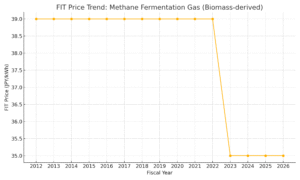
The trend in purchase prices under the FIT published by the Agency for Natural Resources and Energy is as follows, and the purchase price for biogas (methane fermentation gas (derived from biomass)) power generation in fiscal year 2025 is still 35 yen/kWh.
This is ridiculously high compared to the current FIT prices for solar and wind power!
Power supply system
The article states that the electricity generated by JFE Engineering will be sold at the FIT price, and the company's power subsidiary will buy it back at a discount and supply it to partner restaurants.
The subsidiary is believed to be Urban Energy Co., Ltd.
Also, "buying back" probably means simply purchasing electricity at market price.
In addition, it appears that the power subsidiary will supply electricity to restaurants such as Sushiro by entering into a power purchase agreement (PPA) between the power subsidiary and the restaurant.
There are two types of PPAs:
- On-site PPA : A model in which power generation equipment is installed on the consumer's premises
- Off-site PPA : A model in which the power plant and the consumer are located in different locations and electricity is sent through the power grid.
However, in this case, the power subsidiary itself does not generate electricity; rather, it purchases electricity and then sells it to restaurants, so it is important to note that this is different from the PPA that people normally assume.
Handling of environmental values
Electricity derived from renewable energy sources usually has an "environmental value" attached to it and is traded in the form of non-fossil certificates, etc.
However, for electricity sold under the FIT system, the environmental value already belongs to the state, so non-fossil certificates are not issued.
In this case, the generated electricity is first sold under FIT, but then the electricity subsidiary buys it back and supplies it to the restaurant consumer.
It is not clear from the article whether there is any room for this "buyback amount" to be considered a non-FIT energy source, but if it is considered to be non-FIT, it would be possible to obtain a "Non-FIT Non-Fossil Certificate."
Recycling in the Food Service Industry
Unlike the food manufacturing industry, the restaurant industry often contains used tissues, disposable chopsticks and other waste, making it difficult to recycle in the traditional way into feed or fertilizer.
This food waste power generation project could be one effective solution to this issue.
This is because biogas technology can process waste even with poor sorting, allowing waste from restaurants to be converted into an energy source.
Additionally, there has been an increase in the use of waste food oils and other waste materials to produce Sustainable Aviation Fuel (SAF) for aviation fuel, and the diversification of recycling and re-use of waste materials from the food service industry is progressing.
summary
This initiative by JFE Engineering and four restaurant companies can be described as an advanced attempt that can simultaneously achieve environmental considerations, cost sharing, and energy procurement.
As mentioned above, the FIT price for biogas (methane fermentation gas (derived from biomass)) is very high, and this business model still appears to have a lot of appeal, so it is expected that more and more other companies in the same industry will begin to adopt similar frameworks.







comment